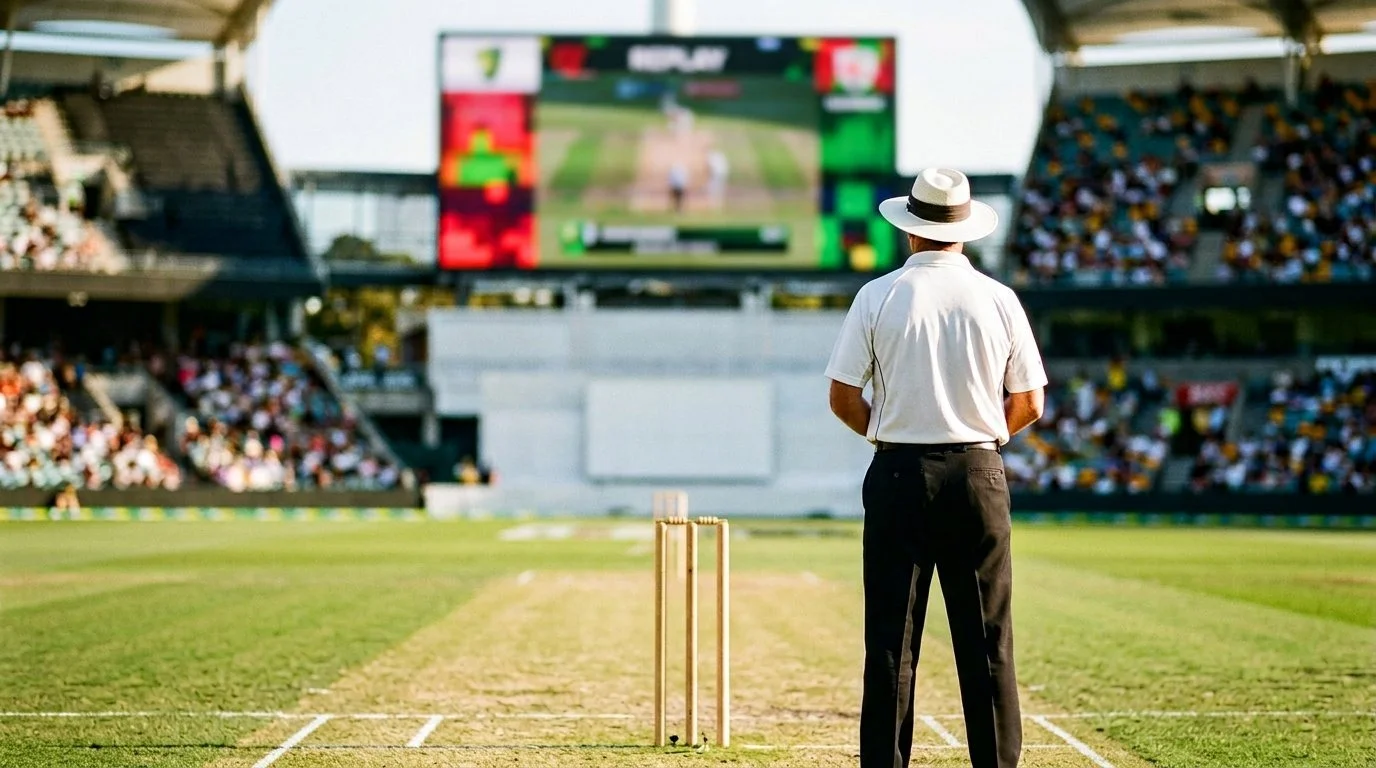
A batter is given out lbw, asks for a review and watches the screen. Ball tracking suggests the delivery would clip the stumps, yet the decision remains out. In another match, an apparently similar replay leaves the batter not out. The difference is not necessarily a mistake: a marginal result called umpire’s call can leave the original on-field decision in place.
The Decision Review System, or cricket DRS, is not a second game played by television graphics. It is a procedure for reviewing eligible decisions using the evidence and technology available under a competition’s playing conditions. This guide follows one review from the appeal to the final signal, with examples that explain why the answer can depend on the first decision.
Also Read:One Raider, Seven Defenders: How Kabaddi Points Build Toward an All-Out
For the wider site, visit Mahadev Book. A working webpage does not establish that a specific match, market or service is available, licensed or lawful in your location.
The review begins on the field, not on the big screen
Imagine a bowler hits a batter’s front pad and the fielding side appeals for leg before wicket. The umpire makes a decision: out or not out. If the competition uses DRS and an eligible team has a review available, the side that disagrees can request a player review according to that competition’s procedure and time limit.
An on-field umpire can also refer certain decisions to the third umpire under the applicable protocol. A player review and an umpire referral are not necessarily the same process. The number of reviews, the incidents that can be reviewed and the timing requirements can differ by format or competition. Check the current playing conditions for the actual event.
The third umpire works through relevant questions rather than looking only at a projected line. Was the delivery fair? Did the ball hit the bat before the pad? Where did it pitch? Where did it strike the batter? Would the ball have hit the wicket under the applicable law and DRS protocol? Not every question is relevant to every appeal, and a definitive finding on an earlier point can make a later graphic unnecessary.
Also Read:Offside Without the Confusion: Five Football Moments That Change the Referee’s Decision
The site’s cricket betting guide provides general sport context. It is not the competition’s DRS protocol and does not establish that any particular live market is offered.
First question: was the delivery legal?
Before a batter can be dismissed in many ways, the delivery’s status matters. A no-ball can affect whether a particular dismissal is available. The relevant official examines the evidence under the playing conditions; not every no-ball question is handled identically in every tournament.
A replay may focus on the bowler’s front foot, but the viewer should not assume that an isolated still image settles every question about the delivery. The officials use the applicable law, the available camera angles and the competition’s technology protocol.
If the delivery is ruled a no-ball, some dismissals, including lbw, are unavailable. Other dismissals, such as a run out, can still be possible under the Laws of Cricket. A broadcast review should therefore be read as a sequence of rule questions, not a single yes-or-no test of the bowler’s foot.
Second question: bat before pad?
For an lbw decision, contact with the bat before the ball strikes the batter’s person can be decisive. The third umpire may use replay pictures and available sound- or heat-based tools to examine whether the ball touched the bat. The technology used depends on the match and its approved equipment.
A spike on an audio trace is information to be interpreted in context. The official must consider the timing of the sound and the pictures. A noise could have another source, such as bat contacting pad or ground. Viewers should not treat every visible spike as conclusive proof of an edge without the accompanying images and official decision.
Likewise, if a particular tool is unavailable or inconclusive, the applicable protocol determines what evidence can be used. The absence of a clear spike is not a licence for a spectator to announce a definitive finding from a screenshot. The third umpire communicates the decision through the prescribed process.
This distinction also matters for a caught-behind appeal. An edge relevant to a catch is a different dismissal question from whether an otherwise legal ball would have hit the stumps. Both can involve the same delivery, but the applicable facts and review sequence are not interchangeable.
Third question: where did the ball pitch?
Ball tracking commonly displays pitching, impact and wickets as separate components of an lbw review. Pitching concerns the ball’s position when it first lands before reaching the batter. A delivery that pitches outside leg stump cannot result in an lbw dismissal under the usual law, even if a later projection suggests it would hit the wicket.
The off side and leg side depend on the batter’s stance. A viewer who assumes the same screen side for every batter can misread the graphic when a left-handed batter replaces a right-hander. Follow the broadcast labels and the official finding rather than relying on screen orientation alone.
A full toss has not pitched before reaching the batter, so the pitching question is handled differently. The other applicable lbw conditions still matter. A wicket-hitting graphic alone is never a complete description of the legal test.
The cricket terminology glossary explains broader cricket vocabulary. For a specific review, the match’s official playing conditions and umpire decisions take priority over a general glossary.
Fourth question: where did impact occur?
Impact refers to where the ball first strikes the batter’s person in relation to the stumps, as assessed under the applicable law and protocol. Whether the batter made a genuine attempt to play the ball is relevant to some outside-off situations. These details cannot be reduced to “the ball hit the pad.”
The tracking display may classify the result as in line, outside or a marginal umpire’s-call category where the protocol provides for it. The significance of that classification can depend on the original decision and on the other lbw requirements.
A batter can be hit outside the line in circumstances where the rules make an lbw dismissal unavailable; in other circumstances, an appeal may remain eligible for consideration. The exact wording and technical zones belong to the current playing conditions. Avoid drawing a verdict from a cropped image that omits the batter’s action or the rest of the sequence.
Fifth question: would the ball hit the wicket?
The wicket component uses approved ball tracking to estimate the ball’s path after impact. The display can report that the ball is hitting, missing or in the marginal umpire’s-call area, subject to the specific protocol. It is a projection used within the rules, not a recording of a ball physically travelling through the batter’s pad.
If tracking indicates the ball is missing the stumps, an lbw dismissal generally cannot stand on that basis. If the report is a marginal umpire’s call, the original on-field decision can remain. Other requirements, including pitching, impact and bat contact, still need to be satisfied.
The important distinction is between the same marginal evidence being reviewed from different starting decisions. In one case the umpire initially raised the finger; in another the umpire initially said not out. The technology does not automatically replace both decisions with a single universal answer.
Two hypothetical reviews with different outcomes
Scenario A: out remains out. The on-field umpire gives the batter out. The batting side reviews. Assume the delivery is fair, there is no bat contact, the pitching and impact requirements are satisfied, and the wicket result is umpire’s call. Under the relevant protocol the original out decision remains.
Scenario B: not out remains not out. The same type of marginal wicket result follows an initial not-out decision, and the fielding side reviews. Assume the other relevant conditions are the same. If the protocol requires a clear hitting result to overturn not out, the original not-out decision remains.
These examples simplify a technical protocol to show the role of the initial decision. They are not predictions for a real match. The official review can involve additional facts, and a finding such as bat before pad or a ball pitching outside leg can change the analysis before the wicket projection becomes decisive.
Does umpire’s call use up a review?
Under the cited ICC player-review protocol, an lbw review categorised as unchanged solely because of umpire’s call does not count against the innings review limit. That is a specific rule in the relevant playing conditions, not a reason to assume that every competition uses the same review allocation or accounting.
A review can fail for reasons other than umpire’s call. For example, clear evidence supporting the original decision may lead to a different review classification. Follow the official graphic and the tournament’s rules; an unchanged decision is not automatically an umpire’s-call outcome.
The number of reviews available, when they are replenished and which decisions are eligible are competition-specific. An old Test match graphic should not be used as proof of the rules for a current T20 league.
Why a replay can look more certain than it is
Broadcasts compress a technical assessment into a few seconds of images. Camera angles, frame rates, synchronisation and the permitted technology matter. A viewer may see a single replay while the third umpire considers multiple angles and communicates with the on-field officials.
An image of the ball near the stumps is not itself the complete lbw test. Pitching, impact, bat contact and the laws concerning an attempted shot can all matter. A decision that looks inconsistent when judged from one frame may become understandable when the sequence and original call are included.
That does not mean every official decision is immune from scrutiny. It means that a responsible analysis should state the rule, the available evidence and the official outcome before asserting an error. Separate disagreement with the decision from a claim that the wrong protocol was used.
DRS, rain interruptions and the official score
A review and a rain delay solve different problems. DRS concerns eligible umpiring decisions; DLS can be used to revise targets or determine a result in applicable interrupted limited-overs games. Similar initials do not make them the same system.
The site’s revised cricket targets guide explains the rain-interruption concept. Check that the current competition actually uses the relevant method and playing conditions.
A reversed wicket can change the score, the number of wickets in hand and the next ball’s context. If a live scoreboard briefly displays an old score, wait for the official correction. A review is not complete merely because a social-media account posts one angle of the replay.
How an official review differs from market settlement
The competition decides whether the batter is out and what score is recorded. A platform applies the rules of a particular market, if that market exists. A wicket, a player total and a match result are different outcomes, and an operator’s rules may address corrections, abandoned play or other events differently.
The rules and regulations page gives general platform information. Read the exact terms for the relevant event and market before making any decision; do not assume a decision review automatically means a bet is void or settled in a particular way.
If a displayed score changes after review, verify the official scorecard and the market status separately. A live price can move quickly, and a price visible on screen is not a promise that it will remain available. No understanding of DRS guarantees a profitable outcome.
The site’s how to bet guide covers general terminology. It does not confirm that a particular cricket review-related market is offered.
A viewer’s checklist for the next appeal
- Record the initial decision: out or not out.
- Identify whether a player review or an umpire referral was requested.
- Check the delivery and any evidence of bat contact before focusing on tracking.
- Read pitching, impact and wicket as separate components.
- Remember that the batter’s stance affects off-side and leg-side interpretation.
- Wait for the official decision and the corrected scoreboard.
- Check the current competition’s review rules before commenting on reviews remaining.
These steps help explain what happened; they do not let a reader predict an umpire’s decision with certainty. Technology, available evidence and applicable rules vary.
Keep watching and wagering separate
A closely contested review can create pressure to react immediately. There is no need to wager to follow the match, and gambling involves the possibility of losing money. Only adults where lawful should consider it; set an affordable limit and never chase losses.
The responsible gaming information page describes general safeguards. Verify the tools available to your account and seek independent support if gambling is causing harm.
Review timing: a captain’s decision under pressure
The side considering a player review must act within the time and procedures specified by the competition. A captain or batter may seek input from teammates, but a useful discussion cannot turn an uncertain observation into certainty. The wicketkeeper may have a close view of a possible edge; a fielder elsewhere may have a better angle on the ball’s line. Neither necessarily has access to the full evidence that the third umpire will see.
The number of reviews remaining affects the decision to request one. If a team has no review available under the applicable conditions, it may not be able to initiate another player review, even if the players strongly disagree with the decision. Umpire referrals are a separate procedure. Check the official display and the event’s rules before describing a team as unable to use technology at all.
A decision not to review is not proof that the on-field decision was correct. The team may be uncertain, short of time or concerned about preserving a review. Equally, requesting a review is not proof that the decision was wrong. The official outcome is established by the review process, not by the confidence of the appeal.
A caught-behind sequence is not an lbw sequence
Consider a different hypothetical delivery. The ball passes the bat and the wicketkeeper catches it. The fielding side appeals for a catch, and the batter is given out. The batter reviews, saying there was no contact. The third umpire examines the delivery and the relevant evidence of contact, using the tools available under the match protocol.
If the authorised evidence establishes that the ball missed the bat and there is no other applicable basis for the catch, the original decision can be overturned under the rules. If the evidence supports an edge and a legal catch, it can remain. The wicket projection used in an lbw review does not answer whether the ball touched the bat on the way to the keeper.
A low catch can raise a further question: did the ball touch the ground before the fielder had control? Camera angles and the review protocol matter. The broadcast should not describe a catch as definitively clean or grounded based solely on one inconclusive frame. Wait for the third umpire’s communicated decision.
Reporting a reviewed decision clearly
A concise match report can name the initial decision, the team requesting review, the decisive finding and the final decision. For example, “given out lbw; reviewed; the original decision remained on umpire’s call” tells readers more than “DRS controversy.” If the decision is reversed because of bat contact, say that rather than implying the ball-tracking graphic alone decided the review.
Where a review is unavailable or the technology is not used, avoid calling an ordinary replay a DRS decision. A television replay shown after play resumes is not necessarily an official review. If the playing conditions or official scorecard are unclear, label the uncertainty rather than filling the gap with a guess.
Frequently asked questions
What does DRS stand for?
Decision Review System. It is a procedure for reviewing eligible decisions under the competition’s playing conditions.
Why can an lbw decision stay out on umpire’s call?
A marginal result can leave the original on-field decision unchanged when the applicable protocol says so, provided the other requirements are met.
Is DRS the same as DLS?
No. DRS concerns review of eligible decisions; DLS is a method used in applicable rain-interrupted limited-overs matches.
Does a ball hitting the pad mean lbw?
No. Delivery legality, bat contact, pitching, impact and the projected path are among the relevant questions.
Does every match use identical review rules?
No. Check the competition’s current format-specific playing conditions.
Official Regulatory & Industry References
Mahadev Book adheres to industry compliance, fair play principles, and statutory regulatory standards: