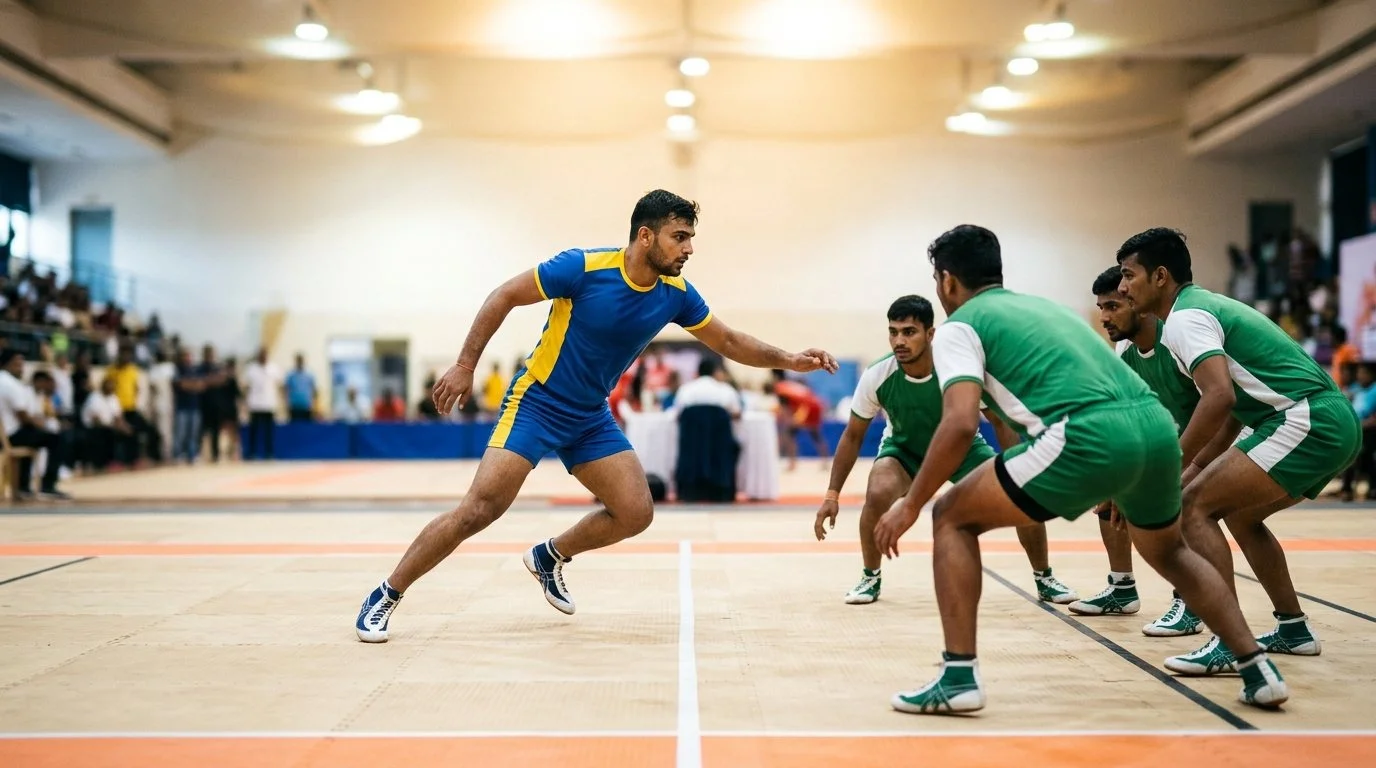
A raider slips across the midline, tags a defender and races back. The scoreboard changes by one point, but the mat changes too: one defender leaves, and an eliminated teammate may return. Those movements are why a single raid can have consequences far beyond the point displayed on screen.
This guide follows that chain through kabaddi scoring, revival, bonus points and the all-out. Examples are based on commonly described Pro Kabaddi League rules; specific tournaments can use different playing conditions or interpretations. Always check the current competition rulebook and official match record.
Also Read:Offside Without the Confusion: Five Football Moments That Change the Referee’s Decision
For the broader site, start at Mahadev Book. A category page does not confirm a particular fixture, market, licence or availability in the reader’s location.
Follow the people before counting the points
A standard team has seven players on court at full strength. Teams take turns sending a raider into the opponents’ half while the other side defends. The raider tries to score and return safely; defenders try to stop the raider under the competition’s rules.
A successful touch that results in an opponent being eliminated can earn a point. A successful tackle that prevents the raider returning can earn the defending team a point. Points can also arise through bonus, all-out and technical circumstances defined in the rules.
The official scoreboard is the record of the match. The mat helps explain how the next raid may develop, but a viewer should not infer a point solely from a player briefly stepping outside a line. Referees apply the rules to the complete action, and a review may change an initial signal where the competition provides that procedure.
Also Read:DRS Decisions Decoded: Why Umpire’s Call Can Save a Batter — or Send Them Back
The site’s kabaddi guide provides broader sport context. Its existence does not establish that a particular Pro Kabaddi fixture or market is available.
A touch point can change both sides of the mat
Imagine Team Red has five players active and Team Blue has six. Red sends a raider who legally touches one Blue defender and returns safely. Assuming no other infringement, Red earns a touch point and the touched defender is eliminated. Blue’s active count falls from six to five.
The point can also revive an eliminated Red player under the competition’s revival rules. If Red has an eligible player waiting for revival, its active count can rise from five to six. A single scoring action has therefore changed the numerical situation on both halves of the mat.
The order of revival matters. In the Pro Kabaddi explanation, eliminated players return in the order in which they were eliminated. Viewers should not assume that a team can always choose any player to revive after a point. Substitutions and special situations are governed by the competition’s rules.
If a raider legally eliminates more than one defender in the same raid, more than one touch point can be scored, with corresponding revivals where eligible. The exact result depends on the officials’ assessment of every touch, line and return. A dramatic hand movement is not proof that contact occurred.
The bonus line: a point without a revival
In the Pro Kabaddi explanation, the bonus line becomes active when at least six defenders are on the mat. A raider who satisfies the line-crossing conditions can earn a bonus point. The rule concerns the defenders present at the relevant time and the position of the raider’s feet; consult the current competition rules for the detailed application.
A bonus point does not eliminate a defender or revive an eliminated teammate under the cited Pro Kabaddi explanation. That makes it different from a touch point. A scoreboard can increase while the number of players on the mat stays the same.
The question of whether a bonus is awarded can be distinct from whether the raider is subsequently tackled. Do not infer the final scoring from the first referee signal or assume that every bonus attempt ends with the raider returning safely. Follow the complete official decision for the raid.
Suppose Blue has six defenders, so the bonus line is active. Red’s raider earns a valid bonus and returns without a touch. Red’s score increases by one, but no Blue defender is eliminated and no Red player is revived from that bonus alone. The example is illustrative, not a record of an actual match.
The site’s Pro Kabaddi basics discusses the wider vocabulary of raids and scoring. The league’s current rules govern a real match.
The tackle: one point can prevent a larger swing
If defenders legally stop a raider from returning and the officials award a successful tackle, the defending team scores under the applicable rules. The raider is eliminated, and the defending team may revive an eligible player. One tackle can therefore reduce the attacking side’s active count while strengthening the defence that made the stop.
A tackle can involve several defenders working together, but the team score is not necessarily multiplied by the number of players who participated. Individual tackle statistics and team points follow the competition’s definitions. The visible number of defenders holding the raider is not a shortcut to the final score.
Line awareness is central. A raider may try to reach the midline while defenders attempt to prevent a legal return. The officials consider the position of the raider, defenders and boundaries. A replay may show one angle of contact but not every relevant body part or line.
A defensive team near an all-out has an additional reason to value a successful tackle: a point and revival can increase its active numbers. That does not guarantee that the team will escape the all-out; the next raid starts a new sequence.
Super tackle: why fewer defenders can mean more points
In Pro Kabaddi terminology, a super tackle is associated with a successful tackle when the defending side has three or fewer players on the mat, under the league’s rules. It can award an extra point compared with an ordinary tackle. The exact scoring and revival treatment should be checked against the current competition rules.
The number of defenders is counted at the relevant moment; a graphic showing three players during an earlier raid is not enough to establish that the next tackle qualifies. Officials may need to resolve whether a player was active, eliminated or revived before the action.
A super tackle demonstrates a trade-off rather than a guaranteed opportunity. A team with few defenders may be vulnerable to an all-out, yet it can earn additional points for a qualifying successful tackle. The attacking side may prefer to avoid a risky engagement; the defence must still execute the tackle legally.
Do not confuse a super tackle with a Super 10. A Super 10 is an individual raiding milestone, while a super tackle describes a defensive scoring situation. One player’s total raid points and the team’s all-out points are separate statistics.
The all-out: extra points and a reset
An all-out occurs when every player of one team has been eliminated under the competition’s rules. Pro Kabaddi’s explanation awards the opposing team two additional all-out points, after which the eliminated team is revived and play continues.
Those two points are additional to the points earned through the actions that eliminated the final players. The exact sequence must be read from the official scorecard. If a team’s last defender is legally touched, for example, the scoring can include the touch point and the all-out award, but any other simultaneous events or technical rulings require the officials’ determination.
The all-out also resets the active-player situation for the eliminated team. That is important tactically: the team that has been reduced to one player returns with a full complement under the applicable rule. A strong team cannot assume the next phase will begin against the same depleted defence.
Worked sequence: from three defenders to a reset
Suppose Blue has three active defenders. Red’s raider legally touches two and returns. Red receives two touch points, subject to the official ruling, and Blue is left with one active player. If Red has eligible eliminated players, the touch points can also produce revivals under the rules.
On a later raid, Red legally eliminates Blue’s last active player. The officials award the relevant action point and, because the all-out conditions have been met, two additional all-out points. Blue’s team is then revived. This is a simplified sequence: real matches can include empty raids, tackles, bonus attempts, substitutions or technical decisions between these steps.
The lesson is not that the team with one defender must lose the next raid. A successful defensive action can change the count. Nor does a two-point all-out award replace the points from the final action. Read the official breakdown to see what was awarded.
Empty raids and changing pressure
An empty raid produces no scoring outcome for the raider under the relevant rules. In competitions using do-or-die raid provisions, consecutive empty raids can create an additional requirement on a later raid. The exact sequence and consequences must be checked in the tournament rulebook rather than generalised to every form of kabaddi.
The scoreboard may show no change after an empty raid, but the strategic context can change if the competition tracks consecutive empty raids. Players may also use the raid to test defensive positioning or manage time, although an outside viewer cannot know a team’s full tactical intent.
A do-or-die situation is not a guarantee that the raider will attempt the same technique every time. The active defender count, score, clock and substitution options can influence the decision. The defending side must still avoid an infringement while trying to stop the raider.
Team totals versus individual milestones
A team’s total can include raid points, tackle points, all-out points and technical points. An individual player’s tally does not necessarily include every point awarded to the team. Adding two star players’ totals will not always reproduce the scoreboard.
A Super 10 is achieved by a raider reaching at least ten raid points in a match under Pro Kabaddi’s statistical definition. Those can include touch and bonus points, but team-awarded technical points are not simply added to the raider’s tally.
A High 5 refers to a defender reaching at least five tackle points in a match under the league’s definition. A tackle involving several players does not automatically give each participant an individual tackle point. Check the official statistics for attribution.
The distinction matters when a broadcast highlights one player while the team score rises through an all-out or technical ruling. Both figures can be accurate because they measure different things.
Reading a late-match scoreboard
Start with the score and time remaining, then count active players on each side. A narrow points lead with only one defender active can create a different situation from the same lead with a full defence. The next raid may produce a touch, a tackle, an empty raid or another ruling.
Look for whether the bonus line is active and whether a super-tackle situation is shown under the competition’s rules. These labels depend on the active defender count and the specific play. Neither tells you in advance which side will score.
Finally, check whether substitutions or reviews have changed the line-up or score. A live graphic can lag behind the referee’s final decision. A clear report distinguishes the score at the end of a raid from the score after an official review.
For event-level context, the site’s kabaddi events calendar discusses scheduled competitions. Verify dates, teams and rules with the organiser because calendars can change.
Match rules and market rules are different
The league decides the match score. A platform, if it offers a market, applies the terms attached to that market. A match winner, an individual player total and a team points total are different questions. A stat correction or abandoned match can have different consequences under different terms.
The sports betting guide describes the broader category; it does not confirm a kabaddi market is currently offered.
Responsible viewing
A late all-out can change the score quickly, but it cannot be predicted with certainty. Watching requires no wager. Gambling should only be considered by adults where lawful, with money they can afford to lose; never chase a loss after a late raid.
The responsible gaming information page describes general safeguards. Check the controls available to your account and seek independent help if needed.
A defensive comeback without an all-out
Imagine Team Blue has three active defenders and Team Red sends a raider. Blue executes a qualifying successful tackle and the officials award the applicable points. If Blue has an eligible eliminated player, a revival can increase its active count. On Blue’s next raid, its raider may score a legal touch and revive another player. The numerical danger can recede without an all-out occurring.
This sequence is not automatic. A defence with three players can fail to tackle, and a raider attempting a touch can be caught. A revival also depends on an eligible eliminated teammate and the current rules. The point is that a low active-player count describes the present state, not an inevitable future result.
A commentator may call a team “one raid away” from an all-out when only one player remains. That is shorthand for a possibility, not a promise. An empty raid, a successful tackle, a technical ruling or another event may intervene. The official score and active-player list after each completed raid are more reliable than a prediction made before it.
How to keep a raid-by-raid scorebook
Create one row per raid. Record the raiding side, active defenders before the raid, the officials’ final decision, points awarded to each side and the active-player counts after revivals or eliminations. If an all-out is declared, show the action point and the additional all-out points separately where the official record does so.
For a bonus, note that the point can change the score without eliminating a defender or reviving a teammate. For a successful tackle, record the raider’s elimination and any revival allowed by the rules. For a review, retain the initial signal as a provisional note and replace the scoring entry with the final official ruling.
This approach makes discrepancies easier to identify. If a team total rises by more than the visible raid or tackle points, look for an all-out or technical award instead of assigning every point to a player. If the active count seems wrong, check the order of revival and any substitution or official correction.
Why the same score can describe different matches
A 20–20 score at halftime does not show whether the teams have the same number of players active or whether an all-out was inflicted near the break. Those details can shape the opening raids of the next period. Nor does a tied score reveal how many points came from bonuses, tackles or technical awards.
A balanced match report can therefore include the score, active-player situation where relevant and the official scoring breakdown. Avoid turning a single statistic into a claim that one side controls the whole match. A lead can change, and the next period starts under the competition’s actual rules, not the narrative suggested by the previous raid.
Frequently asked questions
How many points is a Pro Kabaddi all-out worth?
The league’s explanation awards two extra points to the team inflicting it, in addition to the relevant points from the actions that led to the all-out.
Does a bonus point revive a player?
Not under the cited Pro Kabaddi explanation. It differs from a touch or tackle point that can trigger a revival.
What is a super tackle?
A qualifying successful tackle by a defence with three or fewer active players under Pro Kabaddi rules can earn an extra point. Check the current competition conditions.
Is a Super 10 the same as a super tackle?
No. A Super 10 is an individual raid-points milestone; a super tackle is a defensive scoring situation.
Are these rules identical in every league?
No. Terminology and playing conditions can differ. Follow the current event’s official rules.
Official Regulatory & Industry References
Mahadev Book adheres to industry compliance, fair play principles, and statutory regulatory standards: