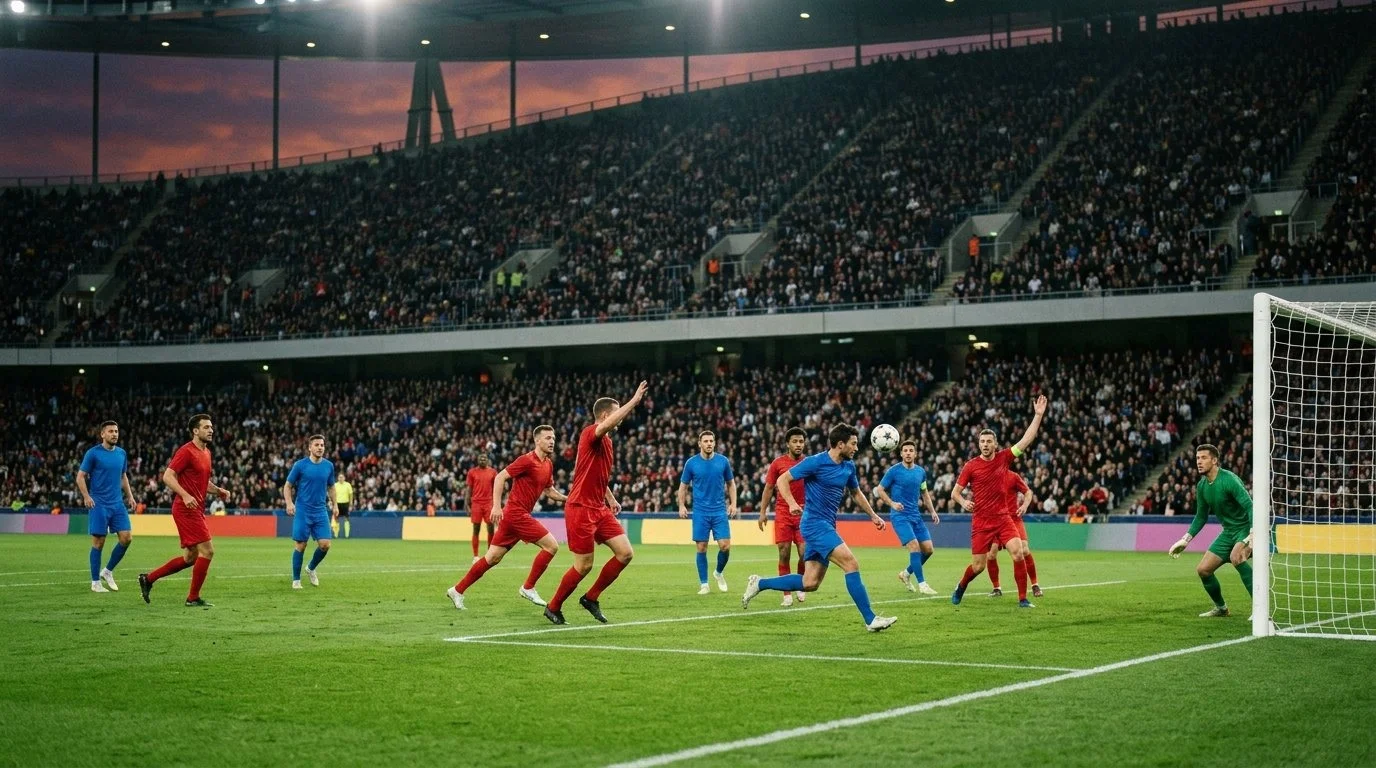
A striker receives the ball beyond the last defender and the flag goes up. A few minutes later, another attacker stands just as close to goal but play continues. The difference can be the moment the ball was played, the position of the ball itself, the number of opponents nearer the goal line or whether the attacker became involved in the play.
This guide uses five match situations to explain football offside. It follows the International Football Association Board’s Law 11, but a real decision belongs to the match officials using the facts and competition procedures. A television still or a line on a social-media graphic is not a substitute for the official decision.
Also Read:One Raider, Seven Defenders: How Kabaddi Points Build Toward an All-Out
The wider Mahadev Book site provides sport information. A category page does not confirm that a specific football event or market is available or lawful in the reader’s location.
The rule in one sentence — and the detail inside it
An attacker is in an offside position when any part of the head, body or feet is in the opponents’ half and nearer to the opponents’ goal line than both the ball and the second-last opponent. The hands and arms of all players, including goalkeepers, are not considered for this position test under the law.
Being in an offside position is not an offence by itself. The player is penalised only if, at the relevant moment, they become involved in active play in one of the ways specified by Law 11. That might include playing a ball touched by a teammate, interfering with an opponent or gaining an advantage after a rebound, deflection or deliberate save.
The crucial moment for position is generally when the ball is played or touched by a teammate, not when the attacker eventually receives it. Under the current law, the first point of contact of the play or touch is used, with a stated exception for a goalkeeper’s throw. Each new relevant touch can create a new assessment.
Also Read:DRS Decisions Decoded: Why Umpire’s Call Can Save a Batter — or Send Them Back
The site’s football guide gives broader sport context. The Laws of the Game and the competition’s rules govern a specific match.
Moment one: the attacker is beyond defenders but behind the ball
Imagine Red attacker A runs past several Blue defenders. Red teammate B carries the ball even closer to Blue’s goal line and passes backward to A. At the moment B plays the ball, A is not nearer the opponents’ goal line than the ball. A is therefore not in an offside position on that basis, even if only the goalkeeper is between A and the goal.
This example explains why “there must be two defenders ahead of the attacker” is an incomplete shortcut. The position test compares the attacker with both the ball and the second-last opponent. Being behind the ball at the relevant moment can keep the attacker onside.
“Backward pass” is a useful description in this simple example, but the direction of a pass alone is not a substitute for checking positions. Officials assess the attacker’s position relative to the ball and opponents when the teammate plays it. A pass can travel sideways or change direction after a touch, creating more complicated facts.
The second-last opponent is not always the final outfield defender. The goalkeeper can be one of the two opponents nearest the goal line, but a goalkeeper who has moved upfield may not occupy that position. Count opponents according to their actual positions, not their job titles.
Moment two: level is not beyond
Now suppose an attacker is level with the second-last opponent at the moment a teammate plays the ball. Under the offside-position definition, being level is not being nearer the opponents’ goal line than that opponent. The player is not in an offside position on that comparison.
A player can run beyond the defender after the pass is played and still have been onside at the relevant moment. Conversely, a player who starts in an offside position cannot necessarily erase that position merely by moving backward before receiving the same pass. The timing of the teammate’s touch and the later involvement matter.
A broadcast replay can freeze the picture close to the contact, but two-dimensional angles can be misleading. Depending on the competition, video review and calibrated tools may be used under the applicable protocol. The availability and implementation of those tools differ across competitions.
Avoid claiming that a toe, shoulder or head was definitively beyond a line from an uncalibrated phone screenshot. The law identifies eligible body parts; the official review process assesses the available evidence. Arms are excluded for the positional test.
Moment three: an offside-positioned player does not touch the ball
Red attacker A is in an offside position when a teammate shoots. A does not touch the ball, and the ball goes directly into the goal. That does not automatically mean the goal is disallowed. Officials must consider whether A interfered with an opponent or otherwise committed an offence under Law 11.
Interfering with an opponent can include preventing an opponent from playing the ball by clearly obstructing their line of vision, challenging for the ball or making an obvious action that clearly affects the opponent’s ability to play it. Merely standing somewhere near the goal is not enough to resolve every case.
Consider a second version: A stands directly in front of the goalkeeper and clearly blocks the keeper’s view of the shot. If the officials determine that the conditions for interfering with an opponent are met, A can commit an offside offence even without touching the ball. The actual judgement depends on the facts and the law.
A third version involves A moving toward a ball close enough to affect a defender’s attempt to play it. Whether the movement meets the law’s criteria depends on proximity, the action and its impact. Do not replace that assessment with the vague claim that the attacker was “distracting.”
Moment four: a rebound is not always a reset
An attacker is in an offside position when a teammate shoots. The ball rebounds from the post or is deflected by a defender, and the attacker then plays it. Law 11 includes gaining an advantage from a rebound or deflection among the situations that can lead to an offence.
A deliberate save is treated differently from an ordinary deliberate play by an opponent. The law addresses a ball that reaches an offside-positioned attacker after a deliberate save; that can still be an offence if the other conditions are satisfied. The goalkeeper or another defender can make a save under the law’s definition.
By contrast, a player in an offside position who receives the ball from an opponent who deliberately plays it is generally not considered to have gained an advantage, unless the play was a deliberate save. IFAB’s guidance describes deliberate play in terms of control and the possibility of passing, gaining possession or clearing the ball.
A failed clearance is not automatically a deflection just because it was inaccurate. Equally, a defender who stretches instinctively and makes limited contact may not have had the control required for deliberate play. The officials assess the circumstances, including the ball’s speed, distance and the defender’s opportunity to coordinate the action.
Moment five: direct restarts have special exceptions
A player is not penalised for an offside offence when receiving the ball directly from a goal kick, throw-in or corner kick. “Directly” is important. If another teammate touches or plays the ball after the restart, a new offside assessment can arise from that subsequent touch.
A free kick is not in that list. An attacker can commit an offside offence from a free kick if the relevant position and involvement conditions are met. Likewise, the fact that a set piece occurs close to goal does not remove the need to assess the law.
A pass received in the player’s own half is another important part of the position test: a player must have an eligible part of the body in the opponents’ half to be in an offside position. The law explicitly excludes the halfway line itself from the opponents’ half for this position test.
What VAR can and cannot mean
Video assistant referee procedures are used only where the competition has implemented them and under the authorised protocol. Offside can be one of the decisions reviewed in connection with an eligible incident, such as a goal. Not every football match has VAR, and the presence of television cameras does not prove that a review system is in operation.
An assistant referee may delay raising the flag in certain close attacking situations under the relevant instructions, allowing a promising phase to finish before a review. A delayed flag is not necessarily proof that the assistant missed the original position. Procedure can differ according to the competition and match circumstances.
A review can involve factual position and judgement about involvement, obstruction or deliberate play. Some decisions are more complex than drawing one line. The referee’s final decision remains the official match decision, and later reports should distinguish a provisional broadcast display from the result after review.
Offside and the scoreboard: what counts as a goal?
A goal can be awarded, disallowed or remain under review. Until the official decision is made, a live scoreboard may change. A supporter who sees the ball cross the goal line should wait for the referee’s signal and any review before treating the score as final.
A goal disallowed for offside is not an ordinary goal on the official scorecard. That can affect statistics and any market whose terms refer to goals or the official result. A match-winner market, a next-goal market and a player-specific market may use different definitions and conditions.
The site’s rules and regulations describe general platform information. Check the current terms of any particular market rather than assuming how it treats a cancelled goal, delayed review or correction.
For broader background, the football extra-time guide distinguishes regulation time, qualification and shootouts. Offside is a separate question about a phase of play.
A five-question replay worksheet
1. Who last played or touched the ball? Identify the relevant teammate’s touch. If an opponent touched it, ask whether the law treats that action as a deliberate play, a deflection or a save.
2. Where was the attacker at that instant? Compare the eligible parts of the attacker’s body with the ball, the second-last opponent and the halfway line. Do not judge only where the player receives the ball.
3. Did the attacker become involved? Playing the ball is one route, but interfering with an opponent or gaining an advantage after a rebound can also matter.
4. Was the ball received directly from an exempt restart? A direct goal kick, throw-in or corner kick has a specific exception. A later teammate touch can create a new phase.
5. What did the officials decide? A replay can support analysis, but the referee’s official decision and the competition record determine the recorded score.
This worksheet helps organise the discussion. It cannot replace calibrated equipment, the officials’ view or the current Laws of the Game.
Common offside myths
“The goalkeeper is always the last defender.” The law refers to opponents and the second-last opponent. A goalkeeper can be positioned elsewhere.
“A player in an offside position is always penalised.” Position alone is not an offence. Involvement in active play under the law matters.
“The attacker’s arms make them offside.” Hands and arms are excluded from the offside-position test.
“Any touch by a defender resets the phase.” A deflection or deliberate save is treated differently from a deliberate play under Law 11.
“You can never be offside if the ball goes backward.” The direction alone is an incomplete test; compare positions at the relevant teammate touch.
“A flag after the shot proves the assistant was late.” Some competitions instruct assistants to delay in certain tight attacking situations.
Responsible use and interpretation
Football is enjoyable without a wager. If you choose to gamble where lawful, only use money you can afford to lose, set time and spending limits and do not chase a loss after a disallowed goal. An offside explanation cannot predict a match or guarantee a market result.
The sports betting guide is a broad resource, not proof that a particular offside-related market exists.
The how to bet guide explains general terminology; individual market terms and local law should be checked separately.
Why a new teammate touch creates a new assessment
Imagine an attacker is onside when a teammate sends a through ball. The attacker runs forward and reaches a position beyond the second-last opponent. Before the attacker touches the ball, another attacking teammate deliberately plays it onward. The officials assess the attacker’s position again at that later teammate touch. The first pass being onside does not settle the second phase.
The reverse can also happen. A player who was in an offside position during an earlier phase may later be in an onside position when a teammate makes a new relevant play. Whether an earlier offence has already occurred remains important; a subsequent touch does not retroactively erase an offence that the referee has already identified.
This is why a useful replay starts with the correct touch, not simply the last frame before the attacker scores. Ask whose touch is being assessed and whether it was a teammate’s play, an opponent’s deliberate play, a deflection or a save under the law. Those details can change the answer without changing where the attacker eventually receives the ball.
The indirect free kick and the restart
When an offside offence is penalised, Law 11 provides for an indirect free kick at the place where the offence occurred, including a location in the player’s own half where applicable. The offence location can differ from the position the player occupied when the teammate first played the ball. Moving back to receive a pass can therefore make the restart location look surprising.
An indirect free kick is signalled and administered under the Laws of the Game. It is not a penalty kick merely because an attacker was in an offside position inside the penalty area. The relevant offence belongs to the attacking side, and the defending side takes the restart.
Other offences can occur in the same phase. For example, a foul against an attacker may happen before that player commits an offside offence, or after the attacker has already become involved. Law 11 addresses the order in which those events are penalised. A viewer needs the sequence, not just a still showing two possible incidents.
How to describe a disputed decision responsibly
Identify the attacking team, the relevant teammate touch and the action that officials considered involvement. Then state the official ruling: goal awarded, goal disallowed or play stopped for offside. If VAR was used, explain whether it reviewed position, involvement or another eligible incident, rather than assuming the technology decided every component automatically.
If the available footage is inconclusive, say so. A moving defender, a partially obscured body part or a missing contact frame can make a public replay difficult to interpret. A careful report can discuss the applicable law and the limits of the image without asserting that the officials were certainly right or wrong.
Frequently asked questions
Is standing in an offside position a foul?
Not by itself. The player must become involved in active play in a way described by Law 11.
When is the attacker’s position judged?
Generally when the ball is played or touched by a teammate, subject to the law’s precise wording and exceptions.
Can a player be offside from a throw-in?
There is no offside offence for receiving the ball directly from a throw-in. A later teammate touch can create a new assessment.
Does a defender’s deflection always make an attacker onside?
No. A rebound, deflection or deliberate save can still lead to an offside offence; a qualifying deliberate play is treated differently.
Is every football match reviewed by VAR?
No. VAR is used only where the competition has implemented the authorised system and protocol.
Official Regulatory & Industry References
Mahadev Book adheres to industry compliance, fair play principles, and statutory regulatory standards: