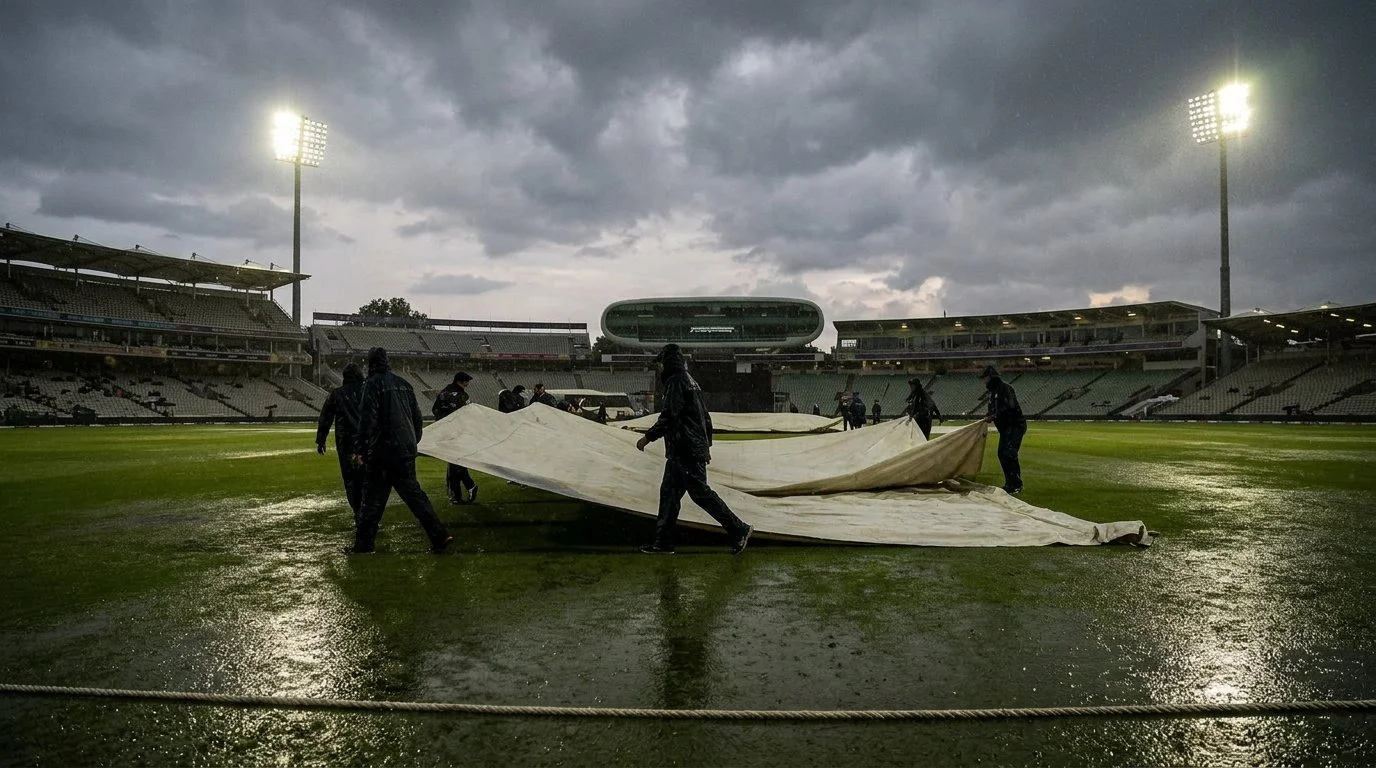
A chase is underway, clouds gather and the players leave the field. When they return, the target on the scoreboard may have changed. For a casual viewer, that can look unfair or even arbitrary: why should a team suddenly need fewer runs, and why does the number of wickets lost matter? The answer usually lies in the Duckworth–Lewis–Stern method, known as DLS.
This guide explains what a revised target means, how it differs from a par score and why an abandoned match is not always recorded as “no result.” It focuses on limited-overs cricket and is written for people who want to follow a rain interruption without pretending that every tournament uses identical playing conditions.
Also Read:Bingo Rules Made Simple: Cards, Calls, Prize Patterns and the Odds Questions to Ask
Readers exploring cricket coverage on Mahadev Book should distinguish the official match result from any separate market settlement. Rules, jurisdiction and product availability vary; the existence of a page does not establish that a particular market is available.
The quick answer: what does DLS do?
DLS is a method for setting revised targets and deciding certain interrupted limited-overs matches. It accounts for the run-scoring resources available to each side, primarily the overs remaining and wickets in hand. It is not simply “subtract the overs lost” and it is not a prediction that a team would certainly have scored a particular number.
A batting team with ten wickets available and twenty overs left is in a different position from one with only two wickets and twenty overs left. Both situations involve the same nominal overs, but the second team has fewer wickets to risk. DLS uses a resource model to account for that difference within the applicable playing conditions.
The official target is calculated by the match officials using the authorised method and relevant competition rules. An online estimate or a graphic posted by a fan can be useful context, but the published target and the officials’ decision control the actual match. Do not invent a DLS target by multiplying the original target by the proportion of overs remaining.
Also Read:Tennis Tie-Breaks and Retirements Explained: The Rules Behind a Confusing Scoreline
Why rain changes more than the clock
In a normal limited-overs innings, a captain plans around a fixed maximum number of overs. Batters can balance the value of scoring quickly against the risk of losing wickets. If play is interrupted and the available overs shrink, that original plan may no longer fit the match.
Suppose a team expects a fifty-over innings but learns after a long break that it will have far fewer overs. A player who had been pacing an innings for a long chase may now need to change approach. The fielding side also adjusts its use of bowlers and field placements. The loss of time changes opportunity, not merely the length of television coverage.
Conditions can affect play in other ways too. A wet outfield may be unsafe, the ball may need attention, and further rain can produce more than one interruption. Officials consider playing time and safety under the competition’s rules. The target can be recalculated if the match is reduced again, so a number announced after the first break is not necessarily the final number.
For the wider relationship between surface, forecast and match context, the site’s cricket pitch weather and toss guide covers conditions beyond the calculation itself. A forecast is not an official DLS decision.
The two resources: overs and wickets
Overs remaining represent opportunities to score. The more balls a side can face, the more time it has to build partnerships, recover from a setback and attempt a larger total. An over contains six legal deliveries under ordinary playing conditions, though wides and no-balls can extend it.
Wickets in hand represent the batting side’s capacity to continue. A side that has lost eight wickets is closer to being all out than a side that has lost two. A team cannot normally continue its innings once ten wickets have fallen, so a wicket has consequences beyond the immediate loss of a batter.
The resources interact rather than working as two independent discounts. Losing wickets early can affect how a team approaches the remaining overs. Conversely, losing a small number of overs at the very end of an innings is not necessarily equivalent to losing the same number at a different stage. The authorised tables and calculations handle those relationships.
DLS does not promise that it knows how any particular batter would have performed. It applies a consistent method to a situation in which the teams did not have the same opportunities. Some spectators may disagree with a particular outcome, but the correct question is whether the method and the competition’s playing conditions were applied as required.
Target, par score and official result: three different terms
A target is the score the chasing side needs to win. If the official revised target is 151, a team reaching 151 wins the chase, subject to any unusual ruling or competition-specific condition. A target is normally one run above the score needed to tie.
A par score is used for comparison at a particular point in an interrupted chase. It depends on the overs completed and wickets lost. If play cannot resume and the conditions for a result are satisfied, the match can be decided by comparing the chasing team’s score with the relevant DLS par score. A team ahead of par wins, a team behind par loses, and equality may produce a tie under the applicable conditions.
A result is the official outcome recorded by the competition. It may be a win by a stated margin under DLS, a tie, an abandonment or a no result. These labels are not interchangeable. A match can stop permanently because of rain and still have a result if the required conditions have been met.
The numbers on a broadcast can change after a wicket because the par score takes wickets lost into account. A graphic saying “five runs ahead” is a snapshot at that moment. If another wicket falls or another delivery is completed, the applicable comparison can change.
A worked example without fake precision
Imagine Team A completes its innings and Team B begins a chase. Rain arrives during Team B’s innings. After assessing the remaining playing time and applying the official method, the officials announce a revised target of 151 from 20 overs. This number is illustrative: it is not calculated from a particular real score and should not be used as a shortcut for another match.
If Team B reaches 151 within the permitted overs, it has reached the announced winning target. If it finishes on 150 after using the available overs, the result is generally a tie, subject to the competition’s conditions. If it scores 149, it falls short. The exact result and margin should always be read from the official scorecard.
Now imagine a second interruption before the innings can finish. If the minimum requirements for a DLS result have been met and play cannot resume, officials compare Team B’s score to the par score for the precise point and number of wickets lost. If those requirements have not been met, the match may be declared a no result or handled under another competition-specific provision.
This example shows why a fixed “runs needed per over” calculation is insufficient. The target and par scores are produced from the match state and the relevant regulations. Without the authorised resource calculations, any precise number offered in a generic article would be speculation.
Does every rain-shortened match use the same minimum overs?
No universal minimum should be applied to every competition. Different formats and playing conditions can prescribe different requirements, and tournament-specific provisions may apply to knockout games, reserve days or unusually short matches. A condition for an ordinary league fixture is not automatically the condition for a final.
The ICC’s published ODI playing conditions, for example, describe a twenty-over minimum for certain interrupted-result scenarios in that document. Other competitions can adopt different conditions. Verify the current playing conditions for the actual event before reporting that enough overs have been bowled for a result.
A reserve day is not a guarantee that a match starts again from the beginning. The competition rules determine whether and how play resumes, what happens to the existing score and when the reserve day is used. A social-media summary that says “rain tomorrow” is not a substitute for those rules.
The site’s cricket formats guide compares T20, ODI and Test cricket. DLS is associated with limited-overs target adjustments; a Test match follows a different structure and should not be treated as a short-form chase with a DLS target.
The information to record during an interruption
A useful match note contains the score, wickets, overs and balls completed at the precise interruption. Write “94 for 4 after 14.2 overs,” not simply “94 after fourteen overs.” The extra two deliveries are part of the match state. If a broadcaster displays a par score, record the time and state to which it applies.
Next, record whether the innings is scheduled to resume and the official revised allocation, if announced. Officials may need time to inspect conditions and determine a restart. A provisional broadcaster estimate is not necessarily the final decision.
Finally, note the next official update. A changed restart time, a further interruption or a wicket after play resumes can make the earlier information obsolete. Keep corrections visible if publishing an article; a reader should be able to tell which target was final and which was an earlier projection.
What the scoreboard cannot tell you by itself
A score can say that a team is 94 for 4, but it does not reveal all the relevant timing rules, the state of the ground or whether another inspection is planned. Likewise, the required run rate before rain may no longer be the required run rate after the target and overs are revised.
A team might appear to be scoring quickly and still be behind a DLS par score because it has lost wickets. Another side may be below the original asking rate but ahead of par at the interruption. Those observations do not mean the model is a forecast of the next ball; they describe the comparison under the method at that point.
Avoid translating a par score into an individual player’s expected future performance. A batter may accelerate, a bowler may take a wicket or play may never resume. The scorecard gives an official match state; the match’s future remains uncertain.
How to read a shortened chase after the restart
Start with the revised target, not the original target shown in a pre-match preview. Then confirm the overs available and the score already made. Subtract the current score from the winning target and use the remaining legal deliveries to understand the new required pace.
For example, if the announced target is 151 and the chasing side has 101, it needs 50 more runs. If exactly six overs remain, that is an average of about 8.33 runs per over. This arithmetic describes the requirement; it does not tell you whether the team will achieve it or whether another interruption will change the match again.
Look at wickets too. A team with several recognised batters still available may have different options from a team near the end of its order. But player reputation alone does not decide a chase. The opposition’s remaining bowlers, field restrictions and conditions all matter, and any statement about an injury should come from an appropriate source.
For a general introduction to the sport and formats, the site’s cricket betting guide is a separate resource. It should not be mistaken for the official playing conditions of a particular competition.
Why a match result and a market result may differ
The competition decides the cricket result. A sportsbook or exchange applies the terms of the specific market. Those two systems can refer to the same match while answering different questions. A match-winner market, a team-total market and an individual-over market may have different conditions for interruption, abandonment or the amount of play needed.
Do not assume that every bet is void because rain stopped the game. Equally, do not assume every market settles simply because the competition produces a DLS winner. Some outcomes may already have been determined before the interruption, while others depend on additional play. Only the operator’s current market-specific terms can establish its treatment.
The site’s cricket betting terminology glossary explains common market vocabulary. Use it for definitions, not as a substitute for the rules attached to the specific fixture.
The site’s rules and regulations provide general platform information. Before making any decision, look for the current terms attached to the exact market, including DLS, abandonment, postponement and revised targets. If they are unclear, ask support before committing money.
A site may offer information about cricket without offering every fixture or market. Availability, prices and terms can change, and access must be lawful in your location. No explanation of DLS can remove the financial risk of gambling or guarantee a return.
A practical decision tree for viewers
Has the first innings ended? If not, a shortened allocation can affect the batting side’s remaining opportunity. Wait for the official number of overs and any further conditions.
Has a revised target been announced? If yes, use that target for the chase. If a broadcaster is showing only a projection, label it as an estimate rather than an official target.
Has play stopped again? Record the exact score, wickets and completed deliveries. A fresh calculation may be necessary if the overs are reduced further.
Can play resume? Follow the officials’ inspection and restart updates. A television graphic may lag behind an official announcement.
Have the result requirements been met? Check the competition’s current playing conditions. If they have, a DLS comparison may decide the game; if not, another outcome such as no result may apply.
Is a market involved? Read the operator’s rules separately. A match’s official result does not answer every settlement question.
Common myths about rain and revised targets
Myth: DLS just removes runs in proportion to lost overs. The method accounts for resources, including wickets and overs. A simple ratio cannot reproduce every official calculation.
Myth: The chasing side always benefits. A revised target is determined by the method and the match circumstances; it is not a guaranteed advantage to either team.
Myth: A team ahead of par is certain to win. It can win on that comparison if play ends and the result conditions are satisfied. If play resumes, the eventual outcome still depends on what happens next.
Myth: Rain automatically means a no result. Some interrupted matches have official results. Others do not meet the required conditions. The scorecard and competition rules matter.
Myth: The same rules apply to every tournament. Competition-specific playing conditions can differ, including minimum overs and reserve-day provisions.
Myth: A weather forecast guarantees an interruption. Forecasts change and the officials decide whether conditions permit play. Treat weather information as context, not a result.
Responsible viewing and useful limits
Watching a changing target can be exciting, but rapid updates can also encourage impulsive decisions. There is no obligation to place a wager to follow a match. If you choose to gamble where lawful, set a budget you can afford to lose, avoid chasing losses and take a break when you feel rushed or uncertain.
The site’s responsible gaming information explains general safeguards. Check which limits or self-exclusion options are actually available for your account and seek independent help if gambling is causing harm.
Frequently asked questions
What does DLS stand for in cricket?
Duckworth–Lewis–Stern, a method used in applicable interrupted limited-overs matches to revise targets or determine a result.
Is the par score the same as the winning target?
No. A target is the score needed to win a chase. A par score is a comparison at a particular point in the innings under the relevant conditions.
Why can the par score change after a wicket?
Wickets in hand are part of the DLS resource model. When the match state changes, the relevant par comparison can change too.
Does a cancelled match always have no winner?
No. If the applicable conditions for a result have been met, a match stopped by rain can have an official DLS result. Check the competition’s decision.
Can I calculate the exact target from this article?
No. The examples explain the concepts, not the authorised resource tables or the precise conditions of a real match. Use the officials’ published figure.
Does this guide confirm that a DLS market is offered?
No. General information and a live webpage do not establish the availability or terms of any particular market.