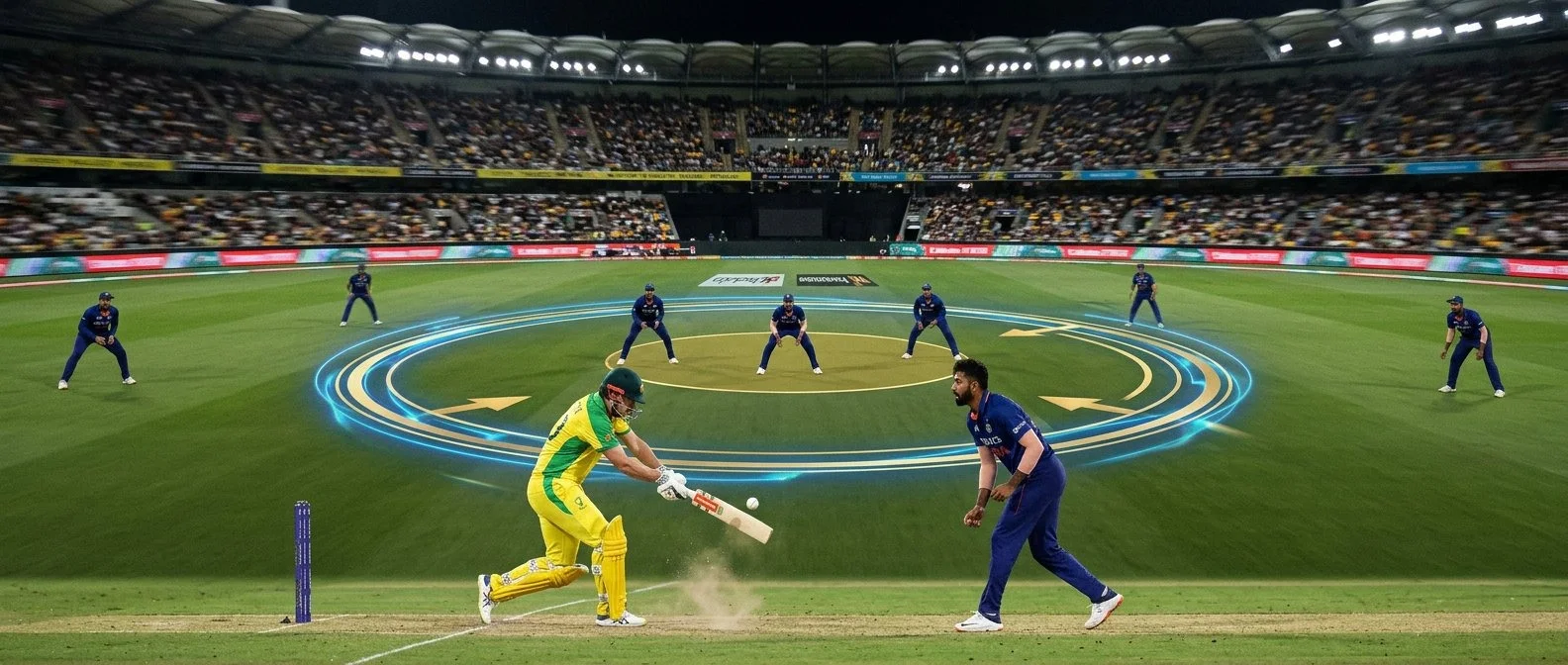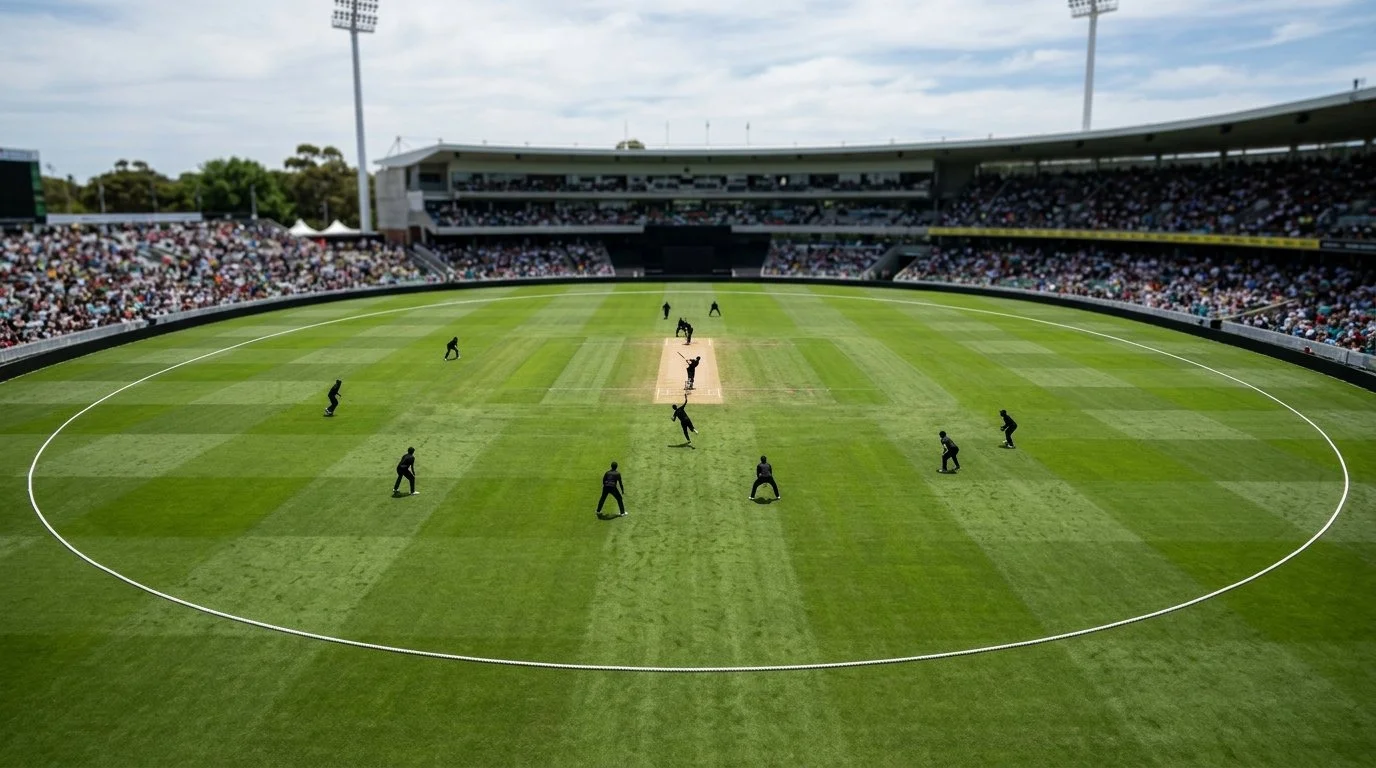
At the start of a T20 innings, a batter may see several fielders close to the pitch and only a small number positioned near the boundary. Later, the field can spread out. That visual change is not simply a captain's preference: fielding restrictions limit the number of players allowed outside a marked area during certain phases.
This article explains the fielding geometry of a full-length T20 international as a reference point, then shows why readers must check the playing conditions of the actual competition. It does not claim every league uses the same rules or predict how a powerplay will unfold.
Also Read:BBL Betting: What the Designated Batter Rule Means for Team Selection
The Mahadev Book IPL Betting page provides IPL-related information, but the competition's official playing conditions determine the fielding restrictions for a particular match.
The circle is a limit, not a wall
A restricted fielding area is marked around the pitch. It gives umpires and scorers a reference for the maximum number of fielders permitted outside it at the relevant time. A fielder can still move, catch or stop a ball within the Laws; the marking itself does not stop the ball.
For a full 20-over T20 international innings, the first six overs ordinarily form the powerplay, during which no more than two fielders may be outside the 30-yard circle when the ball is delivered. After that phase, the standard limit ordinarily allows up to five outside, subject to the applicable conditions and any additional restrictions.
The word “maximum” matters. A captain does not have to place exactly two outside during the powerplay. They can choose fewer, within the rules. The same principle applies to a later maximum: a limit defines what is permitted, not a required formation.
Also Read:BBL Betting: How the Power Surge Changes a Two-Over Window
What changes when the field spreads?
With fewer fielders stationed deep, more players are available to cover areas closer to the batter. A lofted shot may travel beyond the infield into an unprotected area, but a mistimed shot can be caught by someone inside the circle. Neither possibility guarantees a boundary or a wicket.
When more fielders can move outside the circle, a captain can protect additional boundary areas. That can leave larger spaces closer to the batter, where singles or twos might be available. The exact gaps depend on the positioning of all fielders, the bowler's plan, the batter's strengths and the dimensions of the ground.
A Mahadev Cricket Betting guide can explain general cricket terms. The field shown on a broadcast still needs to be interpreted using the actual match conditions and the officials' decisions.
A fictional field: two outside
Imagine a right-handed batter facing a fast bowler during a full-length T20 international powerplay. The captain places one fielder deep on the leg side and another deep on the off side. Other fielders cover positions closer to the pitch, subject to the applicable Laws.
The bowler delivers a short ball and the batter pulls it toward the leg-side boundary. A deep fielder may be positioned to stop or catch it. If the ball goes through a different gap, the same two-fielder limit can leave another section less protected. The actual result depends on the delivery, shot and fielding—not the restriction alone.
A captain can adjust positions between deliveries within the rules. A viewer who sees a diagram at the start of an over should not assume every fielder remains in the same place for the entire over.
A second fictional field: five outside
Later in the same imagined innings, the standard post-powerplay maximum applies. The captain chooses to place five fielders outside the circle, distributing them across likely boundary areas. This leaves fewer fielders available inside the circle than in the earlier setup, though the precise positions are still a tactical choice.
A batter may push the ball into a gap for one run, attempt to clear a deep fielder or change the direction of a shot. A good boundary fielder can prevent runs, but positioning does not guarantee a stop. The illustration shows a trade-off, not a preferred or guaranteed tactic.
The Online Cricket Betting Book page offers powerplay statistics background. A phase total is only one part of the story: runs, wickets, opponents and conditions all matter.
Count the phase correctly
In a full 20-over innings with a six-over powerplay, the opening phase covers the first 36 valid balls. A wide or no-ball normally does not count as a valid ball, so a powerplay can contain more than 36 physical deliveries. The official scorer and umpires determine the count.
If a scoreboard shows 5.4 overs, that means five completed overs and four valid balls of the sixth over. Under the full-length example, two valid balls remain before the end of the sixth over. It does not mean 5.4 decimal overs.
Do not apply the six-over description automatically to an innings shortened by weather or another interruption. The current competition conditions specify how restrictions are adjusted, and some competitions use different formats or additional phases. Wait for the official allocation and check the relevant rule table.
What if a fielder is out of position?
The umpires enforce the applicable fielding restrictions and any consequences specified in the Laws and playing conditions. A spectator's camera angle may not show every player or the exact position at the moment of delivery. Do not declare an infringement solely from a cropped television image.
If the umpire signals a no-ball, the scoring and any subsequent procedure follow the relevant rules. Some competitions provide for a free hit in specified situations, but its availability and restrictions depend on the competition. Use the official call rather than assuming a particular consequence from a general article.
An IPL Cricket ID information page does not decide whether an umpire has correctly applied a fielding rule. That is a matter for the match officials and playing conditions.
Look beyond the boundary count
A powerplay total can include singles, twos, boundaries and extras. Two teams can reach the same total with different wicket counts and very different ball-by-ball patterns. For example, a fictional side may score 48 for one, while another scores 48 for three. Both have the same runs after six completed overs, but they have different wickets remaining.
Those totals do not establish which side will win. The pitch, opposition, remaining batting resources and subsequent play all matter. A large opening score can be followed by a slowdown; a modest opening score can be followed by a strong middle or finish.
To describe a phase accurately, note the runs, wickets, completed valid balls and any relevant interruption. Avoid labelling a score “winning” or “losing” without evidence. Even a historically common benchmark is not a guarantee.
Three questions for a live viewer
How many fielders are outside? Count only if the broadcast view shows enough of the field. The umpire's decision remains authoritative.
Which phase applies? A full-length T20 international, a shortened match and a different league can have different restrictions. Check the official playing conditions.
What is the team trying to do? The scoreboard can show runs and wickets, but the precise tactical plan is usually an inference. Describe it as such.
A Mahadev Book ID Login page may concern an account rather than match regulations. A user's identifier does not change the fielding restrictions or verify the service's legal status.
Powerplay misconceptions
“The batting team must attack.” The rules restrict fielding positions; they do not require a batter to play a particular shot.
“Exactly two fielders must be outside.” In the full-length T20 international example, two is the maximum during the powerplay, not a minimum.
“Every T20 uses identical shortened-match rules.” Competitions can differ. Use the applicable current conditions and official announcements.
“A good powerplay total guarantees a win.” The remaining innings still has to be played, and the other team has its own innings.
How a writer can explain a powerplay without overclaiming
Specify the format and whether the innings is full-length. State the official score and wickets at the end of the phase. If describing field placement, identify it as an observation from the available footage rather than a complete account of the captain's reasoning.
Avoid treating a field restriction as a promise that a specific player will score quickly. Individual results remain uncertain, and a service's event terms may use different statistics from a general match report.
For readers of Mahadev Book Online Betting, the official cricket record and a third-party service's terms are separate. Check local law and operator authorisation independently; a live page is not proof of either.
Why two captains can choose different fields under the same rule
A rule specifies the maximum number of fielders outside the circle, but it does not specify exactly where they must stand. One captain might protect the boundary behind square on the leg side and cover a deep off-side gap. Another might use both deep positions on the leg side. The choice depends on the bowler's intended line and length, the batter and the available fielders.
The field visible before a delivery is only a snapshot. A captain can move a fielder between deliveries, subject to the Laws, while a batter may change stance or select a different shot. A tactical description should distinguish an observed position from an assumed plan. “A deep fielder was stationed on the leg side” is an observation; “the captain knew the next shot would go there” is an unsupported claim.
Even a well-planned field does not cover every part of the ground. The bowler and wicketkeeper occupy roles that also affect the arrangement, and a shot can be struck in an unexpected direction. A fielding map explains coverage; it does not predict the next result.
A comparison of two fictional six-over starts
Team North reaches 45 for no wickets after six completed overs. Team South reaches 52 for three after the same number of valid balls. South has scored seven more runs, while North has more wickets in hand. The better platform depends on the remaining batting resources, surface, opposition and what happens later.
A report can state those facts without inventing a winner. North's current run rate is 7.5 per over; South's is approximately 8.67. Neither rate alone measures the consequences of the wickets lost. A batter dismissed in the sixth over is no longer available in the same way as a batter who remains not out, subject to the applicable match rules.
If the first innings is still in progress, there is no chase target yet. Do not call either opening score sufficient without knowing the final total and the other team's innings. If the second innings is a chase, compare the remaining target and valid balls as well as the powerplay score.
How fielding restrictions interact with a bowler's plan
A bowler may aim to make a batter hit toward a protected area, while the batter may attempt to find the unprotected side. The relationship between line, length and field placement can be seen in a replay, but intentions are not always visible. A captain might adjust a field after a boundary, a near miss or a change of batter.
It is tempting to describe every boundary as a fielding error. That is too simple. A strong shot can beat a legal field, and protecting one region can leave another available. Conversely, a catch does not prove that the field was perfectly planned; the delivery and the batter's response also matter.
Fielders inside the circle can contribute by preventing singles as well as taking catches. A diving stop that saves a run may not appear as a named statistic on a basic scorecard. The official total captures the runs, but a written report may need video or commentary to explain how they were prevented.
When the innings is shortened before it begins
The number of powerplay balls may be reduced under the competition's table. Do not automatically multiply the new allocation by a fraction and round it according to your own preference. Some regulations specify a result in complete overs and balls, and their tables can change by format or season.
If the innings is shortened after it has begun, the applicable conditions may address whether the new allocation changes restrictions already in progress. That is a different scenario from a reduction made before the first ball. Wait for the officials' announcement and use the current rulebook rather than applying a rule from another competition.
A broadcaster may initially show a provisional allocation. Label it as such. Once a change is confirmed, update the phase endpoint and any calculations based on it. Do not rewrite the past score: an adjusted allocation changes future limits, not the runs already recorded.
Why a boundary count is not a complete phase report
A phase containing five boundaries can also include dot balls, singles, extras and wickets. Two sides with the same number of boundaries can finish with different totals because of those other events. A wide adds at least a penalty run under the ordinary Laws and does not count as a valid ball; additional runs can also be recorded as appropriate.
When comparing powerplays, note whether both innings had the same scheduled length and restrictions. A six-over phase in an uninterrupted innings should not be directly compared with a shorter phase without explaining the difference. The number of valid balls is an essential part of the denominator.
Finally, check the official score after the phase ends. A live graphic may correct an earlier run or dismissal. If a report is updated, identify the correction rather than silently preserving a figure that no longer matches the official record.
A field map for a new viewer
Start at the pitch and identify the bowler and wicketkeeper. Next locate the marked circle and the fielders clearly outside it. Then look for gaps, remembering that a broadcast camera may not show the entire field. If you cannot see every player, do not claim an exact count from the image alone.
At the end of the over, compare the field with the next one. Did a fielder move closer or deeper? Did the phase officially change? Write only what can be observed and use the competition conditions for the permitted maximum. This practice turns the field from a static picture into a useful part of the match narrative.
The boundary and the circle serve different purposes
The boundary marks the edge used for scoring a boundary under the Laws. The fielding circle is an internal reference for restrictions. A fielder outside the circle is not necessarily standing on the boundary rope; they can be anywhere beyond the circle within the playing area, subject to the rules. A diagram that draws only a circle and a rope can hide many possible positions between them.
A ball crossing the fielding circle does not automatically score four or six. The result depends on whether it reaches or crosses the boundary and the circumstances prescribed by the Laws. Likewise, a fielder standing inside the circle can run outward to intercept the ball after it is delivered. The restriction concerns positions at the specified time, not a prohibition on moving while the ball is in play.
For a live viewer, the fielding circle helps explain the initial distribution of players. The official ball-by-ball record explains what actually happened next. Keep these two observations separate when describing an over.
Official Regulatory & Industry References
Mahadev Book adheres to industry compliance, fair play principles, and statutory regulatory standards: