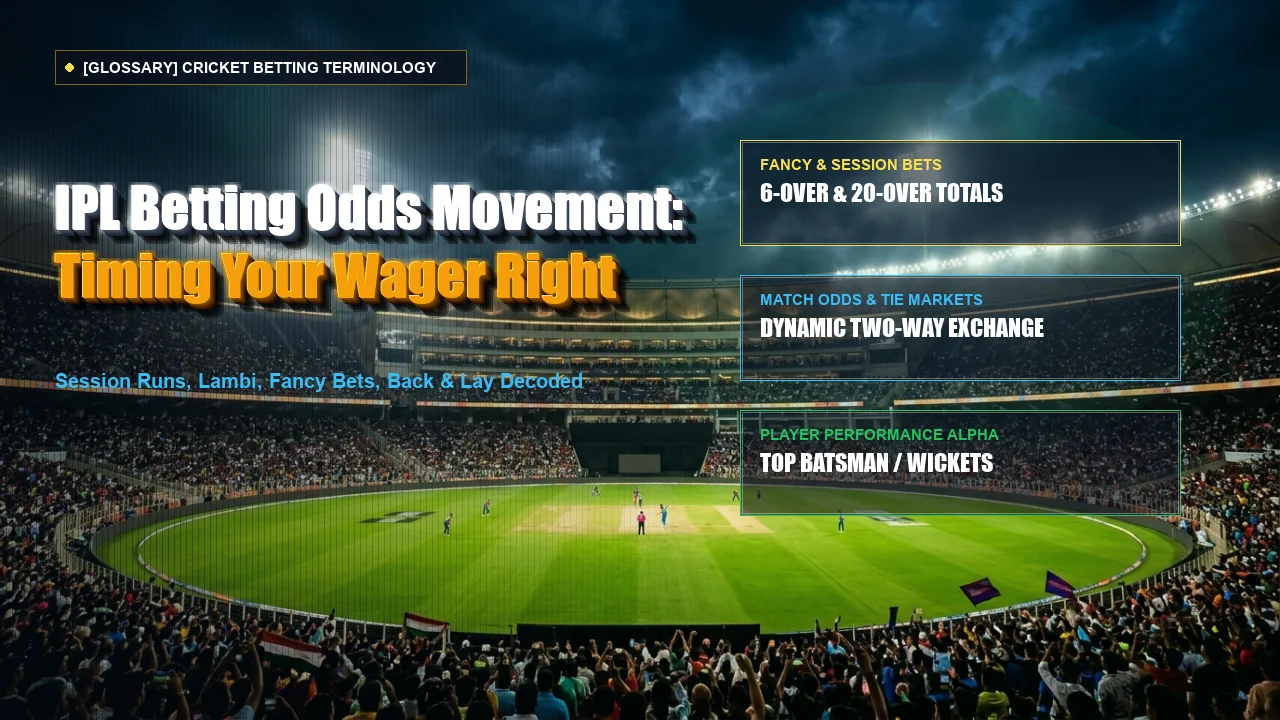
Why does an IPL match odds shift from 1.80 to 2.10 within minutes of a toss, even before a ball is bowled? The answer lies in the invisible mechanics of odds compilation and market liquidity—forces that determine whether your bet represents value or a trap. This deep dive into IPL betting odds movement will equip you with the analytical framework to time your wagers with precision.
The Engine Room: How Bookmakers Set and Adjust IPL Match Odds
Bookmakers don't guess; they calculate. The opening odds for any IPL match are derived from sophisticated models that weigh team strength, player form, venue statistics, historical head-to-head records, and even weather forecasts. These models output a true probability estimate, to which the bookmaker adds a margin—their built-in profit. This margin is why the sum of implied probabilities across all outcomes exceeds 100%.
Also Read:IPL Cricket Betting: How Bookmaker Margin Really Works
For example, if a model suggests Team A has a 60% chance of winning, the fair decimal odds would be 1.67 (1 / 0.60). But the bookmaker might offer 1.62, incorporating a margin. The difference between fair odds and offered odds is the overround, and it's the first thing sharp bettors calculate when comparing Ipl Betting markets across platforms.
From Probability to Price: The Conversion Triangle
Every odds format is a different language for the same underlying probability. Decimal odds are the most intuitive for calculating implied probability: Implied Probability = 1 / Decimal Odds. Fractional odds (common in the UK) express the same concept as a ratio of profit to stake. Moneyline odds (popular in the US) use a positive/negative system.
Consider decimal odds of 2.50. The implied probability is 1 / 2.50 = 0.40, or 40%. In fractional terms, 2.50 decimal equals 6/4 (since 2.50 - 1 = 1.50, and 1.50 = 6/4). If you stake ₹1,000 at 2.50, your total return is ₹2,500 (₹1,500 profit + ₹1,000 stake). Understanding these conversions is fundamental to IPL Betting because it allows you to quickly spot discrepancies between your own probability estimates and the market's.
Key Takeaway: The implied probability of an outcome is simply 1 divided by the decimal odds. If you believe the true probability is higher than the implied probability, you've found a value bet—provided your model is more accurate than the bookmaker's.
Market Liquidity and Order Matching: The Invisible Hand
On exchange platforms (like Betfair), odds are not set by a bookmaker but by supply and demand from other bettors. This is the world of back and lay bets. Backing means you're betting on an outcome to happen; laying means you're betting against it. The odds you see are the best available prices from the order book—a constantly updating list of unmatched back and lay orders.
Liquidity determines how much you can bet without moving the market. In a high-profile IPL match, liquidity can be immense, allowing large stakes at stable prices. But in niche markets (e.g., top bowler for a specific team), liquidity is thin, and even a modest bet can cause significant odds movement. This is why IPL Betting strategies must account for market depth: a bet that looks like value at 2.00 might only be available for ₹5,000 before the price drops to 1.95.
The Role of Commission and Vig
Exchanges charge a commission on net winnings (typically 2-5%), while bookmakers build their margin into the odds. Both reduce your effective return, but in different ways. When calculating expected value, always factor in the commission or margin. For example, if you back at 2.00 on an exchange with 2% commission, your effective odds are slightly lower: (2.00 - 1) * (1 - 0.02) + 1 = 1.98. Over many bets, this difference compounds.
Timing the Wager: Decoding Odds Movement Patterns
Odds movement is information made visible. Sharp money—bets from professional syndicates—often moves lines before news breaks publicly. By monitoring price changes, you can infer what informed bettors are doing. But beware: not all movement is sharp; some is driven by public sentiment or recreational money.
Key moments to watch:
- Toss and team news: The announcement of playing XIs can drastically shift odds, especially if key players are rested or injured. The market often overreacts, creating opportunities.
- In-play fluctuations: During the match, odds react to every ball. A wicket or a boundary can cause rapid swings. The art is to distinguish between noise and genuine shifts in probability.
- Weather and pitch reports: Late changes in conditions can move odds, particularly for totals and innings runs markets.
To time your wager right, you need to anticipate these movements. For instance, if you expect a star batsman to be rested, betting before the toss might secure better odds. Conversely, if you believe the market will overreact to a slow start, waiting could yield value.
Numerical Example: Backing a Team After a Wicket
Imagine Team A is chasing 180. At the start of the 15th over, they need 60 runs at 10 an over. The live odds for Team A to win are 2.50 (implied probability 40%). A wicket falls, and the odds drift to 3.20 (implied probability 31.25%). If your model, based on the quality of the batsmen remaining and the pitch conditions, suggests the true probability is still 38%, then 3.20 offers value. The market overreacted to the wicket, creating an opportunity.
Realistic Scenarios: Stakes, Payouts, and Margins
The table below illustrates how different stake sizes and odds affect payouts, and how bookmaker margins influence overall profitability. Assume a two-way market with a 5% overround.
| Scenario | Odds (Decimal) | Stake (₹) | Payout (₹) | Profit (₹) | Implied Probability |
|---|---|---|---|---|---|
| Value Bet | 2.50 | 1,000 | 2,500 | 1,500 | 40.0% |
| Overreaction Drift | 3.20 | 1,000 | 3,200 | 2,200 | 31.25% |
| Shortened Odds | 1.80 | 1,000 | 1,800 | 800 | 55.56% |
| High Margin Market | 1.90 | 1,000 | 1,900 | 900 | 52.63% |
Notice how the implied probabilities differ. In a fair market, the sum of implied probabilities for both outcomes would be 100%. With a 5% overround, the sum is 105%. The bookmaker's expected profit is 5% of the total stakes, assuming balanced action. As a bettor, your goal is to find outcomes where your estimated probability exceeds the implied probability by a margin large enough to overcome the overround.
Pro Tip: Always compare the implied probability of the odds you're offered with your own assessment. If the gap is less than the bookmaker's margin, it's not a value bet—it's a donation.
Liquidity, Order Matching, and Execution Risk
On exchanges, your bet is matched against another user's order. If you place a back bet at 2.00, it will only be matched if someone is willing to lay at that price. In liquid markets, this happens instantly. In illiquid markets, your order may sit unmatched or partially matched, leading to execution risk. This is particularly relevant for pre-match bets on less popular teams or niche markets.
Bookmakers, on the other hand, take the other side of your bet directly, but they manage risk by adjusting odds and limiting stake sizes. If you consistently beat the closing line, you may face account restrictions. This is why Mahadev Book official platform emphasizes transparency and fair play, ensuring that skilled bettors can operate without arbitrary limitations.
Commission Structures and Net Returns
Exchange commissions are typically charged on net winnings per market. For example, if you win ₹1,000 on a market but lose ₹400 on another, your net winnings are ₹600, and commission (say 2%) is applied to that ₹600. Over time, this can erode a significant portion of your profits if you're not mindful. Bookmakers' margins, embedded in the odds, are less visible but equally impactful. When evaluating Ipl Betting opportunities, always calculate the effective odds after commission or margin.
Regulatory Nuances and Safe Betting Practices
In India, IPL betting legality varies by state. While skill-based games like fantasy cricket are permitted, sports betting is largely restricted. However, many offshore operators accept Indian players, operating in a grey area. It's crucial to understand your local laws and use licensed platforms that prioritize IPL betting app safety and data privacy. Look for encryption, responsible gaming tools, and clear terms of service.
Responsible gaming is paramount. Set deposit limits, never chase losses, and treat betting as entertainment, not a source of income. If you suspect you have a problem, seek help immediately.
Frequently Asked Questions
How can I predict odds movement in IPL betting?
Odds movement is driven by new information (team news, toss, in-play events) and market sentiment. By staying informed and understanding the likely impact of events, you can anticipate shifts. Monitoring sharp money via sudden price changes can also provide clues.
What is the difference between back and lay bets?
Backing is betting on an outcome to happen (e.g., Team A to win). Laying is betting against an outcome (e.g., Team A not to win). On exchanges, you can do both, effectively acting as a bookmaker.
How do bookmaker margins affect my long-term profitability?
Margins reduce the odds you receive, lowering your expected value. Consistently betting on markets with lower margins (e.g., high-liquidity exchanges) can significantly improve your returns over time.
Is IPL betting legal in India?
The legality of IPL betting in India is complex and varies by state. While some forms of skill-based gaming are legal, sports betting is generally prohibited. However, offshore operators often accept Indian players, and enforcement is inconsistent. Always check local laws and bet responsibly.
How can I ensure my IPL betting app is safe?
Choose platforms with robust security measures, such as SSL encryption, two-factor authentication, and a clear privacy policy. Read reviews and verify licensing. Avoid apps that ask for excessive permissions or have poor customer support.
Disclaimer: This article is for educational purposes only. Betting involves financial risk. Please gamble responsibly and within your means.
Official Regulatory & Industry References
Mahadev Book adheres to industry compliance, fair play principles, and statutory regulatory standards: