
Every time you place an IPL cricket bet, you're not just wagering against other punters or the outcome of a match—you're also paying a silent tax to the bookmaker. That tax is the margin, and it's the single most important number in betting mathematics that most recreational bettors never calculate. Understanding how margin works is the difference between a sustainable strategy and slowly bleeding your bankroll.
In this mechanics deep dive, we'll strip down the odds board, convert decimal prices into implied probabilities, expose the overround, and show you exactly how bookmakers build their profit into every market. We'll use concrete numbers, explore back vs lay dynamics on exchanges, and explain why the same match can have wildly different margins across platforms. By the end, you'll have the tools to spot value, compare bookmakers fairly, and apply IPL betting odds explained principles to every wager.
Also Read:IPL Betting Glossary: 30 Terms You Need to Know
The Illusion of Fair Odds: What the Board Doesn't Tell You
When you see odds like 1.90 for Team A and 1.90 for Team B, it looks like a coin flip. But those odds are not fair—they're engineered to ensure the bookmaker profits regardless of the outcome. The margin, also called the overround or vig, is baked into the prices. The sum of the implied probabilities of all outcomes in a market will always exceed 100%. That excess is the bookmaker's edge.
Consider a simple two-way market: Mumbai Indians vs Chennai Super Kings. A bookmaker might offer 1.90 for each side. The implied probability for each is 1 / 1.90 = 52.63%. Add them together and you get 105.26%. That extra 5.26% is the margin. It means that if the bookmaker takes equal stakes on both sides, they pay out 100 units for every 105.26 units collected, pocketing the difference. Over thousands of bets, that margin guarantees profit.
But margins aren't uniform. They fluctuate based on market liquidity, event popularity, and the bookmaker's risk exposure. An IPL match between two high-profile teams might have a margin as low as 4-5% on the main match odds, while a niche market like "top batsman" could carry a margin of 10% or more. Understanding this hierarchy is crucial for anyone serious about Mahadev Book official platform and its transparent margin policies, as it allows you to prioritise markets where the bookmaker's edge is thinnest.
Converting Odds: Decimal, Fractional, and Implied Probability
Before we go further, let's solidify the mathematical relationship between odds formats. Decimal odds are the most intuitive for calculating margin because they directly represent the total return per unit staked. Fractional odds, common in the UK, express profit relative to stake. Implied probability is the inverse of decimal odds, expressed as a percentage.
Also Read:How to Bet on the IPL: A Complete Starter Guide
Here's a concrete example: Decimal 2.50 is equivalent to fractional 6/4 (since 2.50 - 1 = 1.50, and 1.50 = 6/4). The implied probability is 1 / 2.50 = 0.40, or 40%. If a bookmaker offers 2.50 on an outcome they believe has a 40% chance, they are offering a fair price—but they rarely do. They'll shade it to 2.40, implying 41.67%, creating a margin.
Let's apply this to a real IPL scenario. Suppose the bookmaker prices Rajasthan Royals at 2.20 and Sunrisers Hyderabad at 1.70. The implied probabilities are 45.45% and 58.82%, summing to 104.27%. The margin is 4.27%. If you believe the true probability of RR winning is 50%, then the fair odds would be 2.00. The bookmaker's 2.20 is actually generous—but only if your assessment is correct. This is where IPL betting odds explained becomes practical: you're not just reading numbers, you're comparing your estimated probability against the market's implied probability plus margin.
Key Takeaway: The margin is the bookmaker's built-in profit. Always calculate the overround before placing a bet. If the sum of implied probabilities exceeds 105%, the market is expensive; if it's below 102%, it's competitive.
Back, Lay, and the Exchange Alternative
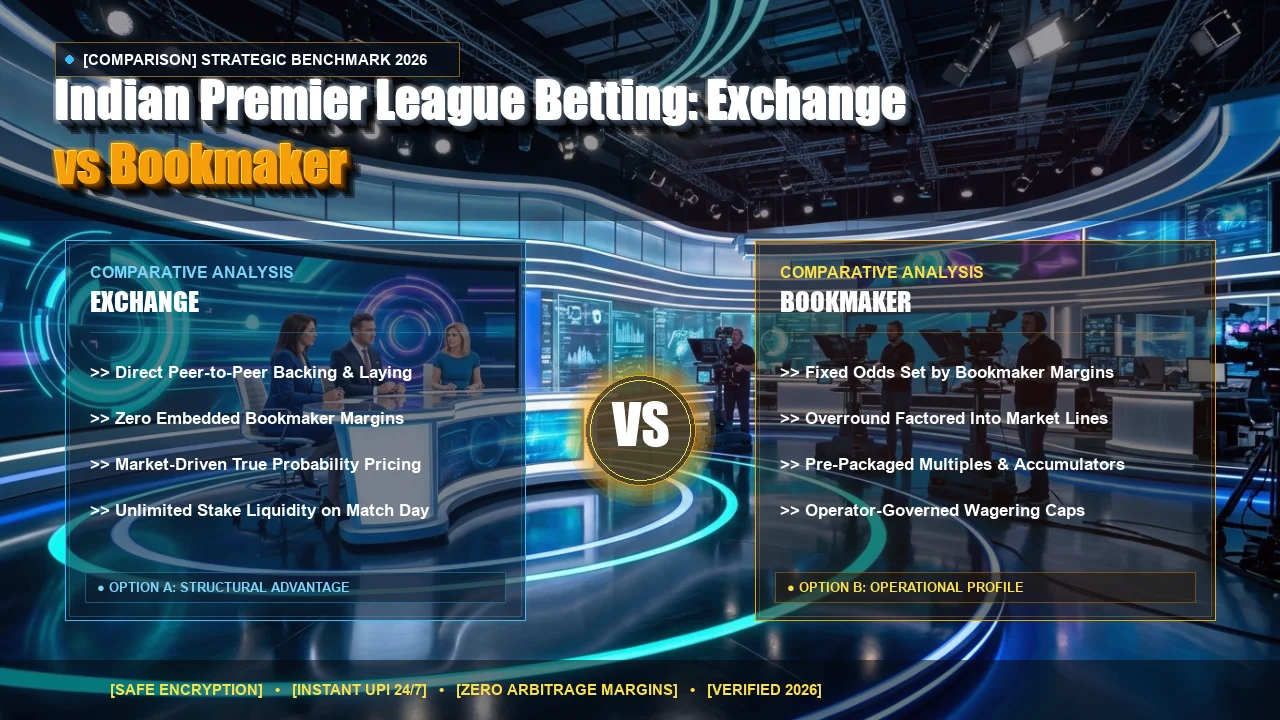
Traditional bookmakers operate on a fixed-odds model: they set prices and you take them. Betting exchanges flip this dynamic. On an exchange, you can back (bet for) or lay (bet against) an outcome, and the exchange matches you with another user. The exchange takes a commission on net winnings, typically 2-5%, but the odds are set by the market, not the house. This means the margin is often much lower—sometimes as low as 1-2% on major markets.
For IPL cricket, exchanges can offer superior value because the margin is compressed by competition among traders. However, liquidity is key. A high-profile match like the IPL final will have deep markets, but a group-stage game between less popular teams might have thin liquidity, leading to wider spreads. Understanding IPL Betting dynamics in the final overs is crucial here, as liquidity often spikes during tense finishes, allowing sharper odds. If you're used to fixed-odds bookmakers, transitioning to an exchange requires a shift in mindset: you're now a market maker, not just a price taker.
Commission structures vary. Some exchanges charge commission only on net winnings per market, while others charge per bet. Always factor commission into your effective odds. For example, if you back at 2.00 and win, but pay 5% commission on the profit, your effective odds are 1.95. That's a significant haircut. On the other hand, laying at 2.00 means you're risking 1.00 to win 1.00, but if you lose, you pay the liability; if you win, you receive the backer's stake minus commission. The mathematics of laying is more complex but offers flexibility for hedging and trading.
Numerical Deep Dive: Stake, Payout, and Margin Scenarios
Let's put numbers to work. The table below illustrates how bookmaker margin affects payouts across different stake sizes and odds. We'll compare a fair market (0% margin) with a typical bookmaker margin (5%) and a high-margin market (10%). Assume you stake ₹10,000 on a single outcome with true probability of 50% (fair decimal odds 2.00).
| Market Type | Offered Odds | Implied Probability | Stake (₹) | Payout if Win (₹) | Profit if Win (₹) |
|---|---|---|---|---|---|
| Fair (0% margin) | 2.00 | 50.00% | 10,000 | 20,000 | 10,000 |
| Low margin (5%) | 1.90 | 52.63% | 10,000 | 19,000 | 9,000 |
| High margin (10%) | 1.80 | 55.56% | 10,000 | 18,000 | 8,000 |
As you can see, the margin directly reduces your potential profit. In the high-margin scenario, you're sacrificing ₹2,000 compared to a fair market. Over 100 bets, that's ₹200,000—a massive sum. This is why comparing margins across bookmakers is essential. A platform that consistently offers 3% margins instead of 8% can dramatically improve your long-term ROI.
But margin isn't the only factor. Market efficiency and your ability to predict outcomes matter more. If you have a genuine edge, even a high-margin bookmaker can be profitable. However, for recreational bettors, minimising margin is one of the few controllable variables. It's also why understanding the mechanics behind IPL Betting opening partnership markets can reveal value that others miss, as these niche markets often carry higher margins that can be exploited with specialised knowledge.
Market Liquidity and Price Fluctuations
Liquidity refers to the volume of money available to be matched at a given price. In fixed-odds betting, liquidity is less visible because the bookmaker absorbs your stake. But on exchanges, liquidity is king. A liquid market allows you to get on at the desired price without moving the odds. In IPL cricket, liquidity is highest on the main match winner market, especially during the toss and early overs. As the match progresses, liquidity can dry up, leading to wider spreads and higher effective margins.
Price fluctuations are driven by new information: team news, weather, pitch conditions, and in-play events. Bookmakers adjust their odds to balance their book and manage risk. If a flood of money comes in on one team, the bookmaker will shorten their odds and lengthen the other side to attract opposing bets. This is why you often see odds move minutes before the start. Understanding these movements can be an edge if you're quick to react. However, it's important to remember that IPL betting legal India requires you to use licensed operators and adhere to responsible practices, so always prioritise platforms that are transparent about their odds movements and margin calculations.
On exchanges, price fluctuations are purely supply and demand. If you spot a discrepancy between a bookmaker's price and the exchange price, you can arbitrage. But such opportunities are rare and fleeting. More practically, you can use exchange prices as a benchmark for fair value. If a bookmaker offers significantly worse odds than the exchange, you know you're paying over the odds.
Commission, Taxes, and the True Cost of Betting
Beyond margin, there are other costs: exchange commission, betting taxes, and sometimes withdrawal fees. In India, the legal landscape for online betting is evolving. While skill-based games are permitted, games of chance are restricted in many states. IPL betting legal India is a grey area, but offshore operators like Mahadev Book operate under international licenses. It's crucial to understand the tax implications: winnings may be subject to TDS (Tax Deducted at Source) under Indian law. Always consult a tax professional.
Exchange commission, as mentioned, typically ranges from 2% to 5% on net winnings. If you're a high-volume bettor, even a 2% commission can eat into your profits. Some exchanges offer discounted commission for frequent users. When comparing bookmakers and exchanges, always calculate the effective odds after commission and taxes. A bookmaker offering 2.00 with no commission might be better than an exchange offering 2.05 with 5% commission on winnings.
Another hidden cost is the "each-way" or "place" market margin. In cricket, place markets (e.g., top two finish) often have higher margins because they are less liquid. Similarly, novelty markets like "man of the match" can have margins exceeding 15%. These are fun but expensive. For serious bettors, sticking to main markets with low margins is advisable. And always verify IPL betting app safety by checking for encryption, licensing, and user reviews before depositing funds. The IPL Betting auction slots market is a prime example where margin can be high due to uncertainty, but informed analysis can uncover value.
Putting It All Together: A Framework for Margin-Aware Betting
To consistently profit from IPL betting, you need to integrate margin analysis into your workflow. Here's a step-by-step checklist:
- Calculate the overround: For any market, sum the implied probabilities of all outcomes. If the total is above 105%, the market is expensive.
- Compare across bookmakers: Use odds comparison sites or manually check multiple platforms. A difference of 0.05 in decimal odds can translate to 2-3% in margin.
- Estimate true probabilities: Use your own models, statistical analysis, or expert insights. Compare your estimate to the market's implied probability (net of margin).
- Factor in commission and taxes: Adjust your expected value accordingly.
- Focus on liquid markets: Main match winner, top batsman, and total runs markets typically have the lowest margins.
- Shop for value: Don't be loyal to one bookmaker. The best price for a given outcome can vary significantly.
Remember, margin is not the enemy—it's a cost of doing business. The key is to minimise it while maximising your edge. By applying the principles of IPL betting rules and odds explained, you can turn the mathematics from a disadvantage into a competitive advantage. Whether you're betting on the final overs or the opening partnership, a deep understanding of margin will make you a sharper, more disciplined bettor.
Frequently Asked Questions
What is a typical bookmaker margin in IPL betting?
For major IPL markets like match winner, margins typically range from 4% to 8%, depending on the bookmaker and the match's popularity. Niche markets can exceed 10%.
How do I calculate the margin from odds?
Convert each outcome's decimal odds to implied probability (1/decimal odds), sum them, and subtract 100%. The result is the margin percentage.
Is betting on IPL legal in India?
The legality is complex and varies by state. Offshore operators like Mahadev Book operate under international licenses. Always check local laws and use licensed, secure platforms.
What is the difference between back and lay betting?
Backing is betting on an outcome to win; laying is betting against an outcome. Laying is only available on exchanges and involves risking liability to win the backer's stake.
How can I reduce the impact of margin on my bets?
Compare odds across multiple bookmakers, focus on low-margin markets, and use exchanges for better prices. Always factor in commission and taxes.
Disclaimer: This article is for educational purposes only. Betting involves risk; never bet more than you can afford to lose. Ensure you comply with local regulations and practice responsible gaming.
Official Regulatory & Industry References
Mahadev Book adheres to industry compliance, fair play principles, and statutory regulatory standards: