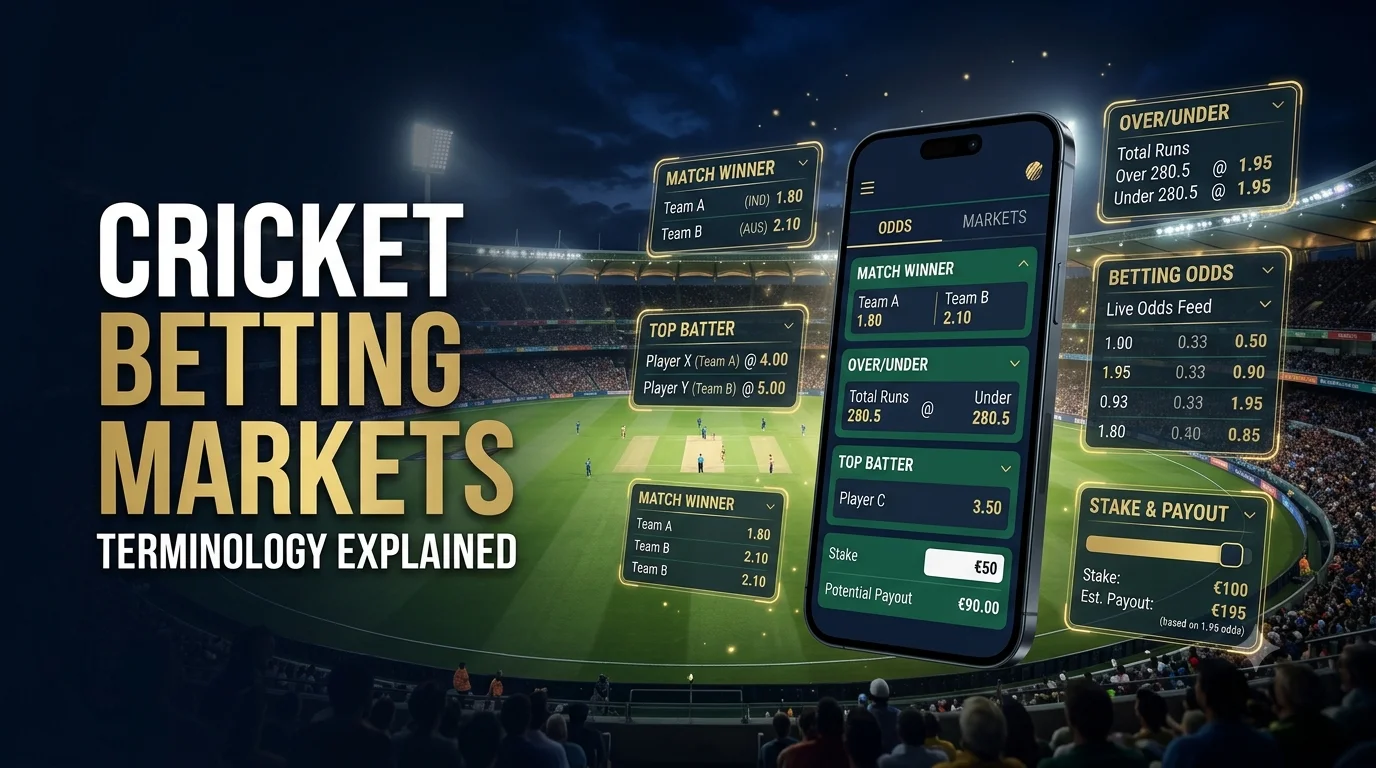
Cricket betting markets are categories of wagers based on specific outcomes in a cricket match or tournament. They may concern which team wins, how many runs are scored, which batter performs best, or what happens during a particular innings or over. Each market has its own terminology, odds, and settlement conditions.
For readers exploring cricket betting online, understanding these terms is essential to interpreting the information displayed on sports wagering platforms. Expressions such as match winner, over/under, top batter, run line, and in-play market describe different sporting outcomes rather than interchangeable ways of predicting the same result.
Cricket also has distinctive rules that influence betting markets. Test matches can end in draws, limited-overs matches may be shortened by rain, and tied contests can involve special result procedures.
This guide explains the main cricket betting markets, common terminology, odds formats, payout calculations, live markets, settlement rules, and frequently misunderstood expressions. It uses hypothetical examples to make the concepts easier to understand while recognising that real-money gambling involves financial risk.
A cricket betting market is a category of wagers concerning a defined cricket outcome, such as the match winner, total runs, or highest wicket-taker. Each market contains selections with quoted odds. Common terms include stake, payout, over/under, in-play, and void bet. Understanding the market definition and settlement rules is essential because different wagers can produce different results in the same match.
What Is a Cricket Betting Market?
A cricket betting market is a defined set of possible outcomes associated with a match, innings, player, or tournament.
For example, a match-winner market concerns the winning team, while a top-batter market concerns an individual scoring achievement.
A single cricket match may have numerous market categories. However, each market must be understood separately because its conditions and settlement criteria can differ.
Market vs Selection: What Is the Difference?
The market describes the question being asked.
The selection identifies one possible answer to that question.
For example:
-
Market: Match Winner
-
Selection A: Team A
-
Selection B: Team B
A different market might ask whether a team scores more or fewer than a specified number of runs.
This distinction is particularly important because selecting a team to win does not mean predicting its total runs or individual player performances.
Why Are Market Definitions Important?
Market definitions determine exactly what must happen for a wager to be successful.
They also explain how unusual circumstances are treated, including ties, abandoned matches, shortened innings, and player withdrawals.
A clear market description should identify the relevant event, outcome, and applicable settlement conditions.
Common Cricket Betting Markets Explained
Cricket markets can be grouped into match-result, scoring, player-performance, and tournament categories.
The specific markets offered by cricket betting sites vary according to the operator, competition, and match format.
1. Match Winner Market
The match-winner market concerns which team wins a cricket contest.
In a hypothetical India versus Australia match, the selections might be India and Australia.
However, the number of possible outcomes depends on the format and market definition.
Test cricket can end in a draw, while limited-overs competitions may use tie-breaking procedures.
A two-way winner market and a three-way result market should not be assumed to have identical settlement conditions.
2. Total Runs Market
A total-runs market concerns the number of runs scored by a team, innings, or match.
These markets commonly use an over/under structure.
For example, a hypothetical market may display:
Team Total Runs: 175.5
The two selections are:
-
Over 175.5 runs
-
Under 175.5 runs
Because cricket scores use whole numbers, the half-run threshold avoids an exact tie with the quoted line.
3. Top Batter Market
A top-batter market concerns which player scores the most runs within a defined group.
The market may refer to one team or the entire match.
For example, the highest-scoring player in Team A's innings might be the relevant outcome.
The treatment of tied scores, players who do not bat, and shortened matches depends on the published rules.
4. Top Bowler Market
A top-bowler market generally concerns the player who takes the most wickets.
This market differs from predicting the match winner because a bowler can perform well even when their team loses.
Some markets may apply special rules when multiple players take the same number of wickets.
5. Innings Runs Market
An innings-runs market concerns the score recorded during a particular innings.
It may involve a specified total, range, or over/under threshold.
The market's outcome depends on its precise definition and the relevant innings.
6. Tournament Winner Market
Tournament-winner markets concern the team that ultimately wins a competition.
Unlike single-match markets, these outcomes may remain unresolved until the tournament concludes.
Examples of competitions associated with cricket markets include the Indian Premier League and international tournaments.
Comparison of Major Cricket Betting Markets
|
Market |
What it measures |
Example outcome |
|---|---|---|
|
Match Winner |
Winning team |
Team A wins |
|
Total Runs |
Runs above or below a threshold |
Over 175.5 runs |
|
Top Batter |
Highest run scorer |
Player A |
|
Top Bowler |
Highest wicket-taker |
Player B |
|
Innings Runs |
Score in a defined innings |
Under 250.5 runs |
|
Over Runs |
Runs scored in a specified over |
Over 8.5 runs |
|
Tournament Winner |
Competition champion |
Team C wins |
All examples are illustrative rather than current market offerings.
Cricket Betting Terminology: Essential Words and Definitions
Understanding betting terminology helps distinguish sporting outcomes from financial calculations.
A cricket betting website may use some or all of these expressions, although individual operators can define certain terms differently.
Bookmaker
A bookmaker is an operator that offers betting markets and quotes odds on possible outcomes.
The bookmaker determines the prices it offers and applies settlement rules to accepted wagers.
Sportsbook
A sportsbook is a service offering wagering markets on sporting events.
The term may refer to an online platform or a physical betting operation.
Odds
Odds are numerical prices that determine potential returns relative to the amount staked.
They also allow the implied probability of an outcome to be calculated.
Stake
The stake is the amount of money risked on a wager.
For example, a hypothetical ₹100 wager has a stake of ₹100.
Payout
The payout is the total amount returned following a successful wager, generally including the original stake.
Net Profit
Net profit is the amount remaining after the original stake is subtracted from the total payout.
For example, a successful ₹100 wager at decimal odds of 2.50 would return ₹250, producing ₹150 in net profit.
Selection
A selection is a particular outcome chosen within a market.
For example, Over 175.5 Runs is a selection within a total-runs market.
Settlement
Settlement is the process of determining a wager's result and calculating the corresponding financial outcome.
It depends on the official sporting result and the applicable market conditions.
Void Bet
A void bet is a wager cancelled under specified conditions.
The original stake is generally returned, although the treatment of void selections within combined wagers can differ.
Bookmaker Margin
The bookmaker margin is the pricing advantage incorporated into the odds offered across a market.
It is often discussed using the term overround.
Understanding Cricket Betting Odds and Their Terminology
Cricket betting odds determine the potential return associated with a selection.
Two common formats are decimal and fractional odds.
Both represent the same underlying relationship between stake and potential payout.
Decimal Odds
Decimal odds are expressed as numbers such as 1.50, 2.00, or 3.25.
They represent the total payout multiplier.
The formula is:
For example, a hypothetical ₹100 stake at decimal odds of 2.50 would produce a total payout of ₹250 if successful.
Fractional Odds
Fractional odds express potential profit relative to the stake.
They are written as ratios such as 1/2, 3/2, and 5/1.
For example, fractional odds of 3/2 mean three units of potential profit for every two units staked.
American Odds
American odds use positive and negative numbers.
Positive odds indicate potential profit on a standard stake of 100 units.
Negative odds indicate the stake required to generate 100 units of potential profit.
For example, +150 is mathematically equivalent to decimal odds of 2.50.
Odds Format Comparison
|
Decimal odds |
Fractional odds |
American odds |
Implied probability |
|---|---|---|---|
|
1.50 |
1/2 |
-200 |
66.67% |
|
1.80 |
4/5 |
-125 |
55.56% |
|
2.00 |
1/1 |
+100 |
50% |
|
2.50 |
3/2 |
+150 |
40% |
|
3.00 |
2/1 |
+200 |
33.33% |
|
4.00 |
3/1 |
+300 |
25% |
The values are mathematical equivalents, not prices quoted for a real cricket event.
What Does Over/Under Mean in Cricket Betting?
Over/under is a market structure involving a numerical threshold.
In cricket, the threshold may concern runs, wickets, or another measurable statistic.
For example, a total-runs market with a line of 180.5 distinguishes between scores of 181 or more and scores of 180 or fewer.
Why Do Markets Use Half-Run Lines?
Half-run lines prevent a cricket score from finishing exactly on the stated threshold.
Since runs are recorded as whole numbers, a score cannot equal 180.5.
This creates two distinct outcomes.
What Is a Run Line?
A run line is a numerical adjustment or threshold associated with a scoring market.
The exact meaning varies by operator and market type.
A run line should not automatically be treated as equivalent to a conventional match-winner market.
What Is a Handicap Market in Cricket?
A handicap market applies a numerical adjustment to one or more teams' scores or results for settlement purposes.
Its purpose is to create a separate market outcome from the straightforward match result.
For example, a hypothetical run-handicap market might evaluate Team A's score after subtracting a specified number of runs.
The outcome would depend on the adjusted scores under the published rules.
Handicap vs Match Winner
A match-winner market concerns the actual winning team.
A handicap market concerns the result after a defined adjustment.
Therefore, the team winning the cricket match may not necessarily be the successful selection in a handicap market.
Different operators may use different handicap conventions.
What Is an In-Play Cricket Betting Market?
An in-play market is offered after a cricket match has started.
It may also be called a live betting market.
People researching online cricket gambling may encounter live prices displayed alongside changing match statistics.
How Do In-Play Odds Change?
Live odds may change in response to:
-
Wickets falling
-
Boundaries being scored
-
Changes in required run rate
-
Batting partnerships
-
Weather interruptions
-
Player injuries
-
Market activity
For example, a team chasing a target may be priced differently after losing several wickets.
However, quoted odds also reflect the bookmaker's pricing decisions and are not guaranteed predictions.
What Is a Suspended Market?
A suspended market is temporarily unavailable for new wagers.
Suspensions may occur during important match developments, interruptions, or market reviews.
A suspended market is not necessarily cancelled.
What Is an Odds Change?
An odds change occurs when the quoted price of a selection is revised.
The potential payout calculated using the new odds differs from the payout calculated using the previous price.
Live markets may change rapidly, and broadcast coverage can be delayed relative to events occurring at the venue.
Cricket Betting Terms Related to Match Formats
Cricket format affects how betting markets are defined and settled.
The main international formats are Test cricket, One Day Internationals, and T20 cricket.
Test Cricket
Test matches are scheduled for up to five days, and each team can generally bat twice.
A Test match can end in a win, loss, draw, or tie.
Because draws are possible, some Test match result markets contain three selections.
One Day International Cricket
ODIs generally involve a maximum of 50 overs per team.
Common market categories concern match winners, innings totals, and individual performances.
Weather interruptions can affect the number of overs played and the target required.
T20 Cricket
T20 cricket generally involves a maximum of 20 overs per team.
Its shorter duration creates a greater emphasis on rapid scoring and individual overs.
T20-related markets often concern innings totals, match results, and player performances.
Why Does the Format Matter?
A market involving the first innings of a Test match is structurally different from a market involving a T20 innings.
Likewise, draw-related terminology may be relevant to Test cricket but not to most limited-overs result markets.
Understanding the format prevents confusion about possible outcomes.
Cricket Betting Terms Related to IPL Matches
The Indian Premier League is a professional T20 competition.
IPL-related markets use many of the same terms found in international T20 cricket.
Powerplay
A powerplay is a period during which fielding restrictions apply.
In a standard T20 innings, the first six overs form the powerplay, subject to applicable match conditions.
Markets may concern runs or other events during this period.
Death Overs
Death overs generally refer to the final overs of a limited-overs innings.
The term is descriptive rather than a universally fixed market definition.
Some markets may use a precisely defined group of overs.
Top Run Scorer
A top-run-scorer market concerns the player recording the highest number of runs within the defined scope.
It is not equivalent to predicting which team wins.
Most Wickets
A most-wickets market concerns the player taking the greatest number of wickets.
Settlement may depend on rules governing ties and player participation.
What Is an Accumulator in Cricket Betting?
An accumulator combines multiple selections into a single wager.
The combined outcome generally requires every included selection to succeed, subject to the applicable rules.
Accumulator odds are typically calculated by multiplying the decimal odds of the selections.
For example, two hypothetical selections priced at 2.00 and 1.50 produce combined decimal odds of 3.00.
However, adding selections generally reduces the probability that all required outcomes will occur.
What Happens if One Selection Is Void?
A void selection may be removed from an accumulator calculation, with the remaining selections determining the result.
The exact treatment depends on the operator's rules.
Why Are Accumulators Risky?
An accumulator may display a large potential payout, but it generally requires multiple outcomes to occur successfully.
One unsuccessful selection can cause the entire combined wager to lose.
The larger potential payout should not be confused with a higher likelihood of success.
Cricket Betting Settlement Terminology
Settlement terminology describes how wagers are resolved after sporting events occur.
These terms are especially important when matches are interrupted or results are unusual.
Win
A winning wager is one whose selection satisfies the market's conditions.
The payout is calculated using the accepted odds and stake, subject to applicable rules.
Loss
A losing wager is one whose selection does not satisfy the market conditions.
The stake is generally lost.
Void
A void wager is cancelled under specified conditions.
The original stake is generally returned.
Push
A push occurs when a market result exactly matches a numerical line and the applicable rules provide for the stake to be returned.
For example, an integer total-runs line may permit a push, depending on the market structure.
Dead Heat
A dead heat occurs when two or more selections tie in a market that requires ranking.
Some operators apply special dead-heat settlement calculations.
The precise treatment depends on the published rules.
Abandoned Match
An abandoned match is one that cannot be completed or produce a result under the relevant playing conditions.
Betting settlement does not necessarily follow the same outcome across every market.
How Do Rain Interruptions Affect Cricket Betting Markets?
Rain can shorten a match, interrupt an innings, or prevent a result.
In limited-overs cricket, the Duckworth–Lewis–Stern method may be used to revise targets after certain interruptions.
However, the official sporting result and betting-market settlement are separate questions.
Match Winner Markets
A match-winner market may remain valid when an official result is declared and the market's conditions are satisfied.
Total Runs Markets
A total-runs market may be void if the innings does not meet specified minimum-over requirements.
Player Markets
Player-performance markets may have separate rules concerning shortened matches, substitutions, and non-participation.
These differences demonstrate why market definitions matter.
How to Read a Cricket Betting Market Description
People searching for information about an online bet in cricket may encounter market descriptions containing several pieces of information.
A useful way to interpret such descriptions is to identify the sporting event, market category, selection, odds, and settlement conditions.
Consider this hypothetical example:
Event: Team A vs Team B Market: Team A Total Runs Selection: Over 175.5 Decimal Odds: 1.90
This describes a particular innings-scoring outcome.
It does not predict the final match winner.
The quoted odds indicate the potential payout multiplier if the selection succeeds under the applicable rules.
What Should Readers Check in a Market Description?
The essential questions are:
-
Which match or tournament does the market concern?
-
What specific outcome is being measured?
-
Which innings, team, or player is included?
-
What do the quoted odds represent?
-
How are ties, interruptions, or incomplete matches handled?
These questions help clarify the market's meaning without assuming that similarly named markets operate identically.
Cricket Betting Website Terminology in India
Readers researching a sportsbook india may encounter terms involving account access, balances, transaction histories, and market displays.
These are distinct from cricket-specific market terms.
For example, a betting account balance describes funds recorded by an operator, while a market selection describes a sporting outcome.
Likewise, a withdrawal request concerns a financial transaction rather than the result of a cricket match.
Operators may use different procedures, terminology, and settlement policies.
Website accessibility alone does not establish an operator's licensing, security, or legal availability in a particular jurisdiction.
Common Mistakes When Understanding Cricket Betting Terminology
Confusion about terminology can lead to incorrect assumptions about markets and potential financial outcomes.
Confusing a Market With a Selection
The market describes the question, while the selection represents one possible answer.
For example, Match Winner is a market; Team A is a selection.
Confusing Payout With Profit
Decimal odds generally include the original stake in the payout.
A successful hypothetical ₹100 wager at 2.50 returns ₹250 in total, but only ₹150 is net profit.
Assuming Low Odds Guarantee Success
Lower odds generally represent a higher implied probability.
They do not guarantee that the corresponding sporting result will occur.
Ignoring Settlement Rules
Rain interruptions, tied scores, and abandoned matches may affect different markets in different ways.
Assuming All Platforms Use Identical Terms
A term may have a general industry meaning while still being subject to operator-specific definitions.
Reading the market conditions is therefore important.
Responsible Gambling and Financial Risks
Cricket betting involves risking money on uncertain outcomes.
Understanding the terminology does not eliminate the possibility of losing a stake.
What Is Chasing Losses?
Chasing losses means continuing to gamble, often with larger stakes, in an attempt to recover money already lost.
Previous losses do not increase the likelihood of future success.
Why Is Gambling Not a Reliable Income Source?
Cricket results remain unpredictable, and bookmakers generally incorporate margins into their prices.
A successful wager does not establish that future wagers will be profitable.
Responsible Gambling Principles
Important considerations include:
-
Follow applicable age requirements and gambling restrictions.
-
Never risk money needed for essential expenses.
-
Avoid borrowing money to gamble.
-
Do not increase stakes to recover losses.
-
Recognise signs of compulsive gambling.
-
Seek professional support if gambling begins affecting finances or wellbeing.
The only way to eliminate the financial risk of gambling is not to place a wager.
Frequently Asked Questions About Cricket Betting Markets
1. What is a cricket betting market?
A cricket betting market is a defined category of wagers concerning a particular sporting outcome. Examples include match winners, total runs, and top batters. Each market contains one or more selections and has its own settlement conditions. Different markets associated with the same match can produce different results.
2. What does market mean in cricket betting online?
In cricket betting online, a market identifies the specific event or statistic being predicted. For example, Total Runs describes a scoring market, while Match Winner concerns the final result. The market is different from the selection, which identifies a particular outcome within that category.
3. What is the difference between odds and markets?
A market defines what is being predicted, while odds determine the potential payout associated with a selection. For example, a match-winner market might contain two teams with different quoted odds. The market describes the sporting question; the odds describe the financial price.
4. What does over/under mean in cricket betting?
Over/under refers to whether a specified statistic finishes above or below a numerical threshold. In cricket, it commonly concerns total runs. For example, over 175.5 runs requires a score of at least 176, while under 175.5 runs covers scores of 175 or fewer.
5. What is a match-winner market?
A match-winner market concerns which team wins a cricket contest. Depending on the cricket format and market rules, the selections may include two teams or an additional draw outcome. The official sporting result and the operator's settlement conditions determine the wager's outcome.
6. What is a top-batter market?
A top-batter market concerns which player scores the most runs within a defined team, match, or other specified group. It is separate from predicting the winning team. Tied scores, player withdrawals, and shortened matches may be subject to additional settlement conditions.
7. What does void mean in cricket betting?
Void means a wager has been cancelled under specified conditions. The original stake is generally returned. A market may be void because of an abandoned match, insufficient play, or another condition described in the rules. The treatment of void selections within accumulators can differ.
8. What is live cricket betting?
Live cricket betting involves markets offered after a match has started. Prices may change as runs are scored, wickets fall, or playing conditions change. These markets can also be suspended during significant events. Rapid price movements and broadcast delays introduce additional uncertainty.
9. What is a cricket betting accumulator?
A cricket betting accumulator combines multiple selections into one wager. All required selections generally must succeed for the accumulator to win, subject to the applicable rules. Combined odds can produce larger potential payouts, but the requirement for multiple successful outcomes also increases the risk of losing the stake.
10. Can understanding cricket betting terminology guarantee profits?
No. Understanding cricket betting terminology helps explain market definitions, odds, and settlement conditions, but it cannot guarantee profits. Cricket results remain uncertain, and bookmaker margins influence quoted prices. Knowledge of the terminology does not eliminate financial risk or make gambling a dependable source of income.
Understanding cricket betting markets and their terminology helps explain how sports wagering information is organised and interpreted.
A betting market identifies the sporting outcome being considered, while a selection represents one possible result. Odds determine potential payouts, and settlement rules explain how wagers are resolved after a match or relevant event.
For readers exploring cricket betting online, important terms include match winner, total runs, top batter, over/under, stake, payout, void bet, and in-play market. Cricket formats and match interruptions can also influence how these concepts apply.
Learning these definitions improves understanding but does not reduce the inherent uncertainty of cricket results or guarantee financial returns.
Readers researching cricket-related betting terminology may encounter platforms such as Mahadev Book. This reference does not verify the platform's licensing, security, or legal availability. Any such claims should be independently checked, and the risks associated with gambling should always be recognised.