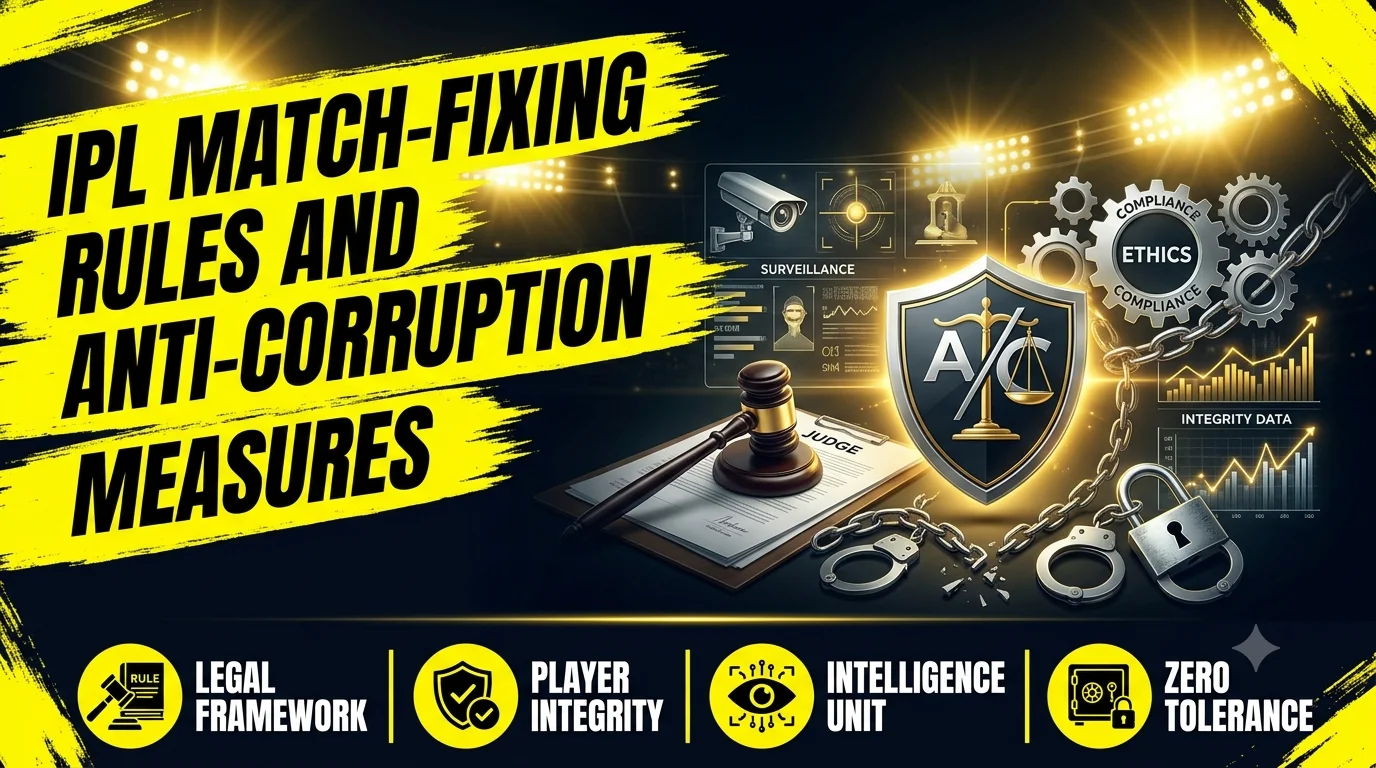
Match-fixing is one of the most serious threats to the integrity of professional cricket. In the Indian Premier League (IPL), where international players, franchise owners, officials, and millions of spectators participate in a high-profile sporting competition, preventing corruption is essential for maintaining public confidence.
The Board of Control for Cricket in India (BCCI) operates an anti-corruption framework designed to identify suspicious activity, educate participants, investigate potential violations, and protect the fairness of IPL matches. These measures address match-fixing, spot-fixing, improper disclosure of inside information, and prohibited betting-related conduct.
The relationship between cricket corruption and ipl betting is particularly important because illegal attempts to manipulate sporting outcomes may be motivated by financial interests connected to wagering markets.
However, ordinary betting activity and match-fixing are not the same thing. Match-fixing involves deliberately manipulating sporting events, while betting involves placing a wager on an uncertain outcome, subject to applicable laws.
This guide explains IPL match-fixing rules, anti-corruption responsibilities, investigation procedures, possible penalties, historical controversies, and the measures used to protect cricket integrity.
IPL match-fixing rules prohibit players, officials, and other covered participants from deliberately manipulating matches, engaging in prohibited betting, misusing inside information, or failing to report corrupt approaches. The BCCI's Anti-Corruption Unit (ACU) oversees prevention, education, intelligence gathering, and investigations. Violations can lead to suspensions, lengthy bans, or other disciplinary action, depending on the applicable rules and findings.
What Is Match-Fixing in the IPL?
IPL match-fixing occurs when a person deliberately attempts to influence the outcome or conduct of a cricket match through dishonest arrangements rather than legitimate sporting competition.
Such manipulation may involve players, officials, intermediaries, or other individuals seeking to influence particular events for an improper benefit.
The essential feature of match-fixing is intentional interference with the integrity of the contest.
For example, a corrupt arrangement to deliberately lose a match would represent a serious integrity violation. The same principle can apply to arrangements involving smaller events within a game.
Not every unexpected result, poor performance, or unusual tactical decision is evidence of corruption. Cricket naturally involves uncertainty, mistakes, and changing match conditions.
Investigators therefore need credible information and supporting evidence before concluding that misconduct occurred.
Match-fixing versus spot-fixing
Match-fixing and spot-fixing are related but distinct forms of corruption.
|
Factor |
Match-fixing |
Spot-fixing |
|---|---|---|
|
Main objective |
Manipulate a match result or broader contest |
Manipulate a particular event |
|
Scope |
Potentially affects the overall match |
Focuses on a specific incident |
|
Example |
Deliberately arranging a defeat |
Deliberately arranging a particular delivery |
|
Integrity impact |
Undermines the sporting result |
Undermines fair competition within the match |
|
Possible consequences |
Serious disciplinary sanctions |
Serious disciplinary sanctions |
Both forms of conduct are prohibited under cricket anti-corruption frameworks.
Spot-fixing is particularly concerning because an isolated event may not obviously change the final match result.
Nevertheless, intentionally manipulating any part of a professional contest can damage confidence in the sport.
Who Regulates Match-Fixing and Corruption in the IPL?
The BCCI is responsible for administering the IPL's domestic cricket governance framework, including anti-corruption arrangements.
Its Anti-Corruption Unit plays a central role in protecting tournaments from corrupt approaches and prohibited conduct.
The International Cricket Council (ICC) also maintains an international anti-corruption framework. Although the ICC and BCCI operate within related cricket governance systems, their responsibilities and jurisdiction are not identical.
Role of the BCCI Anti-Corruption Unit
The BCCI ACU works to prevent and investigate corruption associated with cricket competitions under its jurisdiction.
Its responsibilities generally include:
-
Educating players and support personnel about anti-corruption obligations.
-
Receiving reports about suspicious approaches.
-
Gathering and assessing integrity-related intelligence.
-
Investigating potential violations.
-
Supporting disciplinary procedures.
-
Coordinating with relevant authorities where appropriate.
Prevention is a major part of anti-corruption work.
Rather than relying only on punishment after an incident, cricket authorities seek to identify risks before they develop into serious violations.
Role of the ICC
The ICC maintains an Anti-Corruption Code for international cricket and certain other competitions within its jurisdiction.
Its broader integrity work includes education, investigations, information sharing, and disciplinary enforcement.
The ICC's framework helps establish common expectations across international cricket, particularly because professional players frequently participate in multiple competitions.
However, the precise code governing an individual IPL incident depends on the relevant jurisdiction and applicable regulations.
Role of law enforcement
Cricket disciplinary proceedings and criminal investigations are separate processes.
A sporting authority may investigate whether someone violated cricket regulations, while police or other law-enforcement agencies may examine possible offenses under applicable legislation.
A disciplinary finding does not automatically establish criminal guilt.
Likewise, the absence of criminal charges does not necessarily prevent a sporting organization from taking disciplinary action under its own rules.
What Are the Main IPL Anti-Corruption Rules?
IPL participants covered by the applicable anti-corruption regulations must comply with restrictions designed to prevent improper influence over cricket matches.
These rules address both direct manipulation and conduct that creates opportunities for corruption.
1. Prohibition on match manipulation
Covered participants must not deliberately manipulate a match or any aspect of its conduct for an improper purpose.
This includes corrupt agreements intended to affect results or particular match events.
The prohibition applies even when an attempted arrangement does not ultimately succeed, subject to the wording of the governing code.
2. Restrictions on betting by participants
Players and other covered individuals are subject to strict betting restrictions under cricket anti-corruption regulations.
These restrictions are intended to prevent conflicts of interest and reduce opportunities for participants to profit improperly from information or influence connected to matches.
The rules governing participants are different from the laws that may apply to members of the public.
3. Restrictions on inside information
Inside information refers to non-public information obtained through a person's involvement in cricket that could be relevant to betting.
Examples may include confidential team selection decisions, injury information, or other sensitive sporting details not publicly available.
Improperly sharing such information for betting purposes can violate anti-corruption regulations.
4. Mandatory reporting of corrupt approaches
Covered participants may be required to report approaches involving proposed corruption or prohibited betting activity.
A person who receives an improper proposal should not assume that rejecting it ends their responsibilities.
Failure to report a relevant approach may itself constitute a disciplinary violation.
5. Cooperation with investigations
Anti-corruption investigations depend on accurate information and cooperation.
Covered participants may be required to provide relevant information, preserve evidence, and cooperate with authorized investigators.
Obstructing an investigation, concealing evidence, or providing misleading information can create additional disciplinary problems.
How Does the IPL Anti-Corruption System Work?
The IPL's anti-corruption framework combines preventive education, intelligence gathering, reporting procedures, investigations, and disciplinary enforcement.
These elements work together because no single measure can eliminate corruption risks.
Player education and awareness
Education helps players understand what constitutes a prohibited approach and how they should respond.
A participant may encounter suspicious behavior through social relationships, communications, or professional contacts.
Training emphasizes the importance of recognizing warning signs and reporting concerns promptly.
Education is especially relevant for younger players who may be unfamiliar with the risks associated with high-profile professional competitions.
Integrity monitoring
Anti-corruption authorities may assess information about unusual circumstances surrounding matches.
Suspicious betting-related patterns can sometimes provide investigative leads, but they do not independently establish that fixing occurred.
Legitimate betting markets can experience unusual movements for many reasons, including public team news, weather forecasts, and changes in expectations.
Any integrity concern requires further examination.
Confidential reporting
Reporting systems allow relevant information to reach investigators.
A player who receives a suspicious approach should use the reporting channels specified by the applicable anti-corruption authority.
The handling of information depends on the governing procedures and circumstances.
Investigations and disciplinary action
When credible concerns arise, authorized officials may investigate the alleged conduct.
The process can involve gathering communications, interviewing relevant individuals, reviewing records, and evaluating other available evidence.
If sufficient grounds exist, disciplinary proceedings may follow.
The outcome depends on the applicable regulations, evidence, procedural requirements, and findings.
What Happens When a Player Is Suspected of Match-Fixing?
An allegation of match-fixing does not automatically establish guilt.
Investigations must distinguish between credible evidence, misunderstandings, poor performance, and unsupported speculation.
A typical disciplinary process may involve several stages.
1. Suspicious activity or report
Information reaches anti-corruption authorities
2. Preliminary assessment
Investigators evaluate the credibility and relevance of the information
3. Formal investigation, if warranted
Evidence and relevant communications are examined
4. Disciplinary decision
The case may be dismissed or proceed under the governing code
5. Sanction or other outcome
Findings may result in penalties, subject to applicable procedures and appeal rights
The actual process may differ depending on the governing regulations and circumstances.
Can a player be suspended during an investigation?
Provisional suspension may be available under applicable disciplinary rules.
However, a provisional suspension should not be confused with a final finding of misconduct.
Its purpose and legal basis depend on the relevant code.
What evidence may investigators examine?
Investigators may consider communications, witness accounts, financial information obtained through appropriate processes, and other relevant material.
The admissibility and significance of evidence depend on the governing rules.
A suspicious performance alone is generally insufficient to establish deliberate manipulation.
What Are the Penalties for IPL Match-Fixing?
Match-fixing can result in serious sporting penalties.
Depending on the applicable anti-corruption code, the violation, and the circumstances, sanctions may include lengthy periods of ineligibility or lifetime bans.
Other integrity violations, including failures to report corrupt approaches, may carry different sanctions.
|
Type of violation |
Possible disciplinary consequence |
|---|---|
|
Deliberate match manipulation |
Lengthy ban or potentially lifetime ineligibility |
|
Spot-fixing |
Serious suspension or ban |
|
Prohibited participant betting |
Disciplinary suspension or other sanction |
|
Improper disclosure of inside information |
Sanctions under the applicable code |
|
Failure to report a corrupt approach |
Disciplinary action |
|
Obstruction of an investigation |
Additional or separate sanctions |
This table describes potential consequences, not fixed penalties for every case.
Sanctions depend on the specific code provisions, seriousness of the conduct, and relevant aggravating or mitigating factors.
Criminal penalties may also be possible where conduct violates applicable law, but these are separate from sporting sanctions.
Historical IPL Match-Fixing and Corruption Controversies
The IPL has experienced major integrity controversies that influenced public discussion about cricket governance.
Understanding these incidents helps explain why anti-corruption systems are important.
The 2013 IPL spot-fixing controversy
The 2013 IPL season became associated with a significant spot-fixing investigation involving Rajasthan Royals players.
The controversy attracted extensive public attention and raised questions about the vulnerability of professional cricket to corrupt approaches.
It also highlighted the distinction between allegations, criminal proceedings, and cricket disciplinary action.
Individual legal and disciplinary outcomes must be considered separately rather than assuming that everyone connected to an investigation was found guilty of the same conduct.
The Chennai Super Kings and Rajasthan Royals suspensions
Following investigations into betting-related misconduct and associated governance failures, Chennai Super Kings and Rajasthan Royals were suspended from participation in the IPL for two seasons.
The teams did not participate in the 2016 and 2017 IPL tournaments.
The episode demonstrated that integrity-related controversies can have consequences beyond individual players.
Franchises, administrators, and the reputation of the competition may also be affected.
Lessons from past controversies
Historical incidents underline several important principles.
First, anti-corruption responsibilities extend beyond actions that directly change the final match result.
Second, conflicts of interest and prohibited betting conduct can undermine trust in cricket administration.
Third, transparency, independent examination, and fair disciplinary procedures are essential for maintaining confidence.
Finally, a high-profile allegation should never be treated as proof without examining the actual findings.
How Is IPL Betting Different From Match-Fixing?
Betting and match-fixing are distinct activities, although corrupt arrangements may involve betting-related financial motives.
Betting generally involves placing a wager on an uncertain event. Match-fixing involves deliberately manipulating the event or its components.
For people researching indian premier league betting, this distinction is important.
A person placing a wager does not automatically participate in match-fixing. However, the legality of wagering depends on the applicable jurisdiction, and prohibited betting by cricket participants may violate sporting regulations.
Key differences
|
Aspect |
Betting |
Match-fixing |
|---|---|---|
|
Basic activity |
Wagering on an uncertain outcome |
Deliberately manipulating sporting conduct |
|
Effect on the match |
Does not inherently change the contest |
Intentionally compromises integrity |
|
Legal status |
Depends on jurisdiction and circumstances |
May violate sporting rules and applicable laws |
|
Cricket participant rules |
Often subject to strict prohibitions |
Prohibited |
|
Main concern |
Financial, legal, and consumer risks |
Corruption and sporting integrity |
Someone searching for information about how to bet on the ipl should not assume that the availability of an online service means it is legally authorized.
Similarly, betting-related information does not establish that any particular IPL match has been manipulated.
Why Are Betting Markets Relevant to Anti-Corruption Investigations?
Betting markets can become relevant to cricket integrity investigations because individuals involved in corruption may seek financial benefits from manipulated events.
However, market activity must be interpreted carefully.
Changes in betting prices can reflect legitimate information, differences in market liquidity, or ordinary changes in expectations.
An unusual market movement is therefore a potential investigative signal, not proof of wrongdoing.
For those researching ipl cricket betting, it is useful to understand that the existence of odds, betting markets, or unusual results does not establish a corrupt arrangement.
Why investigators need multiple sources of evidence
A reliable investigation may require independent evidence connecting suspicious conduct to an intentional agreement.
This can include credible communications, admissions, corroborating testimony, or other properly obtained records.
The evidentiary threshold depends on the governing disciplinary process.
Investigators must avoid confusing coincidence with deliberate manipulation.
How Do Anti-Corruption Measures Protect IPL Players?
Anti-corruption systems are designed not only to identify wrongdoing but also to protect players from improper pressure.
Professional athletes may encounter approaches from individuals who seek confidential information or attempt to establish inappropriate relationships.
Clear reporting obligations and education can help players recognize these risks.
Recognizing suspicious approaches
An approach may raise concerns when someone requests confidential team information, offers an improper benefit connected to match events, or asks a participant to conceal communications relevant to cricket integrity.
The appropriate response is to avoid participating and report the matter through authorized channels.
Protecting confidential information
Players and support personnel may possess information that is not publicly available.
Protecting that information reduces opportunities for improper use.
Routine conversations can become problematic when confidential sporting details are intentionally shared for prohibited purposes.
Supporting younger players
Young players entering professional cricket may be unfamiliar with the obligations imposed by anti-corruption codes.
Education, clear guidance, and access to reporting channels help them understand their responsibilities.
These safeguards are important because prevention is generally more effective than responding only after a violation occurs.
What Role Do Technology and Data Play in Cricket Integrity?
Technology can support anti-corruption work by helping investigators organize information and identify patterns that merit further examination.
Possible applications include statistical analysis, communication-record review where lawfully authorized, and assessments of betting-related intelligence.
However, technology cannot independently determine whether a player intentionally manipulated a match.
Statistical analysis
Cricket generates extensive performance data, including scoring rates, deliveries, wickets, and match conditions.
Analysts may examine unusual events in context.
A statistical anomaly can have an innocent explanation, so findings require careful interpretation.
Digital evidence
Electronic communications may become relevant when investigating alleged corrupt approaches.
Any collection and use of digital evidence must comply with applicable legal and procedural requirements.
Limits of automated detection
An automated system may identify patterns, but intent cannot reliably be established from statistical irregularities alone.
Human investigation, corroborating evidence, and procedural fairness remain essential.
How Can Cricket Fans Identify Reliable Match-Fixing Information?
Cricket fans should approach match-fixing claims with caution, particularly when allegations circulate through social media.
A surprising defeat, an unexpected batting collapse, or an unusual umpiring decision does not prove corruption.
Reliable information should distinguish between an allegation, an investigation, a disciplinary charge, and a final finding.
What to check before believing a claim
-
Identify whether the information comes from a recognized cricket authority or credible reporting.
-
Check whether the claim describes an allegation or an established finding.
-
Look for the date and context of the reported incident.
-
Avoid treating speculation about player performance as evidence.
-
Consider whether official disciplinary or legal proceedings have produced a documented outcome.
These steps reduce the risk of spreading unsupported accusations.
They also help protect players and officials from reputational harm caused by misinformation.
Are IPL Betting Applications Connected to Match-Fixing?
The existence of an online betting application does not establish a connection to match-fixing.
Applications may provide wagering-related services, but their legal status, operational practices, and consumer protections must be assessed independently.
People searching for an ipl betting application should distinguish platform-related information from the IPL's official anti-corruption framework.
Similarly, searches involving iplwin or iplwin in should not be interpreted as evidence that a particular website or service has any official relationship with the IPL, BCCI, or ICC.
No such relationship should be assumed without verification.
The BCCI's anti-corruption framework concerns the integrity of cricket competitions and the obligations of covered participants. It should not be confused with the licensing or regulation of third-party betting services.
Responsible Betting, Legal Awareness, and Cricket Integrity
Understanding cricket integrity also requires recognizing the financial and legal risks associated with wagering.
IPL betting is not legal in every jurisdiction, and applicable restrictions may depend on national, state, or local laws.
In India, gambling and online betting are subject to a complex legal framework. Users should verify current rules rather than relying on a website's availability or advertising.
Responsible participation includes observing age restrictions, avoiding unauthorized services, setting financial limits, and never treating betting as a guaranteed source of income.
Cricket statistics, match predictions, and betting odds cannot eliminate the possibility of financial loss.
Anyone who encounters suspected corruption should use appropriate reporting channels rather than attempting to profit from or independently investigate the suspected activity.
Frequently Asked Questions About IPL Match-Fixing
1. What are the IPL match-fixing rules?
IPL match-fixing rules prohibit covered participants from deliberately manipulating cricket matches or specific events within them. The applicable anti-corruption framework also addresses prohibited betting, misuse of inside information, failures to report corrupt approaches, and obstruction of investigations. Violations can lead to serious disciplinary consequences, including lengthy bans, depending on the governing code and findings.
2. Who investigates match-fixing in the IPL?
The BCCI Anti-Corruption Unit plays a central role in preventing and investigating corruption connected to competitions under its jurisdiction, including the IPL. Its work includes education, intelligence assessment, reporting, and investigations. Law-enforcement authorities may separately investigate conduct that potentially violates criminal law. The relevant jurisdiction depends on the circumstances.
3. What is the difference between match-fixing and spot-fixing?
Match-fixing generally involves manipulating the outcome or broader conduct of a match, while spot-fixing concerns deliberately manipulating a particular event within the contest. Both undermine fair competition. Spot-fixing does not necessarily determine the final result, but it remains a serious integrity violation because part of the sporting contest has been intentionally compromised.
4. Can IPL players bet on cricket matches?
Players and other individuals covered by cricket anti-corruption codes are subject to strict betting prohibitions. These restrictions are designed to prevent conflicts of interest, misuse of confidential information, and corruption risks. The exact scope depends on the governing regulations. Rules for professional cricket participants should not be confused with the laws applicable to members of the public.
5. What happens if an IPL player is found guilty of fixing?
A player found responsible for match-fixing may face a lengthy suspension or potentially a lifetime ban, depending on the applicable code and circumstances. Disciplinary proceedings consider the evidence and relevant regulations. Criminal consequences may also arise where applicable laws have been violated, but sporting sanctions and criminal penalties are determined through separate processes.
6. What is the BCCI Anti-Corruption Unit?
The BCCI Anti-Corruption Unit is responsible for important cricket-integrity functions, including preventive education, receiving suspicious-activity reports, intelligence gathering, and investigations. Its purpose is to help protect competitions from corruption. The unit's responsibilities operate within the BCCI's governance and disciplinary framework, alongside relevant cooperation with other authorities where appropriate.
7. Is every suspicious IPL match investigated?
Not every unusual match result establishes grounds for a formal corruption investigation. Cricket naturally produces unexpected outcomes and individual mistakes. Anti-corruption authorities assess the credibility and relevance of available information before deciding whether further investigation is warranted. Suspicion alone should not be treated as proof that players or officials engaged in misconduct.
8. Can betting patterns prove that an IPL match was fixed?
Betting patterns alone do not conclusively prove match-fixing. Unusual market activity can result from legitimate developments, including team announcements, weather conditions, and changing public expectations. Such patterns may provide investigative leads, but establishing corruption generally requires additional evidence connecting the activity to intentional manipulation or other prohibited conduct.
9. Why were Chennai Super Kings and Rajasthan Royals suspended?
Chennai Super Kings and Rajasthan Royals were suspended from IPL participation for the 2016 and 2017 seasons following disciplinary proceedings connected to the 2013 betting-related controversy. The suspensions highlighted the importance of governance and integrity responsibilities within franchise cricket. The underlying findings should be distinguished from broader allegations involving individual players and other parties.
10. How can someone report suspected IPL corruption?
A covered participant should report suspected corrupt approaches through the reporting channels established by the relevant cricket anti-corruption authority. Members of the public with credible information can seek appropriate official reporting routes. Reports should focus on factual information rather than speculation, and individuals should avoid making unsupported public accusations against players or officials.
11. Does IPL betting mean a match is fixed?
No. Betting activity and match-fixing are different concepts. Betting involves wagering on an uncertain outcome, while match-fixing involves intentionally manipulating sporting events. The presence of betting markets does not establish corruption. However, improper financial interests connected to betting can create integrity risks, which is why cricket authorities maintain strict rules for covered participants.
12. How does the IPL prevent match-fixing?
The IPL's anti-corruption framework uses education, reporting obligations, intelligence gathering, investigations, and disciplinary sanctions to reduce corruption risks. Players and other covered participants are expected to recognize and report suspicious approaches. These measures cannot guarantee that misconduct will never occur, but they provide mechanisms for prevention, detection, and accountability.
IPL match-fixing rules and anti-corruption measures are essential for maintaining the fairness, credibility, and reputation of the Indian Premier League. Through the BCCI's anti-corruption framework, players and other covered participants face clear responsibilities concerning match manipulation, prohibited betting, confidential information, and suspicious approaches.
The distinction between allegations and proven misconduct is equally important. Unexpected results and unusual betting patterns do not automatically demonstrate corruption. Reliable investigations require evidence, appropriate procedures, and fair disciplinary decisions.
For readers researching IPL betting, understanding these integrity safeguards provides valuable context, but it does not remove the legal or financial risks associated with wagering. Those exploring third-party services such as Mahadev Book should independently verify applicable laws, service legitimacy, and consumer protections. Protecting cricket integrity ultimately depends on responsible conduct, effective oversight, and informed participation across the sport.