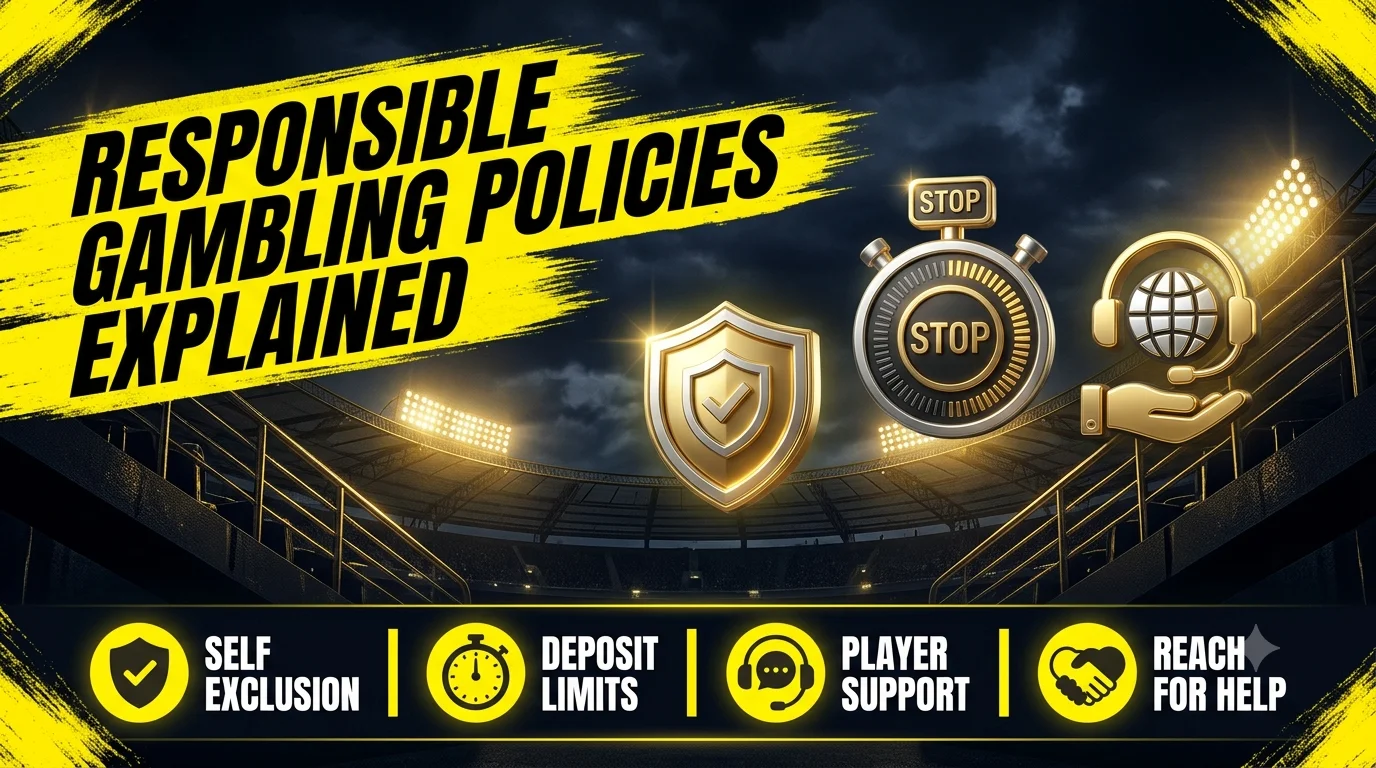
Responsible gambling policies are guidelines, safeguards, and procedures designed to minimize the risks associated with gambling activities. These policies help individuals understand financial risks, establish spending boundaries, recognize problematic gambling behavior, and access assistance when needed.
For people researching betting sites in india, understanding responsible gambling policies is essential. Online gambling involves financial uncertainty, and the legal status of gambling services can vary depending on applicable national and state regulations.
A comprehensive responsible gambling policy should explain age restrictions, identity verification, deposit limits, self-exclusion, account security, and support resources. These safeguards are intended to protect consumers and encourage informed decisions.
However, a website publishing a responsible gambling policy is not automatically licensed, legally authorized, or safe.
This guide explains how responsible gambling policies work, why they matter, what protective features consumers should look for, and how individuals in India can recognize gambling-related risks.
Responsible gambling policies are rules and protective measures designed to reduce gambling-related harm. They commonly include age verification, spending limits, self-exclusion, risk warnings, account security, and access to support services. Effective policies help individuals understand gambling risks, control participation, and seek assistance when gambling begins affecting their finances, relationships, or well-being.
What Are Responsible Gambling Policies?
Responsible gambling policies are formal guidelines that explain how gambling operators aim to protect users from potentially harmful gambling behavior.
These policies typically focus on preventing underage participation, reducing excessive spending, providing transparent information, and supporting people experiencing gambling-related difficulties.
A responsible gambling policy should do more than display a warning. It should describe practical tools, explain their limitations, and provide clear instructions for obtaining help.
Why Are Responsible Gambling Policies Important?
Gambling involves uncertain outcomes and the possibility of financial losses.
Without effective safeguards, individuals may develop harmful habits such as repeatedly increasing wagers, attempting to recover previous losses, or spending money intended for essential expenses.
Responsible gambling policies aim to address these risks through:
-
Financial protection: Encouraging spending boundaries and access to deposit restrictions.
-
Age verification: Preventing participation by individuals below the legally permitted age.
-
Self-exclusion: Allowing users to restrict access to gambling services.
-
Risk awareness: Explaining that gambling outcomes are uncertain.
-
Behavior monitoring: Identifying potentially harmful participation patterns where legally permitted.
-
Consumer support: Providing information about assistance and complaints procedures.
-
Account security: Protecting personal information and reducing unauthorized access.
Although these measures can reduce harm, no responsible gambling policy can eliminate gambling risks entirely.
Why Responsible Gambling Matters for Betting Sites in India
The growing availability of online services has made gambling-related information easier to access. Consumers researching betting websites in india should understand both the risks of gambling and the importance of verifying a website's legal status.
India has a complex legal framework involving national legislation, state-specific laws, and rules addressing online gaming.
The legal treatment of particular activities may depend on the type of game, monetary stakes, applicable legislation, and relevant judicial decisions.
Understanding Gambling Laws in India
India's gambling framework has historically included the Public Gambling Act, 1867, and various state-level laws.
More recent legislation addressing online gaming has introduced additional legal considerations.
Consequently, consumers should not assume that an online gambling platform is legally permitted simply because its website is accessible.
Before considering any gambling activity, individuals should determine:
-
Whether the activity is legally permitted in their jurisdiction.
-
Whether the operator has any required authorization.
-
Whether age and identity verification requirements apply.
-
Whether consumer protection procedures are documented.
-
Whether applicable financial and advertising restrictions are followed.
Legal requirements can change, making current authoritative information important.
Responsible Gambling and State-Level Regulations
Different Indian states have historically taken different approaches to gambling regulation.
For example, people researching rajasthan betting should consider the applicable legal framework in Rajasthan alongside national legislation.
A website based outside a particular state does not automatically have permission to offer gambling services to residents of that state.
Responsible participation begins with understanding whether the activity itself is lawful.
Essential Elements of a Responsible Gambling Policy
A meaningful responsible gambling policy should provide clear information about the protective measures available to consumers.
|
Policy feature |
Purpose |
What consumers should verify |
|---|---|---|
|
Age verification |
Prevent underage gambling |
Minimum age and identity checks |
|
Deposit limits |
Restrict deposited funds |
Available limits and enforcement |
|
Session reminders |
Increase time awareness |
Frequency and clarity |
|
Self-exclusion |
Restrict gambling access |
Duration and effectiveness |
|
Risk disclosures |
Explain potential losses |
Clear financial warnings |
|
Account protection |
Reduce unauthorized access |
Security and privacy measures |
|
Customer assistance |
Address account concerns |
Accessible support procedures |
|
Independent support |
Help people experiencing harm |
Relevant external resources |
These features should be evaluated individually. Their availability cannot be assumed for any particular website.
1. Age Verification and Eligibility Requirements
Age verification is a fundamental element of responsible gambling.
Operators providing lawful gambling services should establish procedures that prevent individuals below the applicable minimum age from participating.
Depending on legal requirements, verification may involve identity documents, date-of-birth confirmation, and other approved checks.
A responsible policy should explain eligibility requirements clearly.
Merely asking users to confirm that they are adults may not provide sufficient protection.
2. Deposit Limits and Spending Controls
Deposit limits restrict the amount of money users can add to a gambling account during a defined period.
Depending on the service, limits may be calculated daily, weekly, or monthly.
These controls are intended to reduce financial exposure and encourage users to consider affordability before depositing money.
However, deposit limits have limitations.
A person may still experience financial harm while remaining within a predetermined limit.
For individuals struggling to control gambling, stopping participation may be more appropriate than adjusting spending limits.
3. Time Management and Session Reminders
Online gambling can make it difficult to track how long a person has been active.
Session reminders, sometimes called reality checks, can provide information about time spent gambling.
Some systems may also display account activity or allow users to establish session restrictions.
These tools help increase awareness, but reminders do not guarantee that someone will stop gambling.
4. Self-Exclusion and Account Restrictions
Self-exclusion allows individuals to request restrictions on their access to gambling services.
Depending on the operator and applicable regulations, restrictions may be temporary or longer-term.
An effective self-exclusion process should clearly explain:
-
How exclusion can be requested.
-
When restrictions take effect.
-
How long they remain active.
-
Whether access to gambling is blocked.
-
How remaining account funds are handled.
-
Whether marketing communications will stop.
Self-exclusion is particularly important for individuals who find it difficult to control gambling behavior.
5. Account Security and Privacy
Responsible gambling policies should address the protection of personal and financial information.
Consumers should understand how account credentials, identity documents, and transaction information are handled.
Relevant security practices may include strong authentication, suspicious-activity monitoring, and privacy disclosures.
Users should never share passwords or one-time verification codes with unknown individuals.
How Do Responsible Gambling Limits Work?
Responsible gambling limits are intended to help users establish boundaries before financial or behavioral problems develop.
Different limits address different risks.
Deposit Limits
Deposit limits control how much money can be added to an account.
They may reduce the likelihood of repeated deposits during periods of emotional decision-making.
Loss Limits
Where available, loss limits restrict the amount of money a user can lose during a specified period.
These limits should not be interpreted as making gambling financially safe.
Session Limits
Session limits restrict the duration of gambling activity.
They may be useful when individuals lose track of time, although they cannot address every form of gambling-related harm.
Cooling-Off Periods
A cooling-off period temporarily restricts access to gambling services.
It may provide an opportunity to reassess behavior without immediate exposure to gambling activity.
Comparing Responsible Gambling Tools
|
Tool |
Primary objective |
Important limitation |
|---|---|---|
|
Deposit limit |
Control deposited money |
Does not eliminate losses |
|
Loss limit |
Restrict financial losses |
Availability varies |
|
Session limit |
Control time spent |
Does not address all financial risks |
|
Cooling-off period |
Provide a temporary break |
May not cover other platforms |
|
Self-exclusion |
Restrict gambling access |
Scope depends on the scheme |
How to Recognize Problem Gambling
Problem gambling refers to gambling behavior that causes financial, emotional, social, or occupational difficulties.
It can develop gradually and may not be immediately obvious.
Recognizing warning signs early is important.
Financial Warning Signs
Common financial warning signs include:
-
Borrowing money to gamble.
-
Using funds intended for household expenses.
-
Hiding gambling-related losses.
-
Repeatedly depositing additional money.
-
Selling possessions to finance gambling.
-
Missing loan or bill payments.
-
Attempting to recover losses through further betting.
These behaviors may indicate that gambling is interfering with financial stability.
Emotional Warning Signs
Gambling-related harm may also affect mental health.
Individuals may experience anxiety, irritability, guilt, shame, depression, or difficulty sleeping.
Some people begin using gambling to escape stressful emotions.
This can create a harmful cycle in which gambling increases the difficulties it was intended to relieve.
Behavioral Warning Signs
Behavioral changes may include spending excessive time thinking about gambling, neglecting responsibilities, or repeatedly breaking personal limits.
Secrecy about gambling activity can also be a warning sign.
A person does not need to experience every symptom before seeking assistance.
How to Evaluate Gambling Sites in India for Consumer Protection
People comparing gambling sites in india should prioritize legal compliance, transparency, and consumer safeguards rather than relying on promotional claims.
A responsible gambling statement is useful only when its protective measures are meaningful and enforceable.
Check the Legal Information
A website should provide clear information about the operator and its legal status.
Consumers should independently verify any licensing or regulatory claims through appropriate authoritative sources.
Website accessibility is not proof of authorization.
Review the Responsible Gambling Policy
A useful policy should explain the available safeguards in plain language.
Important questions include:
-
Does the website explain age restrictions?
-
Are financial limits clearly described?
-
Is self-exclusion available?
-
Are account restrictions enforceable?
-
Does the policy explain gambling risks?
-
Are independent support resources identified?
-
Is there a documented complaints process?
Unclear or missing information should be treated cautiously.
Examine Terms and Conditions
Terms and conditions may explain account eligibility, identity verification, restrictions, privacy practices, and dispute procedures.
Consumers should understand these provisions before sharing sensitive information.
Be Cautious About Unsupported Claims
Descriptions such as "guaranteed winnings," "risk-free gambling," or "government approved" should not be accepted without reliable evidence.
No gambling strategy guarantees financial success.
Responsible Gambling in Cricket and Sports Betting
Sports betting can create a false sense of control because participants may believe their knowledge of a sport improves their ability to predict outcomes consistently.
However, sporting events remain uncertain.
Even experienced followers cannot reliably predict every result.
Understanding Cricket Betting Risks
Cricket is widely followed in India, including international matches and domestic competitions such as the Indian Premier League.
Match outcomes can be influenced by team performance, injuries, weather, playing conditions, and unexpected events.
Knowledge of these factors does not eliminate the possibility of losing money.
What Do Betting Odds Mean?
Betting odds represent potential payouts and implied probabilities.
They do not guarantee that an event will occur.
For example, decimal odds of 2.00 correspond to a simple implied probability of 50%, before accounting for the bookmaker's margin.
Actual probabilities may differ from those suggested by quoted odds.
Why Chasing Losses Is Dangerous
Chasing losses occurs when someone continues gambling in an attempt to recover money already lost.
This may involve increasing stakes or participating more frequently.
Previous losses do not guarantee future wins.
Continuing to gamble to recover losses can increase financial harm.
Responsible Gambling and Mobile Access
Mobile devices allow users to access online services frequently, which can increase exposure to gambling-related content.
For individuals attempting to reduce gambling, constant accessibility can make it harder to maintain boundaries.
Managing Gambling Notifications
Promotional notifications can encourage repeated engagement.
People trying to reduce or stop gambling should consider disabling gambling-related notifications and avoiding promotional messages.
Mobile Application Security
Users should be cautious when downloading applications from unfamiliar sources.
Android APK files obtained from unverified websites can potentially contain malicious software.
Before installing any application, consumers should verify its authenticity, permissions, and suitability under applicable law.
Protecting Personal Information
Sensitive information should not be shared through unknown messaging accounts or unverified support channels.
Strong passwords and appropriate authentication can help reduce unauthorized account access.
Responsible Gambling and Financial Awareness
Responsible gambling requires understanding that gambling is not a dependable source of income.
Financial uncertainty is inherent in gambling activities.
Gambling Is Not an Investment Strategy
Investing generally involves acquiring financial assets or interests that may appreciate or generate returns.
Gambling involves staking money on uncertain outcomes.
Both can involve risk, but gambling should never be presented as a reliable wealth-building method.
Avoid Gambling With Borrowed Money
Borrowing money to gamble can create additional financial obligations through interest and repayment requirements.
Losses funded by borrowing may become especially difficult to manage.
Individuals experiencing gambling-related debt should consider independent financial counseling.
Protect Essential Expenses
Money needed for housing, food, healthcare, education, utilities, and debt repayments should not be exposed to gambling losses.
If gambling threatens essential expenses, stopping is the appropriate response.
Responsible Gambling Advertising and Consumer Awareness
Advertising can influence how consumers understand gambling risks.
Promotional content that emphasizes potential winnings while minimizing losses may create unrealistic expectations.
Misleading Gambling Claims
Consumers should be cautious about advertising that suggests:
-
Gambling provides guaranteed income.
-
Certain outcomes cannot lose.
-
Previous losses can always be recovered.
-
Gambling is an alternative to employment.
-
Large winnings are typical.
-
Participation involves no meaningful risk.
These claims can distort financial decision-making.
Why Clear Risk Warnings Matter
Responsible gambling communication should explain that losses are possible and that gambling can cause harm.
Risk information should be understandable and reasonably prominent.
Advertising should not target minors or exploit people experiencing gambling-related difficulties.
Common Responsible Gambling Problems and Solutions
Users may encounter difficulties understanding or activating protective measures.
|
Problem |
Possible concern |
Recommended response |
|---|---|---|
|
Deposit controls are unclear |
Inadequate information |
Seek clarification and avoid further deposits |
|
Self-exclusion cannot be located |
Weak accessibility |
Request documented assistance |
|
Gambling activity continues after exclusion |
Potential safeguard failure |
Preserve records and raise a complaint |
|
Promotional messages continue |
Marketing-control concerns |
Request removal from communications |
|
Licensing claims cannot be verified |
Uncertain legal status |
Consult authoritative information |
|
Gambling causes financial stress |
Potential gambling-related harm |
Stop gambling and seek support |
Consumers should preserve relevant records when reporting problems while protecting sensitive personal information.
How Identity Verification Supports Responsible Gambling
Identity verification is commonly used in regulated environments to establish a user's identity and eligibility.
It may also support fraud prevention and compliance with applicable legal requirements.
However, identity verification alone does not prove that a gambling website is lawful.
What Is KYC?
Know Your Customer, or KYC, refers to procedures used to verify identity.
Depending on applicable requirements, verification may involve a person's name, date of birth, address, and supporting documents.
Consumers should provide sensitive information only when there is a legitimate reason and appropriate privacy protection.
Why KYC Is Not a Complete Safety Measure
A platform may collect identity information without offering effective consumer safeguards.
Responsible gambling protection also requires meaningful restrictions, transparent policies, and appropriate support procedures.
The Importance of Gambling Education
Education helps people understand the risks associated with gambling and recognize potentially harmful behavior.
A responsible gambling education program should explain probability, financial exposure, warning signs, and available assistance.
It should also make clear that gambling outcomes cannot be guaranteed.
Understanding Probability
Probability describes the likelihood of an event occurring.
People sometimes misunderstand random outcomes and assume that a particular result becomes more likely because it has not occurred recently.
This misconception is commonly known as the gambler's fallacy.
Recognizing it can help individuals avoid decisions based on inaccurate assumptions.
Understanding Financial Risk
Financial risk includes the possibility of losing money, accumulating debt, or compromising essential expenses.
Consumers should understand these consequences before considering any activity involving monetary stakes.
Seeking Independent Support
People experiencing gambling-related harm may benefit from counseling, mental health support, peer-support groups, or financial advice.
Independent support can be particularly important when gambling affects relationships, employment, or emotional well-being.
Frequently Asked Questions
1. What is a responsible gambling policy?
A responsible gambling policy is a set of rules and safeguards designed to reduce gambling-related harm. It may include age verification, spending controls, self-exclusion, risk warnings, and access to assistance. Effective policies explain how protective measures work and how users can access them.
2. Why are responsible gambling policies important in India?
Responsible gambling policies help consumers understand gambling risks and evaluate protective measures. In India, they are particularly relevant because legal requirements can differ depending on the activity and jurisdiction. A responsible gambling policy does not independently establish that an operator is legally authorized.
3. Are all betting websites in India legal?
No. The legal status of gambling services depends on applicable national and state laws, the type of activity, and relevant regulatory requirements. A website being accessible from India does not establish that its services are lawful. Consumers should verify current legal requirements independently.
4. What is self-exclusion in online gambling?
Self-exclusion is a measure that allows individuals to restrict their access to gambling services. Depending on the applicable system, restrictions may last for a fixed period or longer. It can help people who struggle to control gambling, although additional professional and financial support may also be necessary.
5. How do deposit limits help prevent gambling harm?
Deposit limits restrict how much money can be added to an account within a specified period. They may reduce financial exposure and encourage users to establish boundaries. However, they do not eliminate losses or guarantee that gambling remains affordable.
6. What are the warning signs of gambling addiction?
Warning signs include chasing losses, borrowing money to gamble, hiding activity, neglecting responsibilities, and being unable to stop despite negative consequences. Emotional symptoms may include anxiety, irritability, guilt, or depression. Anyone experiencing these difficulties should consider professional support.
7. Is online betting legal in Rajasthan?
The legality of particular online betting activities in Rajasthan depends on applicable state and national laws. Consumers should not assume that a website is legally permitted because it can be accessed from Rajasthan. Current authoritative legal information is necessary to assess the specific activity.
8. Can responsible gambling tools guarantee safety?
No. Responsible gambling tools can reduce certain risks, but they cannot guarantee financial or psychological safety. Deposit limits, reminders, and self-exclusion have different purposes and limitations. People experiencing gambling-related harm may need to stop participation and seek independent assistance.
9. What should I do if I lose control of gambling?
Stop gambling activity, use available self-exclusion measures, and seek support from a qualified professional or appropriate support organization. Consider discussing financial safeguards with someone you trust. If gambling has created debt, independent financial counseling may also help.
10. What should users know before searching for ways to bet on India?
People researching terms such as bet on india should understand the applicable legal framework, financial risks, and consumer-protection requirements. They should not assume that online accessibility indicates legality or that sporting knowledge guarantees successful predictions.
11. What does the search term India bet usually refer to?
The phrase india bet may appear in searches relating to sports wagering, gambling websites, or betting information connected with India. Regardless of the intended activity, users should verify legal requirements and recognize that gambling involves financial uncertainty.
12. How can someone identify trustworthy responsible gambling information?
Trustworthy information clearly explains gambling risks, provides practical harm-reduction guidance, and avoids promises of guaranteed winnings. Independent health organizations, qualified professionals, and authoritative legal sources can provide useful information. Consumers should distinguish verified facts from promotional statements.
Responsible gambling policies are important consumer-protection measures designed to reduce financial, psychological, and social harm. Effective policies should explain age verification, spending limits, self-exclusion, risk disclosures, account security, and access to independent support.
For individuals researching betting sites in India, understanding legal requirements and evaluating consumer safeguards is essential. A website's availability or published responsible gambling statement does not automatically establish its legality, reliability, or effectiveness.
The most important principle is that gambling should never interfere with essential finances, personal relationships, or mental well-being. When gambling becomes difficult to control, stopping participation and seeking appropriate support is the safest response.
Anyone encountering services associated with Mahadev Book should apply these same consumer-protection standards, independently verify applicable legal requirements, and avoid relying on unverified claims before sharing personal information or considering financial transactions.