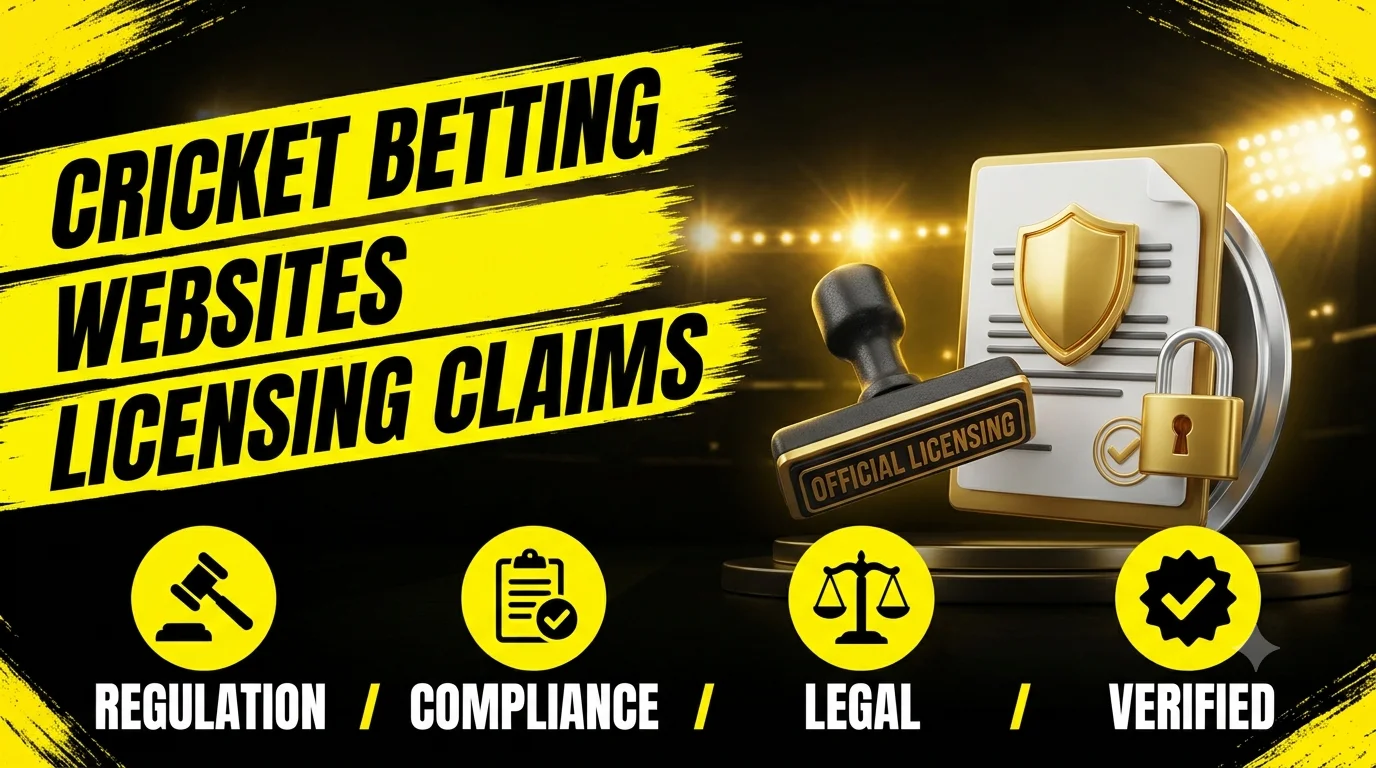
Cricket betting websites frequently display claims about licensing, regulation, security, and legal authorization. However, a website stating that it is licensed does not automatically mean the claim is genuine, current, or applicable to every country where the website can be accessed.
For people researching cricket betting online, understanding licensing claims is an important part of evaluating the legal status and credibility of gambling-related services. A genuine gambling license is generally issued by an authorized regulatory body and applies to specific operators, activities, and jurisdictions.
Licensing claims can appear in website footers, terms and conditions, promotional materials, or account-registration pages. Some operators identify a regulator and license number, while others use broad expressions such as "internationally licensed" or "fully regulated" without providing sufficient supporting information.
These statements should not be accepted without independent verification.
This guide explains what cricket betting website licensing claims mean, how gambling licenses work, why jurisdiction matters, and how users can distinguish verifiable regulatory information from misleading advertising. It also examines common warning signs, the legal complexities surrounding online cricket betting in India, and the consumer-protection considerations associated with gambling websites.
Cricket betting website licensing claims are statements that an operator holds authorization from a gambling regulator. To assess a claim, identify the named regulator, verify the operator and license details through the regulator's independent records, and confirm that the authorization covers the relevant activity and jurisdiction. A license displayed on a website does not automatically establish legality, safety, or consumer protection.
What Are Cricket Betting Website Licensing Claims?
Cricket betting website licensing claims are statements suggesting that a gambling operator has received permission from a regulatory authority to provide specified betting services.
A genuine license may authorize certain gambling activities under defined conditions. These conditions can concern the operator, its legal entity, permitted products, regulatory obligations, and geographic scope.
However, the word licensed has limited value without supporting details.
A meaningful claim should identify who granted the authorization, which legal entity holds it, and what activities it covers.
What Does a Gambling License Mean?
A gambling license is a regulatory authorization issued under a particular legal framework.
Depending on the jurisdiction, licensing requirements may address:
-
Operator identity and ownership
-
Financial suitability
-
Customer verification
-
Anti-money-laundering controls
-
Responsible-gambling obligations
-
Technical standards
-
Recordkeeping and reporting
-
Complaint-handling procedures
The exact requirements differ between regulators.
A license should not be interpreted as a guarantee that an operator will always comply with every requirement.
Why Do Betting Websites Mention Licensing?
Operators may publish licensing information to explain their regulatory status and demonstrate compliance with applicable requirements.
However, licensing statements can also be used in advertising.
The important distinction is between a claim made by the website and authorization independently confirmed by a regulator.
Is a License Number Enough?
No.
A license number can be useful for verification, but its presence does not establish authenticity.
Numbers may be outdated, incorrectly presented, associated with another legal entity, or unrelated to the gambling activity being advertised.
The number must be checked against reliable regulatory records.
Why Does Licensing Matter for Cricket Betting Online?
Licensing matters because gambling services can involve financial transactions, personal information, identity verification, and consumer disputes.
Where a legitimate regulatory framework applies, authorization may subject an operator to defined legal obligations.
These obligations can provide mechanisms for oversight and enforcement.
Regulatory Accountability
A licensed operator may be required to follow conditions imposed by its regulator.
Failure to comply can result in enforcement action, depending on the applicable laws.
Consumer Protection
Some regulatory systems establish rules concerning customer funds, complaints, advertising, and responsible gambling.
However, consumer protections vary substantially between jurisdictions.
Financial Transparency
Licensing frameworks may impose requirements concerning financial reporting, payment processes, or the handling of customer balances.
These requirements do not guarantee that every transaction will be successful or that customers cannot experience losses.
Responsible-Gambling Requirements
Some regulators require operators to provide safeguards such as age verification, account restrictions, or tools designed to reduce gambling-related harm.
The existence and effectiveness of these safeguards must be assessed in the context of the applicable regulatory framework.
How Can Users Verify Cricket Betting Website Licensing Claims?
The most reliable approach is to compare the website's licensing statements with information published independently by the named regulator.
Verification should establish more than whether a license number exists.
It should also determine whether the authorization belongs to the relevant operator and covers the service being examined.
Step 1: Identify the Claimed Regulator
Look for the name of the regulatory authority identified by the website.
A vague statement such as "internationally regulated" does not identify a specific licensing body.
Step 2: Identify the Legal Operator
Find the legal entity named in the website's terms or licensing disclosure.
A brand name and a registered company name may differ.
The relationship between them should be clear.
Step 3: Check the Regulator's Records
Where the regulator provides a public register, search for the legal entity or license reference.
Use independently located regulatory information rather than relying exclusively on a link supplied by the gambling website.
Step 4: Confirm the License Status
Check whether the authorization is active, suspended, expired, revoked, or otherwise restricted.
A previously valid license may no longer authorize current operations.
Step 5: Confirm the Authorized Activities
A license for one type of gambling does not necessarily authorize every gambling product.
The relevant authorization should cover the activity being offered.
Step 6: Check Geographic Restrictions
A license issued in one jurisdiction does not automatically permit an operator to accept customers in another.
Users must consider the laws applicable to their own location.
Step 7: Review Consumer-Protection Information
Examine whether the operator clearly explains complaints procedures, account conditions, identity verification, and other relevant obligations.
Even a verified license should not replace careful review of the service's terms.
What Information Should a Genuine Licensing Claim Contain?
A transparent licensing statement generally provides enough information for independent verification.
The exact disclosure requirements depend on the relevant regulator.
|
Information |
Why it matters |
What to verify |
|---|---|---|
|
Regulator name |
Identifies the claimed licensing authority |
Whether the authority exists and has relevant powers |
|
Legal operator name |
Identifies the licensed business |
Whether the entity matches regulatory records |
|
License reference |
Helps locate the authorization |
Whether the reference is genuine |
|
License status |
Indicates whether authorization remains valid |
Whether it is active or restricted |
|
Authorized activities |
Defines permitted gambling services |
Whether sports betting is covered |
|
Geographic scope |
Establishes jurisdictional limits |
Whether services are permitted in the user's location |
|
Complaint procedure |
Explains available dispute channels |
Whether the stated process is legitimate |
Missing information does not automatically prove fraud, but it can make a licensing claim difficult to substantiate.
What Are the Common Types of Gambling Licensing Claims?
Cricket betting websites may use different expressions to describe their regulatory position.
These expressions are not interchangeable.
Licensed by a Named Regulator
This is a specific claim that should be independently verifiable.
The operator should be identifiable in relevant regulatory records, and the authorization should cover the services being offered.
Internationally Licensed
The phrase "internationally licensed" can be ambiguous.
There is no single universal gambling license that automatically authorizes online sports betting in every country.
A license issued by one jurisdiction does not override the laws of another.
Fully Regulated
A statement that a website is "fully regulated" should be treated as incomplete unless it identifies the relevant regulatory framework.
Regulation involves particular laws, authorities, and obligations.
Government Approved
Claims of government approval require especially careful examination.
An operator may possess a particular authorization without being approved or endorsed by every government where its website is accessible.
Secure and Licensed
Security and licensing are separate concepts.
A website may use encryption without holding gambling authorization.
Similarly, regulatory authorization does not establish that a website is immune to cyberattacks, fraud, or operational failures.
Which Gambling Regulators May Appear in Licensing Disclosures?
Different jurisdictions have established authorities responsible for particular forms of gambling regulation.
Examples include the UK Gambling Commission, the Malta Gaming Authority, and the Isle of Man Gambling Supervision Commission.
Their responsibilities, licensing conditions, and geographic reach are not identical.
UK Gambling Commission
The UK Gambling Commission regulates specified gambling activities within its statutory remit.
Its public information can help users understand licensing requirements and check relevant operator records.
A UK license does not automatically authorize an operator to provide gambling services in India or other jurisdictions.
Malta Gaming Authority
The Malta Gaming Authority oversees gambling activities within its regulatory framework.
Its authorization requirements and license categories depend on applicable Maltese law.
A Malta-related licensing claim should be checked against the authority's own records.
Isle of Man Gambling Supervision Commission
The Isle of Man Gambling Supervision Commission regulates relevant gambling activities under the island's legal framework.
As with other regulators, the existence and scope of an operator's authorization require verification.
Why Regulatory Differences Matter
Regulators can differ in their rules concerning customer funds, complaints, advertising, financial reporting, and enforcement.
A license should therefore be evaluated according to the specific protections and obligations it provides, rather than the regulator's name alone.
Are All Cricket Betting Sites Licensed?
No. It should not be assumed that every website offering cricket betting holds a valid gambling license.
Some operators may hold authorization in particular jurisdictions. Others may operate without the authorization required for certain activities or locations.
There may also be websites whose licensing claims cannot be independently verified.
People researching cricket betting sites should avoid treating website popularity, advertising visibility, or technical functionality as evidence of regulatory approval.
Can an Unlicensed Website Still Be Accessible?
Yes.
Website accessibility and legal authorization are separate issues.
A service may be technically reachable from a location where its gambling activities are restricted or prohibited.
Does a Professional Website Design Prove Legitimacy?
No.
Professional design, mobile compatibility, customer-service features, and attractive branding do not establish that an operator is legally authorized.
These features can exist on both legitimate and fraudulent websites.
Can a Licensed Operator Violate Regulations?
Yes.
Licensing creates obligations, but it does not eliminate the possibility of noncompliance.
Regulators may investigate alleged breaches and take action where permitted by law.
How Can Users Identify Misleading Licensing Claims?
Misleading licensing claims may contain vague language, unverifiable references, inconsistent operator information, or exaggerated assurances.
The following warning signs deserve attention.
No Identifiable Regulatory Authority
A statement such as "licensed worldwide" without naming a regulator provides little useful verification information.
Unverifiable License Numbers
A displayed number may not correspond to a valid authorization.
Users should check it through independent regulatory records.
Conflicting Company Information
Differences between the company named in the terms and the company identified in licensing disclosures may require clarification.
Claims of Universal Legality
Statements suggesting that a single license makes gambling legal everywhere are misleading.
Legal requirements depend on jurisdiction.
Guaranteed Safety Claims
Expressions such as "100% safe" or "risk-free betting" should be treated skeptically.
No gambling license removes financial risk or guarantees complete security.
Pressure to Register Immediately
Aggressive messages encouraging users to provide personal information or make payments before reviewing legal information can be a warning sign.
Cricket Betting Website Licensing vs. Website Security
Licensing and cybersecurity address different risks.
Licensing concerns regulatory authorization and compliance.
Website security concerns the protection of systems, information, and account access.
A service may claim to provide both, but each claim requires separate assessment.
HTTPS Encryption
HTTPS helps protect information transmitted between a browser and a website.
However, HTTPS does not prove that a gambling operator is licensed or trustworthy.
Fraudulent websites can also use HTTPS.
Account Authentication
Passwords and additional verification methods can help prevent unauthorized account access.
Their presence does not establish regulatory legitimacy.
Data Protection
A privacy policy may explain how personal information is collected, used, retained, and shared.
Users should review these disclosures, particularly before submitting identity documents.
Payment Security
Payment-related protections depend on the systems and providers involved.
A licensing statement alone does not guarantee payment security, successful withdrawals, or protection against financial loss.
What Should Users Check on a Cricket Betting Website?
Before providing sensitive information to a cricket betting website, users should evaluate the operator's legal disclosures and account conditions.
Important considerations include the identity of the operator, the claimed regulator, geographic restrictions, privacy practices, and dispute-resolution arrangements.
Operator Identity
The website should provide enough information to identify the business responsible for the service.
A brand name alone may not identify the legal entity.
Terms and Conditions
Terms may explain account eligibility, restrictions, settlement rules, verification requirements, and financial conditions.
Unclear or contradictory terms deserve scrutiny.
Responsible-Gambling Information
Relevant information may include age restrictions, spending controls, self-exclusion options, and support resources.
The availability of these protections depends on the operator and applicable law.
Customer Complaints
A transparent complaints process can help users understand how disputes are handled.
However, the existence of a support form does not establish that independent dispute resolution is available.
Are Offshore Cricket Betting Licenses Valid in India?
An offshore gambling license does not automatically authorize cricket betting services in India.
A license issued by a foreign regulator establishes authorization only within the scope of the relevant legal framework.
Whether a service may lawfully operate or accept customers in India requires separate consideration of applicable Indian laws.
Why Is Jurisdiction Important?
Gambling regulation is jurisdiction-specific.
A service may satisfy requirements in one country while facing restrictions in another.
This distinction is particularly important for internet-based services that can be accessed across borders.
Does an International License Override Indian Law?
No.
A foreign gambling authorization does not automatically override applicable Indian legal requirements.
The legality of an activity must be assessed under the laws relevant to the particular circumstances.
What About State-Level Rules?
India's gambling-related legal framework involves national and state-level considerations.
Rules may differ depending on the activity and location.
Because legislation and regulatory interpretations can change, users should seek current, reliable information when evaluating legality.
What Should Users Know About Sportsbook India Licensing Claims?
The phrase sportsbook india is commonly associated with searches for sports betting services relevant to Indian audiences.
However, the presence of India-focused content, cricket markets, or Indian currency references does not establish that an operator is authorized under Indian law.
Does Accepting Indian Customers Prove Authorization?
No.
A website's willingness to accept customers from a particular location is not evidence that the activity is lawful there.
Can Foreign Regulators Protect Indian Users?
The extent of any protection depends on the regulator's authority, the operator's obligations, the user's circumstances, and applicable legal rules.
Users should not assume that a foreign licensing claim guarantees access to local consumer remedies.
What Should Be Independently Verified?
The operator's legal identity, regulatory status, permitted activities, geographic restrictions, and applicable consumer protections should be examined.
No universal conclusion can be drawn solely from the label "international sportsbook."
What Are the Risks of Unverified Cricket Gambling Sites?
Unverified licensing claims can make it difficult to determine whether a gambling operator is subject to meaningful oversight.
This uncertainty may increase consumer risk.
People examining cricket gambling sites should be aware of several potential concerns.
Financial Loss
Gambling involves the possibility of losing money regardless of licensing status.
A license does not guarantee favorable outcomes or profits.
Withdrawal Disputes
Disagreements may arise over verification requirements, account conditions, or payment processing.
The availability of effective remedies depends on the applicable legal and regulatory framework.
Personal Information Exposure
Account registration may involve sensitive personal information.
Unclear privacy practices can make it difficult to assess how that information will be handled.
Identity Fraud
Fraudulent services may misuse identification documents or other information obtained from users.
Limited Consumer Remedies
Where an operator cannot be identified or is outside effective regulatory oversight, resolving disputes may be difficult.
How Do Licensing Claims Relate to Online Cricket Gambling?
Licensing claims are especially relevant to online cricket gambling because digital platforms can operate across geographic boundaries.
A website may advertise cricket markets to users in several countries while holding authorization from only one jurisdiction.
This creates an important distinction between the operator's claimed regulatory status and the legal position of individual customers.
Does a License Guarantee Fair Betting Odds?
No.
Regulatory frameworks may impose rules concerning betting operations, technical systems, and fair treatment.
However, a license does not guarantee favorable odds or eliminate the bookmaker's margin.
Does Licensing Guarantee Financial Returns?
No.
A gambling license is not an investment guarantee.
Sporting outcomes remain uncertain, and financial losses are possible.
Does Licensing Guarantee Account Protection?
No.
Licensing may establish security-related obligations, but it cannot eliminate every operational or cybersecurity risk.
Users should continue protecting passwords, verification codes, and personal information.
What Is the Difference Between a License, Registration, and Certification?
These terms can refer to different legal or technical arrangements.
They should not be treated as interchangeable.
|
Term |
General meaning |
What it does not automatically establish |
|---|---|---|
|
Gambling license |
Authorization for specified gambling activities |
Worldwide legality or guaranteed safety |
|
Business registration |
Recognition of a business entity under applicable registration rules |
Permission to operate gambling services |
|
Technical certification |
Assessment of particular systems or technical standards |
Gambling authorization |
|
Security certificate |
Supports specified security or identity functions |
Regulatory approval |
|
Advertising approval |
Permission or compliance concerning particular promotional activities |
Authorization for every gambling activity |
A website may possess one type of registration or certification without holding a gambling license.
This distinction is important when evaluating promotional claims.
Can Licensing Information Change Over Time?
Yes.
Licensing status is not necessarily permanent.
An authorization may expire, be renewed, become subject to restrictions, or be suspended or revoked.
Regulatory requirements may also change.
Why Should Users Check Current Records?
A website may continue displaying outdated licensing information.
Historical authorization does not establish current permission to operate.
Can Ownership Changes Affect Licensing?
Changes in ownership, control, or corporate structure may trigger regulatory requirements.
The consequences depend on the relevant licensing framework.
Are Website Claims Always Updated Immediately?
Not necessarily.
Published information may be incomplete or outdated.
Independent regulatory records are generally more reliable for establishing the current status of an authorization.
What Should Users Do If a Licensing Claim Cannot Be Verified?
An unverifiable licensing claim should be treated as unresolved rather than accepted as genuine.
Users should avoid making assumptions based solely on promotional language.
Review the Available Information
Check whether the website identifies a regulator, legal operator, and license reference.
Compare Independent Records
Use reliable regulatory information to assess the claim.
Avoid Sharing Sensitive Information Prematurely
Do not provide identity documents, payment credentials, or other sensitive information to an operator whose legitimacy cannot be established.
Seek Appropriate Guidance
Where legal or regulatory uncertainty remains, qualified professional advice or information from the relevant authority may be necessary.
Report Suspected Misrepresentation
Potentially misleading licensing claims may be reported to an appropriate regulator, consumer-protection authority, or law-enforcement body, depending on the circumstances.
Responsible Participation and Legal Awareness
Licensing is an important consumer-awareness topic, but it does not remove the risks associated with gambling.
People researching an online bet in cricket should understand that betting outcomes are uncertain and financial losses are possible.
Participation should occur only where lawful and only by individuals who meet applicable age requirements.
Users should avoid borrowed money, set strict spending limits, and never treat gambling as a reliable income source.
Attempts to recover previous losses through additional gambling can increase financial harm.
Anyone experiencing difficulty controlling gambling behavior should consider seeking assistance from an appropriate support service.
Frequently Asked Questions About Cricket Betting Website Licensing
1. What does a cricket betting website license mean?
A cricket betting website license is an authorization issued by a relevant gambling regulator for specified activities. Its scope depends on the operator, jurisdiction, and licensing conditions. A genuine license does not automatically establish that the service is lawful in every country or that customers are protected against all financial risks.
2. How can I verify whether a cricket betting website is licensed?
Identify the regulator and legal operator named by the website, then check the information against the regulator's independent records. Confirm the license status, authorized activities, and relevant geographic restrictions. A displayed license number or regulatory logo should not be accepted as sufficient evidence without verification.
3. Are all cricket betting sites legally licensed?
No. Not every website offering cricket betting necessarily holds valid authorization for the activities or jurisdictions involved. Some operators may have licenses covering particular markets, while others may have unverifiable or misleading claims. Website accessibility, popularity, and advertising do not establish regulatory legitimacy.
4. Does an offshore gambling license make cricket betting legal in India?
No. A foreign gambling license does not automatically authorize betting services under Indian law. The legal position depends on applicable national and state laws, the particular activity, and other relevant circumstances. Users should independently verify the legal requirements rather than relying on a website's offshore licensing statement.
5. Is a licensed cricket betting website completely safe?
No. Licensing may impose regulatory obligations, but it cannot eliminate gambling losses, cyber threats, operational problems, or every possibility of misconduct. Users should independently verify regulatory status, examine account conditions, protect personal information, and understand the financial risks associated with gambling.
6. What are the warning signs of fake gambling licensing claims?
Warning signs include unnamed regulators, unverifiable license numbers, conflicting company information, claims of universal legal authorization, and promises of guaranteed safety. These indicators do not independently prove fraud, but they justify additional scrutiny before providing personal information or engaging with a service.
7. What is the difference between a gambling license and business registration?
A gambling license authorizes specified gambling activities under a particular regulatory framework. Business registration generally establishes or records a legal business entity. A registered company does not automatically have permission to operate sports betting services. The two forms of authorization serve different purposes.
8. Can a cricket betting license expire or be revoked?
Yes. Gambling authorizations may expire, be suspended, revoked, or become subject to restrictions under applicable regulatory rules. A website displaying historical licensing information may not accurately reflect its current status. Independent verification should therefore consider whether the authorization remains active.
9. Does a gambling license guarantee withdrawals?
No. A gambling license does not guarantee that every withdrawal will be approved or completed within a particular period. Transactions may be subject to account conditions, verification requirements, and applicable regulations. Consumer remedies and operator obligations depend on the relevant legal framework.
10. What should I do if a betting website's licensing claim looks suspicious?
Avoid assuming that the claim is genuine. Identify the named regulator and operator, examine independent regulatory records, and refrain from sharing unnecessary sensitive information while legitimacy remains uncertain. Suspected misrepresentation can be reported to an appropriate regulatory or consumer-protection authority.
Cricket betting website licensing claims should be evaluated through independent evidence rather than promotional language. A genuine gambling license is associated with a particular regulator, legal operator, authorized activity, and jurisdiction.
For people researching cricket betting online, the central lesson is that licensing, legality, website security, and financial safety are separate considerations. A service may display a license number or regulatory logo without establishing that its activities are authorized in the user's location.
Users should verify regulatory information, examine account conditions, understand applicable laws, and remain cautious about exaggerated claims concerning safety or guaranteed financial outcomes.
Readers researching Mahadev Book should apply these same verification principles. No licensing status has been established for the referenced service in this article, and its regulatory claims, if any, should be checked independently before considering account registration or gambling participation.