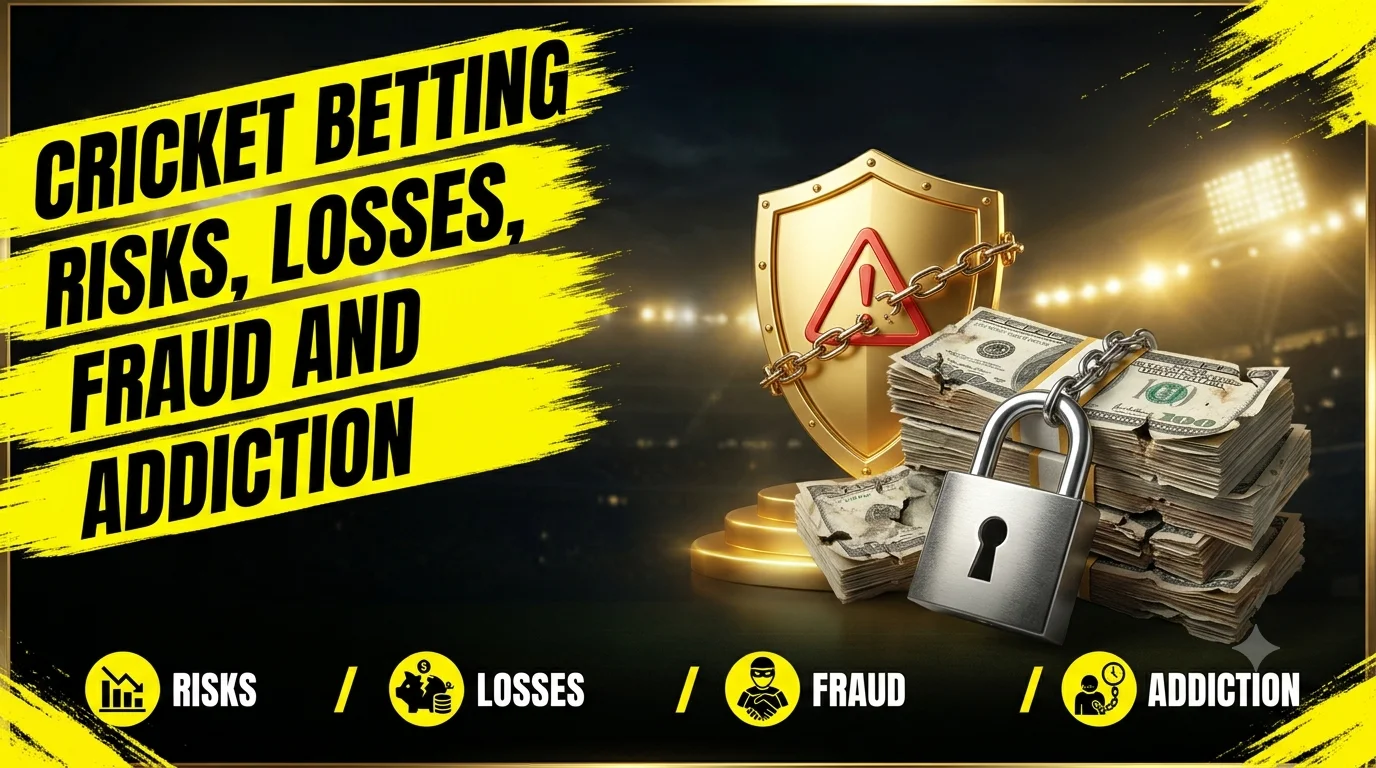
Cricket betting can expose participants to serious financial losses, online fraud, emotional distress, and gambling addiction. Although cricket is widely followed for its excitement and unpredictable results, placing money on match outcomes introduces risks that are often underestimated. Understanding these dangers is essential before making decisions involving real money.
The growing accessibility of cricket betting online has made it possible for users to encounter betting markets through websites, mobile devices, and digital platforms. However, convenient access does not reduce the financial or psychological consequences of gambling.
Common problems include repeated losses, attempts to recover lost money, fraudulent betting platforms, unauthorized transactions, misleading advertisements, and compulsive betting behavior. Even people who understand cricket statistics and betting odds can experience these difficulties.
This guide examines the major risks associated with cricket betting, explains how gambling losses accumulate, identifies common online scams, and describes warning signs of gambling addiction. It also provides practical information about account security, legal considerations, financial protection, and ways to seek assistance when betting becomes harmful.
Cricket betting involves financial, psychological, legal, and cybersecurity risks. Participants can lose money, encounter fraudulent websites, experience payment disputes, or develop gambling-related problems. Common warning signs include chasing losses, borrowing money to gamble, hiding transactions, and losing control over betting frequency. The safest approach is to avoid gambling; anyone experiencing harm should stop betting and seek appropriate support.
What Are the Main Risks of Cricket Betting?
Cricket betting involves staking money on uncertain sporting outcomes. A successful prediction may produce a payout, while an unsuccessful one can result in losing the amount wagered.
Unlike watching cricket for entertainment, gambling introduces direct financial exposure.
The main risks generally fall into five categories:
-
Financial risks: Losing deposits, accumulating debt, and using money needed for essential expenses.
-
Fraud risks: Encountering fake platforms, identity theft, misleading promotions, or fraudulent payment requests.
-
Addiction risks: Developing compulsive gambling behavior and difficulty controlling betting activity.
-
Legal risks: Participating in gambling activities that may be restricted or prohibited in a particular jurisdiction.
-
Privacy and security risks: Exposing personal information, financial details, or account credentials to unauthorized parties.
These risks can overlap.
For example, someone who experiences repeated losses may become more vulnerable to fraudulent promises of guaranteed winnings. Similarly, a person experiencing gambling addiction may continue depositing money despite financial difficulties.
Understanding how these risks interact is important for recognizing potentially harmful behavior.
Why Cricket Betting Online Can Lead to Financial Losses
Financial loss is one of the most immediate consequences of cricket betting.
Cricket matches involve uncertainty, and no statistical model, prediction service, or betting strategy can guarantee a successful outcome.
1. Betting Odds Do Not Guarantee Profit
Betting odds represent the potential payout associated with a particular outcome.
They also communicate an implied probability, although bookmaker margins mean that the prices offered may not represent the true probability of an event.
For example, decimal odds of 2.00 imply a 50% probability before accounting for any margin.
However, even a selection with a relatively high estimated probability can lose.
Over repeated bets, the bookmaker's margin can contribute to negative expected returns for participants.
2. Small Losses Can Accumulate
Individual wagers may appear financially manageable, but repeated betting can produce substantial cumulative losses.
Consider a hypothetical person who loses ₹500 on each of 20 betting occasions.
Their total loss would be:
₹500 × 20 = ₹10,000
This example does not represent actual user behavior or typical losses. It simply illustrates how repeated expenditures accumulate.
The financial impact becomes more serious when gambling expenses interfere with rent, food, education, medical care, or other essential obligations.
3. Chasing Losses Can Increase Financial Damage
Chasing losses occurs when someone continues gambling or increases their wagers to recover money already lost.
For example, a person may lose ₹1,000 and then place a larger wager hoping to recover the original amount.
If that wager also loses, the financial problem becomes worse.
This cycle can continue because the person begins treating gambling as a way to repair previous losses rather than recognizing the uncertainty of future outcomes.
An important principle is that money already lost does not increase the probability of winning the next bet.
4. Borrowing Money to Gamble
Using borrowed money for betting can create additional financial pressure.
Potential consequences include interest charges, repayment difficulties, damaged relationships, and escalating debt.
Credit cards, personal loans, and informal borrowing can make losses more difficult to manage.
Gambling should never be treated as a reliable method of repaying debt or generating essential income.
Understanding the Difference Between Gambling Risk and Gambling Harm
Gambling risk refers to the possibility of negative consequences. Gambling harm refers to the actual damage experienced by an individual, family, or community.
Not everyone who gambles experiences the same level of harm, but problems can develop gradually.
|
Risk Category |
Possible Consequences |
Warning Signs |
|---|---|---|
|
Financial loss |
Reduced savings, debt, unpaid bills |
Repeated deposits despite losses |
|
Fraud |
Stolen money or personal information |
Unexpected payment or verification requests |
|
Addiction |
Loss of control over gambling |
Failed attempts to stop |
|
Emotional distress |
Anxiety, guilt, sleep difficulties |
Persistent worry about betting |
|
Relationship problems |
Conflict and reduced trust |
Hiding gambling activity |
|
Legal exposure |
Possible penalties or disputes |
Using services without checking applicable laws |
|
Privacy breaches |
Identity theft or account misuse |
Unrecognized logins or transactions |
A person does not need to experience every warning sign before seeking help.
Even one serious consequence, such as gambling with money required for household expenses, may justify immediate action.
Common Fraud and Scams Associated With Cricket Betting Sites
Online gambling fraud can involve deceptive websites, impersonation, false promises, or attempts to obtain sensitive information.
People searching for cricket betting sites may encounter both legitimate-looking advertisements and potentially fraudulent services.
A professional-looking website does not establish that its operator is trustworthy, authorized, or legally permitted to provide gambling services.
Fake Betting Websites
Fraudsters may create websites that imitate established gambling brands.
These sites can use similar names, logos, layouts, and account-registration pages.
Their purpose may be to collect deposits, steal login credentials, or obtain personal information.
Warning signs can include inconsistent domain names, unexplained redirects, unverifiable business information, and requests to send money to unrelated personal accounts.
Guaranteed Winning Predictions
Some fraud schemes advertise supposedly fixed matches, insider information, or guaranteed winning selections.
Such claims should be treated with extreme skepticism.
Cricket outcomes cannot be guaranteed through ordinary statistical analysis, and claims of secret arrangements may be fraudulent or involve unlawful activity.
A prediction service demanding payment for guaranteed results presents a significant warning sign.
Fraudulent Withdrawal Demands
A common scam involves claiming that a user must pay an additional fee, tax, verification charge, or security deposit before receiving funds.
While legitimate financial services may have documented procedures, unexpected demands for additional payments should be independently verified.
Users should not transfer money merely because an unknown representative promises that doing so will release a larger balance.
Fake Customer Support
Scammers may impersonate customer-service representatives through messaging applications, social media, or telephone calls.
They may request passwords, one-time passwords, banking details, or remote access to a device.
Legitimate account-security practices do not require sharing passwords or authentication codes with another person.
Malicious Applications and APK Files
Unverified mobile applications can contain malware or software designed to steal information.
Downloading an APK from an unknown source may expose a device to security threats.
Users should be cautious about installation requests that require unnecessary permissions or disable built-in security protections.
How to Identify a Potentially Fraudulent Cricket Betting Website
Evaluating a cricket betting website requires more than checking whether its pages load correctly or display a secure-connection symbol.
HTTPS encryption protects information in transit, but it does not prove that a business is legitimate.
Important Checks Before Sharing Information
Users should examine whether the operator provides verifiable business details, understandable terms, transparent financial conditions, and clear privacy information.
Licensing claims should be checked independently with the relevant regulator where such verification is available.
Other warning signs include:
-
Promises of guaranteed winnings or risk-free gambling.
-
Pressure to deposit money immediately.
-
Requests for passwords or one-time authentication codes.
-
Unexplained account restrictions or payment demands.
-
Missing or contradictory business information.
-
Customer-support accounts that cannot be independently authenticated.
-
Requests to install unknown software.
-
Attempts to move financial conversations to unrelated private accounts.
No checklist can guarantee that a gambling service is safe.
When important information cannot be verified, avoiding financial transactions is the safer decision.
Cricket Gambling Sites and Personal Data Security
Privacy risks are another important concern associated with online betting.
Some gambling platforms collect personal details for account creation, identity verification, payments, and fraud prevention.
Depending on the service, information requested may include names, contact details, identification documents, and financial information.
Such information can become sensitive if mishandled or accessed without authorization.
Identity Theft
Identity theft occurs when someone uses another person's personal information without permission.
Stolen identity documents or account credentials may be used to attempt fraudulent transactions or impersonation.
Users should avoid submitting sensitive documents to unverified websites or unknown individuals.
Account Takeover
An account takeover happens when an unauthorized person gains access to an existing account.
Common contributing factors include reused passwords, phishing messages, and compromised devices.
Unique passwords and multifactor authentication, where available, can reduce some account-security risks.
Payment Information Exposure
Payment-related fraud may involve unauthorized transactions, deceptive payment requests, or misuse of financial details.
People researching cricket gambling sites should understand that a website's appearance does not independently establish how securely it handles payments or personal information.
What Is Cricket Betting Addiction?
Cricket betting addiction is a form of problematic gambling behavior characterized by difficulty controlling gambling despite harmful consequences.
Clinically, gambling disorder is recognized as a behavioral addiction.
It can affect financial stability, mental health, employment, education, and personal relationships.
A person may continue gambling even when they recognize that it is causing serious problems.
Why Gambling Can Become Compulsive
Gambling outcomes are uncertain, and occasional wins can reinforce continued participation.
The possibility of a reward may encourage someone to repeat a behavior even after experiencing losses.
Cricket's changing match situations can add to this pattern.
Live scores, frequent betting opportunities, and rapid changes in odds may encourage repeated decisions during a single match.
However, addiction is complex and cannot be explained by one psychological mechanism alone.
Personal circumstances, emotional distress, accessibility, and individual vulnerability may all contribute.
Early Warning Signs of Gambling Addiction
Common warning signs include:
-
Thinking about betting frequently.
-
Spending more money than originally intended.
-
Repeatedly trying and failing to stop.
-
Gambling to escape stress or negative emotions.
-
Concealing betting activity from family members.
-
Borrowing money to continue gambling.
-
Feeling restless or irritable when attempting to stop.
-
Neglecting work, studies, or relationships.
-
Continuing to gamble despite serious losses.
-
Returning to gambling to recover previously lost money.
These signs do not automatically establish a clinical diagnosis.
However, persistent or escalating symptoms warrant attention from a qualified healthcare or mental-health professional.
How Cricket Betting Addiction Affects Mental Health
Problematic gambling can create substantial emotional and psychological pressure.
Financial uncertainty may contribute to anxiety, while repeated losses can produce shame, frustration, or hopelessness.
Stress and Anxiety
People experiencing gambling-related problems may worry constantly about money, unpaid obligations, or concealed transactions.
These concerns can interfere with concentration, sleep, and everyday activities.
Depression and Emotional Distress
Problem gambling can occur alongside depression and other mental-health conditions.
The relationship can work in both directions: emotional difficulties may contribute to gambling, while gambling-related consequences may worsen emotional well-being.
Professional assessment is important when symptoms become persistent or severe.
Relationship Difficulties
Gambling problems may lead to secrecy, broken financial agreements, and conflict within families.
Trust can be damaged when household money is used without agreement or debts are concealed.
Supportive conversations and professional assistance can help address these problems, although rebuilding trust may take time.
When Immediate Help Is Necessary
Gambling-related distress can sometimes become severe.
Anyone experiencing thoughts of self-harm or suicide should seek urgent help from local emergency services or a crisis-support service.
Immediate safety and access to professional support take priority over resolving gambling debts or account disputes.
Why Live Cricket Betting Can Increase Risk
Live betting allows wagers to be placed while a cricket match is in progress.
Because the game changes continuously, users may encounter repeated opportunities to make financial decisions.
This rapid pace can make it harder to reflect on spending.
Emotional Decisions During Matches
A sudden wicket, boundary, or unexpected partnership can create excitement or frustration.
Making gambling decisions during emotionally intense moments may reduce careful consideration of financial consequences.
Repeated Betting Opportunities
A single cricket match may contain multiple betting markets.
Repeated exposure can encourage frequent wagering and make cumulative spending less noticeable.
The Illusion of Control
People with extensive cricket knowledge may believe they can reliably predict short-term events.
Although statistical understanding can improve interpretation of probabilities, it cannot remove randomness or uncertainty.
Confidence in sports knowledge should not be confused with control over match outcomes.
Online Cricket Gambling and Legal Risks in India
The legal status of online gambling is an important consideration, particularly for people researching online cricket gambling in India.
Gambling regulation can involve central legislation, state-level rules, and distinctions between different activities.
The legal position may also change following legislative developments, regulatory decisions, or court judgments.
Why Location Matters
An activity permitted in one jurisdiction may be restricted in another.
The availability of a website does not establish that participation is lawful in the user's location.
Similarly, an operator's claim of international authorization does not automatically establish permission to offer services in India.
Legal Considerations for Sportsbook India Searches
Searches involving sportsbook india may lead to services with different legal and regulatory characteristics.
Users should independently verify applicable laws, operator authorization, age restrictions, and consumer protections.
They should not attempt to bypass geographic restrictions, identity checks, or payment controls.
Because legal requirements are subject to change, older articles and promotional claims should not be treated as definitive legal advice.
What Should You Do After Losing Money Through Cricket Betting?
The appropriate response depends on whether the loss resulted from ordinary gambling, suspected fraud, or unauthorized account activity.
These situations require different actions.
If You Have Experienced Gambling Losses
-
Stop placing additional wagers.
-
Avoid trying to recover losses through further gambling.
-
Calculate the total amount lost and identify outstanding obligations.
-
Protect money needed for housing, food, healthcare, and other essentials.
-
Consider blocking gambling transactions or restricting access to gambling services.
-
Speak with a trusted person or financial adviser if the losses are difficult to manage.
The goal should be financial stability rather than attempting to reverse losses through another uncertain outcome.
If You Suspect Fraud
Preserve relevant evidence, including transaction records, messages, receipts, and screenshots.
Contact your bank or payment provider promptly to report suspicious transactions and ask about available protective measures.
Change compromised passwords and secure affected accounts.
In India, suspected cyber-enabled financial fraud can be reported through the National Cyber Crime Reporting Portal, and the national cybercrime helpline is 1930. Reporting promptly may improve the possibility of protective action, although recovery is not guaranteed.
If a Withdrawal Is Delayed
A delayed withdrawal does not automatically prove fraud.
However, unexplained delays, inconsistent explanations, and demands for unexpected additional payments are warning signs.
Review documented terms, preserve correspondence, and avoid sending further money merely to obtain a promised payout.
How to Reduce Cricket Betting Risks
The most effective way to avoid gambling-related financial losses is not to gamble.
For people who already participate, harm-reduction measures may help limit exposure, although they cannot make gambling risk-free.
|
Risk |
Protective Measure |
Limitation |
|---|---|---|
|
Overspending |
Establish strict financial boundaries |
Limits do not guarantee control |
|
Chasing losses |
Stop after losses and avoid further wagers |
Emotional urges may persist |
|
Gambling addiction |
Seek professional support and consider self-exclusion |
Recovery may require ongoing assistance |
|
Account fraud |
Use unique passwords and authentication protections |
Security measures cannot prevent every scam |
|
Identity theft |
Avoid sharing sensitive details with unverified parties |
Data can still be compromised |
|
Financial distress |
Prioritize essential expenses and seek debt advice |
Existing debts still require resolution |
|
Legal uncertainty |
Check current laws and regulatory information |
Requirements vary by jurisdiction |
Use Self-Exclusion Where Available
Self-exclusion allows a person to request restrictions on access to gambling services for a defined or indefinite period, depending on the system.
Availability and effectiveness vary across operators and jurisdictions.
It should be viewed as one protective tool rather than a complete treatment for gambling addiction.
Reduce Exposure to Gambling Promotions
Advertisements, notifications, and promotional messages can trigger urges to gamble.
Disabling notifications, unsubscribing from marketing communications, and blocking gambling-related content may reduce exposure.
Seek Professional Support
Counseling and evidence-based psychological treatments, including cognitive behavioral therapy, can help people experiencing gambling-related difficulties.
Financial counseling may also be useful when debt or unpaid obligations have developed.
How to Stop Cricket Betting When It Becomes a Problem
Stopping gambling can be difficult, especially when betting has become connected to daily routines, emotional regulation, or financial expectations.
A structured approach may help.
Step 1: Recognize the Problem
Identify whether gambling has caused financial, emotional, occupational, or relationship difficulties.
Acknowledging these consequences is an important starting point.
Step 2: Restrict Access
Remove gambling applications, block relevant websites, and use available self-exclusion systems.
Consider asking a trusted person to help establish appropriate financial safeguards.
Step 3: Identify Triggers
Triggers may include watching live cricket, receiving promotional messages, feeling stressed, or attempting to recover previous losses.
Recognizing these situations can help individuals develop alternative responses.
Step 4: Build Alternative Activities
Cricket can remain enjoyable without financial wagering.
Watching matches, playing recreational cricket, participating in non-monetary prediction games, or studying sports statistics can provide alternative forms of engagement.
Step 5: Obtain Support
Professional counseling, peer-support groups, and trusted family members can provide assistance.
Relapses or renewed urges should be addressed promptly rather than treated as reasons to abandon recovery efforts.
Can Cricket Knowledge Prevent Betting Losses?
Cricket expertise can improve understanding of match conditions, team selection, and statistical probabilities.
However, it cannot eliminate financial risk.
A knowledgeable analyst may correctly identify the stronger team while still predicting an outcome that does not occur.
Unexpected injuries, weather interruptions, individual performances, and tactical decisions can change a match.
Furthermore, accurate predictions do not automatically produce positive financial returns because betting prices and bookmaker margins affect outcomes.
People searching for ways to online bet in cricket should therefore distinguish sports knowledge from financial certainty.
Understanding cricket is valuable in its own right. It does not establish that gambling is a reliable investment or income-generating activity.
Frequently Asked Questions About Cricket Betting Risks
1. What are the biggest risks of cricket betting online?
The biggest risks include financial losses, gambling addiction, online fraud, identity theft, and possible legal consequences. Repeated betting can create debt, while fraudulent services may misuse deposits or personal information. The severity of these risks depends on individual circumstances, platform practices, and applicable laws. Avoiding gambling is the most reliable way to prevent betting-related financial losses.
2. Can cricket betting lead to addiction?
Yes. Cricket betting can contribute to gambling disorder when a person develops persistent difficulty controlling gambling despite harmful consequences. Warning signs include chasing losses, hiding betting activity, borrowing money, and repeatedly failing to stop. Anyone experiencing these problems should consider professional support, financial safeguards, and restrictions on access to gambling services.
3. How can I identify fake cricket betting sites?
Potential warning signs include guaranteed-profit claims, unverifiable business details, suspicious payment requests, fake customer-support accounts, and demands for passwords or authentication codes. A secure-looking website is not necessarily trustworthy. Independently verify regulatory claims and avoid sharing financial information when an operator's identity or legitimacy cannot be established.
4. Why do people continue betting after losing money?
Some people continue betting because they hope to recover previous losses, a behavior known as chasing losses. Emotional distress, overconfidence, and the possibility of occasional rewards can reinforce this pattern. However, previous losses do not make future wins more likely. Continuing to gamble in an attempt to recover money can deepen financial difficulties.
5. Is cricket betting legal in India?
The legal position depends on applicable laws, the nature of the gambling activity, and the relevant jurisdiction. India has a complex regulatory environment, and requirements may change. The fact that a website is accessible does not establish its legality. Users should consult current authoritative legal information rather than rely on promotional claims or outdated summaries.
6. What should I do if a cricket betting website refuses my withdrawal?
First, preserve transaction records, account communications, and the relevant published terms. Seek a clear explanation through independently verified contact channels. Do not pay unexpected additional charges solely because someone promises to release your funds. If fraud is suspected, contact your financial institution and report the incident to the appropriate authorities.
7. Can cricket betting losses be recovered?
Ordinary gambling losses generally cannot be assumed recoverable simply because a wager was unsuccessful. Unauthorized transactions or fraud may involve different remedies, depending on the circumstances and applicable law. Contacting a bank or payment provider promptly can help clarify available options. Avoid anyone promising guaranteed recovery in exchange for an advance payment.
8. How do I know whether I have a cricket betting problem?
Possible indicators include spending beyond your means, concealing transactions, neglecting responsibilities, chasing losses, and feeling unable to stop. Gambling-related anxiety, debt, or relationship conflict can also signal harm. A qualified professional can assess whether the behavior meets clinical criteria for gambling disorder and recommend appropriate support.
9. Can responsible gambling tools prevent addiction?
Responsible gambling tools may reduce certain risks, but they cannot guarantee prevention. Spending limits, self-exclusion, transaction blocks, and reduced advertising exposure can be useful safeguards. People experiencing compulsive gambling may also require counseling or other professional treatment. Avoiding gambling entirely remains the most effective way to eliminate gambling-related financial exposure.
10. What is the safest way to enjoy cricket without betting?
Watching matches, joining recreational cricket clubs, studying player statistics, discussing tactics, and participating in prediction games without monetary stakes are alternatives. These activities allow fans to enjoy cricket's uncertainty without risking money on match outcomes. For someone recovering from gambling problems, avoiding betting-related triggers may also be important.
Cricket betting carries risks that extend beyond losing an individual wager. Repeated financial losses, fraudulent websites, identity theft, legal uncertainty, and gambling addiction can affect personal finances, mental health, and relationships.
Understanding these dangers is particularly important for anyone researching cricket betting online. Sports knowledge, statistical models, and confident predictions cannot guarantee winnings or remove the uncertainty associated with gambling.
Protective measures include avoiding unnecessary financial exposure, recognizing fraudulent requests, securing personal information, and seeking help when gambling becomes difficult to control. People experiencing serious losses should prioritize essential expenses and avoid chasing money already lost.
When evaluating cricket-related websites, including Mahadev Book, users should independently assess applicable laws, operator credentials, financial terms, and consumer protections rather than relying on promotional information. No betting platform should be assumed safe or legally authorized without verification. Ultimately, informed decisions, financial safeguards, and timely support are more important than any potential gambling payout.