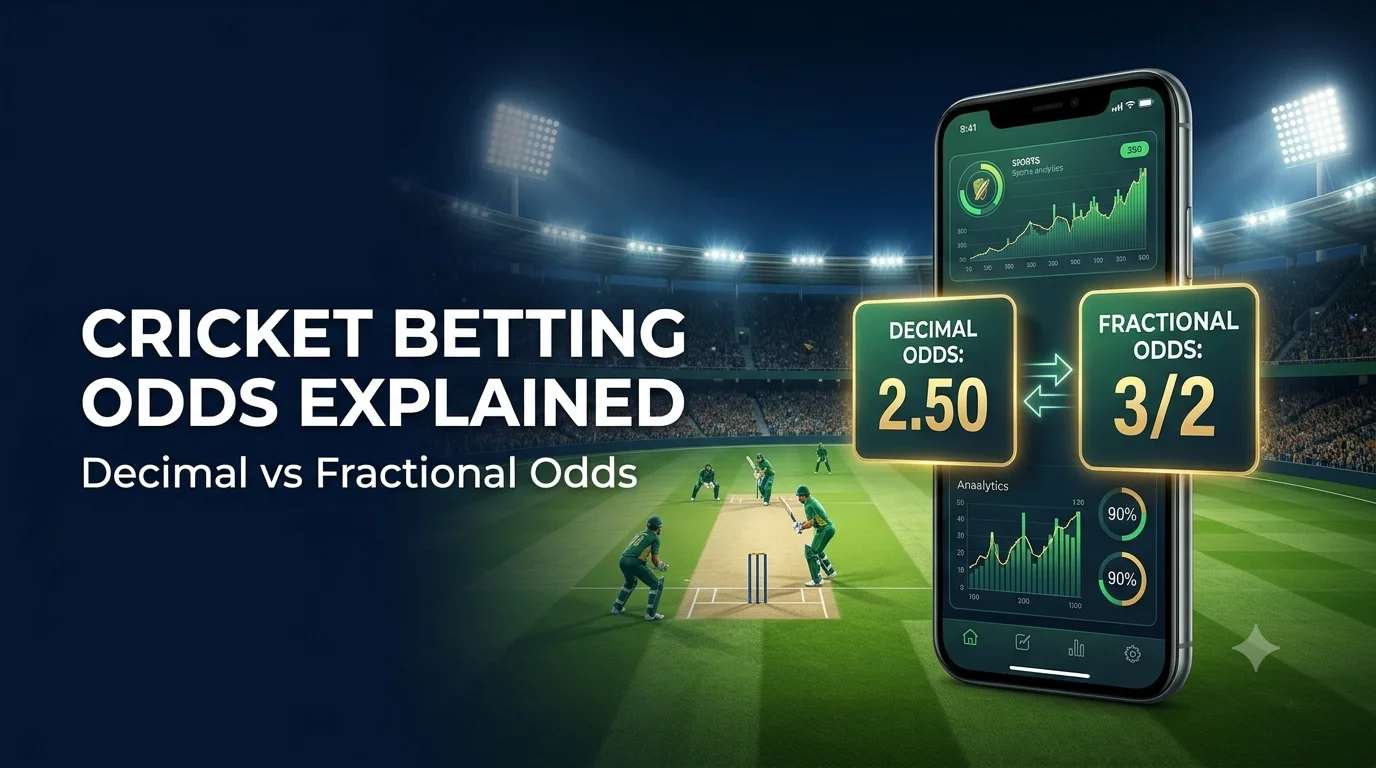
Cricket betting odds are numbers that represent the potential payout of a wager and the probability implied by a bookmaker's pricing. The two widely recognised formats are decimal odds, such as 1.80 or 2.50, and fractional odds, such as 4/5 or 3/2. Although they look different, both can describe exactly the same financial outcome.
Understanding odds is an important part of learning about cricket betting online. Whether a market concerns an India versus Australia match, a T20 tournament winner, or an individual batter's performance, odds determine the potential return relative to the amount staked.
However, odds are not predictions that guarantee a result. They incorporate estimates, bookmaker margins, and sometimes market demand. Even an outcome displayed as highly likely can fail to occur.
This guide explains decimal and fractional cricket betting odds, how to convert between them, how payouts and implied probabilities are calculated, why odds change, and how to recognise the financial risks associated with betting.
Decimal and fractional cricket betting odds express the same potential returns in different formats. Decimal odds show the total payout per unit staked, including the original stake. Fractional odds show the potential profit relative to the stake. For example, decimal odds of 2.50 equal fractional odds of 3/2. Both imply a probability of 40% before adjusting for bookmaker margins.
What Are Cricket Betting Odds?
Cricket betting odds are numerical prices assigned to possible outcomes of a cricket match or related event. They determine how much a successful wager would return and provide a way to calculate the probability implied by the price.
For example, a hypothetical cricket match might display:
-
Team A: Decimal odds of 1.50
-
Team B: Decimal odds of 2.80
These prices suggest that Team A is considered more likely to win under the bookmaker's pricing. They do not guarantee that Team A will win.
Odds generally reflect several influences, including estimated probabilities, the bookmaker's pricing margin, and adjustments to the market.
What Do Higher and Lower Odds Mean?
Lower decimal odds generally indicate a higher implied probability and a smaller potential profit relative to the stake.
Higher decimal odds generally indicate a lower implied probability and a larger potential profit relative to the stake.
For example, odds of 1.25 imply a higher probability than odds of 4.00.
The relationship between probability and potential payout is fundamental to understanding sports betting markets.
Why Do Cricket Betting Odds Matter?
Odds help explain three important concepts:
-
Potential return: The amount a successful wager would pay.
-
Implied probability: The likelihood represented mathematically by the odds.
-
Market pricing: How a bookmaker expresses the relative likelihood of different outcomes.
Understanding these concepts makes it easier to interpret cricket betting information without confusing potential returns with guaranteed earnings.
What Are Decimal Odds in Cricket Betting?
Decimal odds express the total potential payout for every unit staked. The total includes both the original stake and any profit.
They are displayed as numbers such as 1.50, 1.75, 2.00, or 3.25.
Decimal odds are commonly encountered in online sportsbooks because they make payout calculations relatively straightforward.
How to Calculate Returns Using Decimal Odds
The formula is:
To calculate the potential net profit:
Suppose a hypothetical cricket market offers decimal odds of 2.40.
With a ₹100 stake:
-
Total potential payout: ₹240
-
Potential net profit: ₹140
-
Original stake included in payout: ₹100
-
Amount generally lost if unsuccessful: ₹100
The example is purely mathematical and does not represent a current market price.
Decimal Odds Calculation Examples
|
Decimal odds |
Example stake |
Total potential payout |
Potential net profit |
|---|---|---|---|
|
1.25 |
₹100 |
₹125 |
₹25 |
|
1.50 |
₹100 |
₹150 |
₹50 |
|
1.80 |
₹100 |
₹180 |
₹80 |
|
2.00 |
₹100 |
₹200 |
₹100 |
|
2.50 |
₹100 |
₹250 |
₹150 |
|
3.00 |
₹100 |
₹300 |
₹200 |
|
4.00 |
₹100 |
₹400 |
₹300 |
The table demonstrates how the potential payout changes as decimal odds increase. It does not indicate how likely any particular cricket outcome is to occur.
What Does 1.80 Mean in Cricket Betting?
Decimal odds of 1.80 mean that each ₹100 staked would return ₹180 if the wager succeeds.
Of that amount, ₹100 is the original stake and ₹80 is the potential profit.
If the wager loses, the ₹100 stake is generally lost, subject to the market's settlement conditions.
What Are Fractional Odds in Cricket Betting?
Fractional odds express the potential net profit in relation to the amount staked.
They are written as fractions such as 1/2, 4/5, 5/4, 3/2, or 5/1.
Fractional odds have traditionally been associated with British betting markets, although the format can also appear in international sports betting contexts.
How to Read Fractional Odds
Consider fractional odds of 3/2.
The numerator, 3, represents the potential profit units. The denominator, 2, represents the stake units.
Therefore, a successful wager at 3/2 would generate three units of profit for every two units staked.
For example, a hypothetical ₹200 stake would produce ₹300 in net profit and a total return of ₹500.
Fractional Odds Formula
The total payout is:
Fractional Odds Calculation Examples
|
Fractional odds |
Example stake |
Potential profit |
Total potential payout |
|---|---|---|---|
|
1/4 |
₹100 |
₹25 |
₹125 |
|
1/2 |
₹100 |
₹50 |
₹150 |
|
4/5 |
₹100 |
₹80 |
₹180 |
|
1/1 |
₹100 |
₹100 |
₹200 |
|
3/2 |
₹100 |
₹150 |
₹250 |
|
2/1 |
₹100 |
₹200 |
₹300 |
|
5/1 |
₹100 |
₹500 |
₹600 |
These calculations assume a successful wager and standard settlement conditions.
What Does 5/1 Mean in Cricket Betting?
Fractional odds of 5/1 mean that a successful wager would produce five units of net profit for each unit staked.
For example, a hypothetical ₹100 stake would generate ₹500 in profit, plus the original ₹100 stake, giving a total payout of ₹600.
However, the larger potential return corresponds to a lower implied probability than shorter odds such as 1/2 or 1/1.
Decimal vs Fractional Cricket Betting Odds: Key Differences
Decimal and fractional odds use different presentation methods, but they can represent identical prices.
The main difference is that decimal odds include the original stake in their payout multiplier, while fractional odds express profit separately.
|
Feature |
Decimal odds |
Fractional odds |
|---|---|---|
|
Example |
2.50 |
3/2 |
|
Display format |
Number with decimal point |
Ratio or fraction |
|
Main meaning |
Total payout multiplier |
Profit relative to stake |
|
Includes stake in quoted multiplier |
Yes |
No |
|
Potential profit on ₹100 |
₹150 |
₹150 |
|
Total payout on ₹100 |
₹250 |
₹250 |
|
Implied probability |
40% |
40% |
Neither format inherently produces better returns.
When two odds formats are mathematically equivalent, the potential financial result is also equivalent.
How to Convert Decimal Odds Into Fractional Odds
Converting decimal odds into fractional odds involves subtracting one and expressing the result as a fraction.
The formula is:
For example, decimal odds of 2.50 become:
Therefore:
Decimal 2.50 = Fractional 3/2
Another example uses decimal odds of 1.75:
Therefore:
Decimal 1.75 = Fractional 3/4
The final fraction is normally simplified.
How to Convert Fractional Odds Into Decimal Odds
To convert fractional odds into decimal odds, divide the numerator by the denominator and add one.
For example, fractional odds of 7/4 become:
Therefore:
Fractional 7/4 = Decimal 2.75
For fractional odds of 2/1:
Therefore:
Fractional 2/1 = Decimal 3.00
These conversions are mathematical identities. They do not depend on the cricket match, sportsbook, or currency used.
What Is Implied Probability in Cricket Betting?
Implied probability is the percentage likelihood represented by a set of odds.
It is not necessarily the true probability of the event occurring.
For decimal odds, the calculation is:
For example, decimal odds of 2.00 imply:
Decimal odds of 4.00 imply:
Calculating Probability From Fractional Odds
For fractional odds \(a/b\), use:
For fractional odds of 3/1:
For fractional odds of 1/2:
Why Is Implied Probability Important?
Implied probability helps readers interpret odds as more than payout numbers.
However, bookmaker prices generally include a margin. Consequently, the probabilities implied by every possible outcome in a market may add up to more than 100%.
This means implied probability should not automatically be treated as an unbiased forecast.
What Is the Bookmaker Margin in Cricket Betting?
The bookmaker margin, sometimes called the overround or vig, is a pricing mechanism that gives the bookmaker a mathematical advantage across a betting market.
In a market containing all mutually exclusive outcomes, the true probabilities must total 100%. However, the implied probabilities calculated from a bookmaker's odds may total more than 100%.
Example of a Bookmaker Margin
Consider a hypothetical two-outcome cricket market where both selections have decimal odds of 1.90.
Each selection has an implied probability of:
The combined implied probability is:
The excess of approximately 5.26 percentage points represents the market's overround.
This is not a guaranteed profit percentage on every wager or an exact measure of the bookmaker's eventual earnings.
The bookmaker's actual financial result depends on the wagers accepted, stakes, outcomes, and other factors.
Why Do Different Cricket Betting Sites Display Different Odds?
Different cricket betting sites may display different odds for the same cricket event because operators use different pricing models, margins, risk-management methods, and market adjustments.
Odds may also be updated at different times.
A difference in quoted odds does not establish that one website is more trustworthy or legally authorised than another.
Why Do Cricket Betting Odds Change?
Cricket betting odds can change before and during matches as new information affects expectations about possible outcomes.
Odds movements may reflect developments involving players, playing conditions, match performance, or betting-market activity.
Team Selection and Player Availability
The availability of important batters, bowlers, wicketkeepers, or all-rounders can influence how a match is priced.
An unexpected injury or team-selection announcement may lead bookmakers to revise their estimates.
Pitch and Weather Conditions
Cricket pitches vary in their characteristics, including pace, bounce, spin assistance, and deterioration over time.
Rain can shorten a match, change playing conditions, or lead to abandonment.
These factors can influence both the expected result and the settlement conditions of particular markets.
Match Developments
During a live cricket match, events such as wickets, boundaries, partnerships, and changes in the required run rate may affect market prices.
A team that appears likely to win early in an innings may face a very different situation after losing several wickets.
Betting-Market Activity
Bookmakers may also adjust prices in response to the distribution of accepted wagers and their financial exposure.
Therefore, an odds movement does not necessarily mean that a team's actual probability of winning has changed by the same amount.
How Do Odds Work Across Different Cricket Markets?
Cricket betting markets concern different sporting outcomes, but decimal and fractional odds operate according to the same mathematical principles.
Match Winner Markets
Match-winner odds concern the result of a particular cricket contest.
For example, a hypothetical market may assign decimal odds of 1.60 to Team A and 2.40 to Team B.
These figures express potential payouts and implied probabilities. They do not determine the final result.
Test cricket may require additional consideration because a draw is a possible outcome.
Total Runs Markets
Total-runs markets concern whether a team's or match's runs will exceed or fall below a specified threshold.
For example, a market might concern whether a T20 innings finishes above or below 175.5 runs.
The odds apply to the selected scoring outcome, while the operator's rules determine how interruptions and incomplete innings are treated.
Player Performance Markets
Player markets may concern individual batting or bowling performances.
The quoted odds express the potential payout associated with a specified result, such as a player scoring the most runs within a defined market.
Player substitutions, non-participation, and tied performances may trigger special settlement conditions.
Tournament Winner Markets
Tournament markets concern the eventual champion of a competition.
These markets can remain unresolved for weeks or months, depending on the competition schedule.
Odds may change as teams progress or are eliminated.
Understanding Odds on a Cricket Betting Website
A cricket betting website may display odds alongside team names, market descriptions, match information, and potential payout calculations.
Understanding the information requires distinguishing between a market's title, its selections, and the quoted odds.
For example, a display reading Total Runs — Over 180.5 — 1.90 identifies a particular scoring outcome and its decimal price.
The 1.90 figure is not a prediction that the team will score 190 runs. It represents the payout multiplier associated with the defined selection.
Common Odds Display Problems
Readers may encounter several confusing situations:
-
Decimal and fractional formats look different: Convert them mathematically before interpreting the payout.
-
A displayed price changes: Market odds may be updated as circumstances change.
-
A market becomes unavailable: Operators may suspend markets while reviewing significant developments.
-
A payout differs from the expected amount: Settlement rules, void selections, or other applicable conditions may affect the final calculation.
The specific rules and procedures depend on the operator and the market.
Cricket Betting Odds and Indian Sportsbook Searches
People researching a sportsbook india may encounter cricket odds displayed in decimal, fractional, or other formats.
The mathematical meaning of odds does not change based on the currency used.
For instance, decimal odds of 2.00 represent the same payout multiplier whether a hypothetical stake is denominated in Indian rupees, pounds, or another currency.
However, the legality of online real-money betting is a separate matter.
Indian gambling regulation involves national and state-specific laws, and the legal framework can change. Website accessibility does not establish legal authorisation.
Users should independently verify applicable laws and regulatory information rather than relying on promotional claims.
Common Mistakes When Reading Cricket Betting Odds
Misunderstanding odds can lead to incorrect expectations about returns and financial risk.
Confusing Total Payout With Profit
Decimal odds include the original stake in the total payout.
A ₹100 successful wager at 2.50 returns ₹250 in total, but the net profit is ₹150.
Assuming Low Odds Guarantee Success
Low odds imply that an outcome is considered more likely under the quoted price.
They do not guarantee that it will occur.
Even an event priced at decimal odds of 1.10 can fail.
Treating Higher Odds as Better Value
Higher odds offer a larger potential payout relative to the stake, but they also imply a lower probability.
A larger possible return does not automatically mean that a wager is favourable.
Ignoring Bookmaker Margins
The implied probabilities in a betting market often exceed 100% when combined.
Ignoring this margin can lead to misunderstanding the relationship between odds and actual probabilities.
Misunderstanding Combined Bets
An accumulator combines several selections into one wager.
When multiple selections must all succeed, the probability of a successful combined result generally decreases as more selections are included.
A larger displayed potential payout does not remove the risk of losing the stake.
Online Cricket Gambling: Risks and Responsible Participation
Online cricket gambling involves risking money on uncertain sporting outcomes. Understanding the mathematics of odds does not eliminate that uncertainty.
Even a person with extensive cricket knowledge cannot reliably predict every match result.
Why Betting Is Not a Reliable Income Source
Bookmaker margins and unpredictable results mean that gambling should not be treated as a dependable way to earn money.
Individual successful wagers do not establish that a strategy will produce consistent long-term profits.
Recognising Gambling-Related Harm
Warning signs may include repeatedly exceeding financial limits, borrowing money to gamble, hiding gambling activity, or feeling compelled to recover previous losses.
Chasing losses can increase financial harm because previous results do not make a future successful wager inevitable.
Responsible Gambling Principles
Anyone considering gambling should understand the applicable laws and age restrictions, avoid risking essential funds, and never borrow money to finance wagers.
Self-exclusion tools, financial counselling, and professional gambling-harm support can be important resources when gambling becomes difficult to control.
The only way to eliminate the financial risk of gambling is not to place a wager.
Frequently Asked Questions About Cricket Betting Odds
1. What are cricket betting odds?
Cricket betting odds are numerical prices representing potential payouts for particular cricket-related outcomes. They also allow implied probabilities to be calculated. Odds may concern match winners, total runs, player performances, or tournament results. They do not guarantee that any selection will succeed.
2. What is the difference between decimal and fractional odds?
Decimal odds express the total potential payout, including the original stake, as a multiplier. Fractional odds express the potential profit relative to the stake. For example, decimal odds of 2.50 and fractional odds of 3/2 represent identical potential returns and implied probabilities.
3. How do you calculate cricket betting payouts?
For decimal odds, multiply the stake by the quoted odds to calculate the total potential payout. For fractional odds, multiply the stake by the fraction to calculate potential net profit, then add the original stake. These calculations assume the wager succeeds under the applicable settlement rules.
4. What does 2.00 mean in cricket betting odds?
Decimal odds of 2.00 mean that a successful wager returns twice the amount staked, including the original stake. For example, a hypothetical ₹100 stake would return ₹200 in total, representing ₹100 in net profit. Odds of 2.00 imply a probability of 50% before accounting for pricing margins.
5. What does 3/1 mean in fractional cricket odds?
Fractional odds of 3/1 mean that a successful wager produces three units of net profit for every unit staked. A hypothetical ₹100 stake would generate ₹300 in profit and a total payout of ₹400. These odds are equivalent to decimal odds of 4.00.
6. How do you convert decimal odds to fractional odds?
Subtract one from the decimal odds and express the result as a simplified fraction. For example, decimal odds of 1.75 become 0.75 after subtracting one, which equals fractional odds of 3/4. Both formats represent the same potential payout and implied probability.
7. Why do cricket betting odds change during a match?
Live cricket odds may change because of wickets, scoring rates, player performances, weather interruptions, and other developments. Bookmakers may also adjust prices based on their financial exposure and market activity. These movements reflect changing prices rather than guaranteed predictions of the eventual result.
8. Are decimal odds better than fractional odds?
Neither odds format is inherently better. Decimal odds are often easier for calculating total payouts, while fractional odds directly express potential profit relative to the stake. When the prices are mathematically equivalent, both formats produce the same financial outcome.
9. What is implied probability in cricket betting?
Implied probability is the percentage likelihood represented mathematically by betting odds. For decimal odds, divide one by the quoted odds and multiply by 100. For example, odds of 2.50 imply a probability of 40%. Bookmaker margins mean this figure should not automatically be interpreted as the true probability.
10. Can cricket betting odds guarantee winnings?
No. Cricket betting odds cannot guarantee winnings because sporting outcomes remain uncertain. Lower odds generally indicate a higher implied probability, but even strongly favoured teams can lose. Understanding odds improves mathematical literacy; it does not eliminate gambling risk or create a reliable income source.
Understanding decimal and fractional cricket betting odds helps explain how potential payouts and implied probabilities are represented across different sports markets.
Decimal odds show the total return as a multiplier, while fractional odds show potential profit relative to the stake. Both can be converted using straightforward formulas, and equivalent prices produce identical potential financial outcomes.
For readers researching cricket betting online, it is equally important to understand bookmaker margins, changing market prices, and settlement conditions. Odds describe financial terms and implied probabilities, not guaranteed results.
Legal restrictions and responsible gambling considerations also matter. No odds format or calculation can remove the possibility of financial loss.
Readers researching cricket-related betting information may encounter platforms such as Mahadev Book. This reference does not verify the platform's licensing, security, or legal availability. Such information should be independently checked before considering any gambling service.