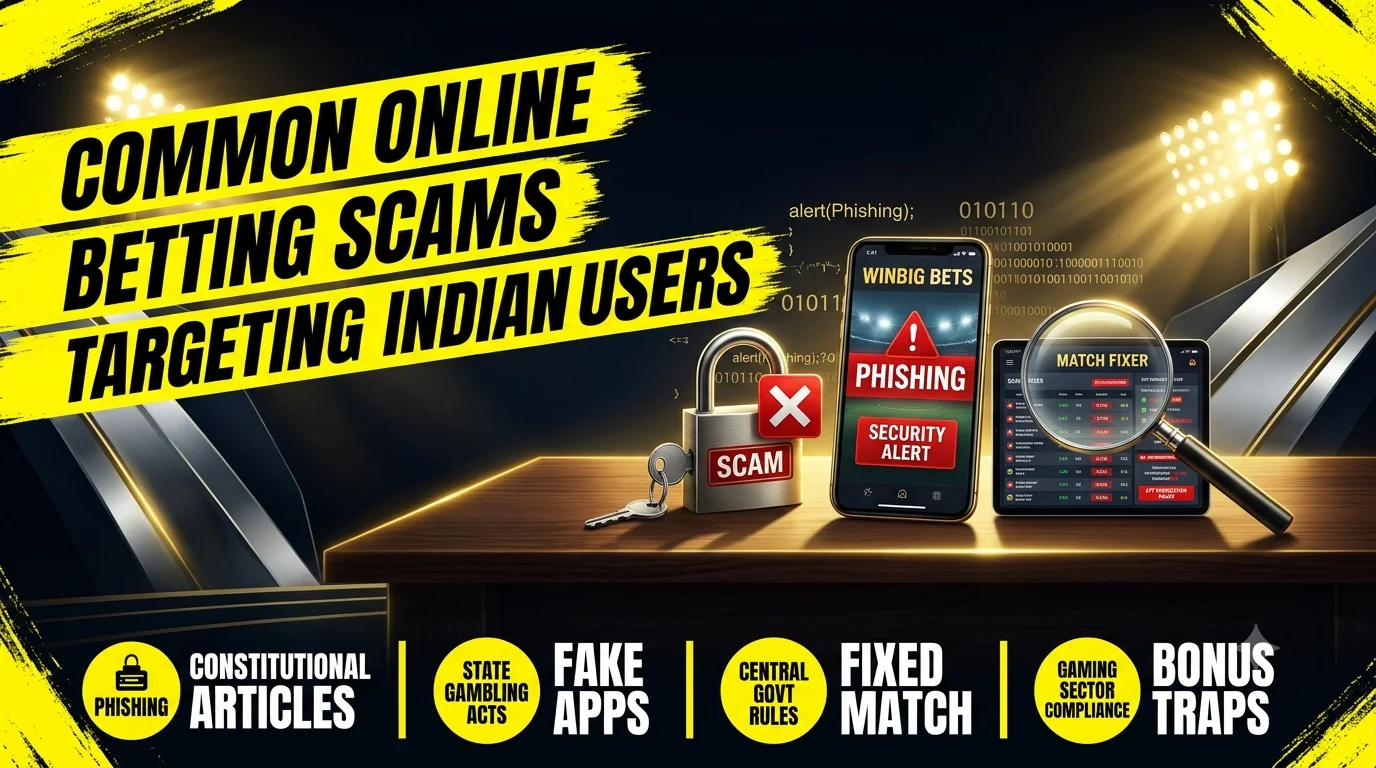
Online betting scams can cause serious financial losses, identity theft, account compromise, and exposure of sensitive banking information. Fraudsters may use fake betting websites, manipulated screenshots, fraudulent withdrawal demands, impersonated customer support, and messaging groups promising guaranteed cricket predictions to deceive Indian users.
People researching betting sites in india should understand that a professional-looking website or active social media presence does not establish legitimacy. A platform may display impressive graphics, payment logos, or claims about international licensing without providing independently verifiable evidence.
Scams can appear during account registration, deposits, withdrawals, customer-support conversations, or app downloads. Some criminals also target people who have already lost money by offering fake recovery services.
Indian users face additional considerations because online money gaming is subject to national restrictions and applicable state gambling laws. Website accessibility does not establish legal authorization.
This guide explains common online betting fraud methods, their warning signs, how to protect personal information, what to do after suspected fraud, and how to report suspicious activity in India.
Common online betting scams in India include fake betting websites, guaranteed-win prediction groups, fraudulent withdrawal fees, phishing messages, fake support agents, and malicious betting apps. Warning signs include requests for OTPs, advance payments to release winnings, unverifiable licenses, and pressure to act immediately. If fraud occurs, contact your bank, report it through India's cybercrime system, and preserve evidence.
What Are Online Betting Scams?
Online betting scams are deceptive schemes that use gambling-related websites, applications, advertisements, or communications to obtain money, personal information, or account access.
They may imitate legitimate-looking online services or exploit interest in cricket betting, casino games, and sports predictions.
Not every unsuccessful wager is a scam. Gambling involves uncertain outcomes and potential losses. Fraud, by contrast, involves deception, misrepresentation, unauthorized access, or dishonest handling of funds.
Why are betting users targeted?
Fraudsters may exploit the financial expectations associated with gambling.
Someone anticipating a payout may be more receptive to a message claiming that a withdrawal is temporarily blocked.
Likewise, users interested in sporting outcomes may encounter misleading advertisements promising access to supposedly exclusive predictions.
The combination of financial transactions, private account details, and urgent communication creates opportunities for manipulation.
Are scams limited to gambling websites?
No.
Fraud can originate through messaging applications, social media accounts, search advertisements, fake customer-support profiles, and malicious mobile applications.
A victim may never visit a functioning gambling website before losing money.
1. Fake Betting Websites and Cloned Platforms
Fake betting websites imitate the appearance of established gambling brands or create entirely fictional operators.
They may display familiar sports imagery, account dashboards, promotional banners, and payment instructions.
The objective may be to collect deposits, harvest credentials, or obtain personal documents.
How cloned websites deceive users
A cloned website may closely resemble another platform while using a slightly different domain name.
Differences may include extra characters, altered spelling, or unfamiliar domain extensions.
Fraudsters can also reproduce logos and website layouts without authorization.
Warning signs
-
No identifiable legal operator
-
Unverifiable licensing claims
-
Conflicting company information
-
Requests for payment to personal accounts
-
Unusual registration demands
-
Pressure to deposit immediately
How to reduce the risk
Independently verify the website's identity and claimed operator.
Do not assume that a familiar logo or attractive interface proves authenticity.
Users researching betting websites in india should also consider whether the underlying service is legally permitted under applicable Indian law.
2. Guaranteed-Win Cricket Prediction Scams
Cricket prediction scams often claim that a person or group has access to guaranteed match results.
These schemes may appear during major tournaments, including the Indian Premier League and international cricket competitions.
Fraudsters may charge for supposedly exclusive predictions or demand a percentage of anticipated winnings.
How the deception works
A scammer may distribute different predictions to separate groups.
After a match, the scammer highlights only the successful predictions and presents them as evidence of exceptional accuracy.
This selective presentation can create a misleading impression of reliability.
Why guaranteed predictions are suspicious
Sporting outcomes are uncertain.
No individual can legitimately guarantee every match result or player performance.
Claims involving fixed matches, secret insider information, or risk-free profits require particular caution.
What users should remember
Do not pay for guaranteed-win promises.
Avoid transferring money to individuals who claim they can manipulate match outcomes.
Such claims may involve fraud and potentially other unlawful conduct.
3. Fake Withdrawal Fees and Payment Demands
Fraudulent withdrawal demands are among the most recognizable betting-related scam patterns.
A user may be told that funds cannot be released until an additional payment is made.
The supposed charge might be described as a verification fee, tax clearance, account activation cost, or security deposit.
Common warning signs
The strongest warning sign is a demand to transfer additional money to an unfamiliar account to receive an existing balance.
Scammers may also invent deadlines or threaten permanent account suspension.
Are all withdrawal delays fraudulent?
No.
A delay alone does not prove fraud. Financial transactions can be affected by technical problems, compliance procedures, or disputes.
However, unexplained fees, changing payment instructions, and demands for sensitive credentials are significant warning signs.
What should users do?
Stop making additional payments while the situation remains unresolved.
Preserve screenshots, transaction references, and relevant communications.
Contact the payment provider if fraud is suspected.
4. Fake Customer Support and Account Recovery Scams
Fraudsters sometimes impersonate customer-support representatives.
They may approach users through social media, messaging applications, or unsolicited phone calls.
Their messages often claim that an account requires immediate verification.
Common impersonation tactics
A fake representative may request:
-
Account passwords
-
One-time passwords
-
Banking credentials
-
Remote access to a device
-
Identity documents
-
Additional payments
A legitimate verification process should never require users to disclose banking passwords or authentication codes to an unknown person.
How to verify support contacts
Check whether the operator clearly identifies its legal entity and support procedures.
Avoid trusting contact details posted by unrelated social media accounts.
Do not assume that a profile using a brand's logo is authorized to represent that brand.
5. Phishing Messages and Fake Login Pages
Phishing involves deceptive communications designed to obtain credentials or other sensitive information.
A fraudulent message may claim that an account has been locked or that a withdrawal requires immediate confirmation.
The link may lead to a page designed to resemble a familiar login screen.
How to recognize phishing
Common indicators include unexpected messages, unusual sender identities, suspicious links, urgent threats, and requests for confidential information.
However, sophisticated phishing messages may contain few obvious spelling or formatting mistakes.
What happens after credentials are stolen?
Criminals may attempt to access other accounts, particularly when passwords have been reused.
They may also use stolen personal information for additional fraud.
How to protect accounts
Use unique passwords and enable available multifactor authentication.
Never disclose OTPs to someone contacting you unexpectedly.
If credentials have been exposed, change them promptly through trusted account-access channels.
6. Malicious Betting Apps and APK Downloads
Fraudulent mobile applications may imitate betting platforms or advertise access to exclusive gaming services.
Some are distributed through unofficial download links rather than established application marketplaces.
Why unverified APK files are risky
An APK file may contain software capable of collecting personal information, monitoring activity, or abusing device permissions.
The risk is particularly serious when an application requests access unrelated to its stated purpose.
Does an app store listing prove legitimacy?
No.
Availability through an application marketplace does not establish gambling authorization or guarantee that software is free from security risks.
Users should separately assess the developer, permissions, and applicable legal restrictions.
What if a suspicious app is already installed?
Stop using the application and review its permissions.
Follow trusted device-security guidance, scan the device using reputable security software, and secure potentially exposed accounts.
If financial credentials may have been compromised, contact the relevant financial institution.
7. Fake Bonuses, Cashback, and Promotional Offers
Fraudulent promotions may promise unusually large rewards in exchange for deposits or personal information.
Some advertisements create a false sense of urgency by claiming that an offer expires within minutes.
Others impersonate familiar brands.
How promotional scams work
A scammer may ask for an advance payment before releasing a supposed reward.
Alternatively, the user may be directed to a fraudulent registration form that collects identity details.
Why bonus screenshots are unreliable
Screenshots can be edited or fabricated.
An image showing a large balance or successful withdrawal does not independently prove that the payment occurred.
What should users check?
Treat unusually generous claims with skepticism.
Avoid providing sensitive information merely to claim a promotional reward.
Remember that a bonus advertisement does not establish that the underlying gambling activity is lawful.
8. Social Media Influencer and Telegram Group Scams
Betting-related fraud frequently uses the appearance of social proof.
A messaging group may display numerous enthusiastic comments, screenshots of supposed winnings, or testimonials from alleged customers.
These materials can be fabricated.
Fake testimonials
Fraudsters may create multiple accounts to post positive comments.
They may also recycle images or use edited transaction screenshots.
A large number of favorable messages does not independently establish credibility.
Paid prediction groups
Some groups demand subscription payments for exclusive sporting predictions.
The presence of a paid subscription does not automatically mean fraud, but guaranteed-return claims and fabricated performance records are warning signs.
Pressure tactics
Users may be told that only a few memberships remain or that a profitable opportunity will disappear immediately.
Such pressure is intended to discourage independent verification.
9. UPI and Bank Transfer Scams
Fraudulent payment instructions can expose Indian users to significant financial losses.
Scammers may request transfers to unrelated individuals or unfamiliar business accounts.
They may also send deceptive payment requests or ask users to approve transactions under false pretenses.
Common UPI warning signs
A request to enter a UPI PIN to receive money is suspicious.
In ordinary UPI transactions, the PIN authorizes a debit, not a routine incoming payment.
Users should carefully inspect transaction details before approving any payment.
What if the recipient changes repeatedly?
Repeated changes in payment recipients may warrant additional scrutiny.
The user should understand who is receiving the money and why.
Do not proceed simply because an unknown contact claims that the change is normal.
What if money has already been transferred?
Contact the bank or payment provider immediately.
Report suspected cyber-enabled financial fraud through the appropriate Indian reporting channels.
Preserve transaction IDs and communication records.
10. Fake Gambling Licenses and Regulatory Approval Claims
Some fraudulent websites claim to hold gambling licenses that cannot be independently verified.
Others display genuine-looking regulatory seals without providing a traceable authorization number.
How to verify a licensing claim
Identify the operator, claimed regulator, and license number.
Then independently check the regulator's official records.
Where available, compare the authorized company, domain, permitted activities, and current license status.
Does foreign licensing establish legality in India?
No.
A foreign gambling license does not automatically authorize services under Indian national or state law.
This is especially important when reviewing gambling sites in india.
What if a website claims government approval?
Request independently verifiable evidence.
Company registration, tax documentation, and payment-processing arrangements are not substitutes for gambling authorization.
11. Fake Cricket Betting and India Match Scams
Scammers frequently exploit public interest in Indian cricket.
Searches such as bet on india may expose users to advertisements, prediction channels, or websites claiming special knowledge of India's match outcomes.
The sporting context can make a scam appear more familiar.
Fake match-fixing claims
A scammer may claim to know the result of a cricket match before it takes place.
Such claims may be used to demand advance payments.
There is no reliable basis for treating an unverified insider claim as proof of a predetermined result.
Fake betting accounts
Fraudsters may claim that users need a special account or paid membership to access exclusive markets.
The account may never be provided, or the credentials may lead to a fraudulent website.
How to respond
Avoid paying for supposed fixed-match information.
Do not share banking credentials or identity documents with unknown intermediaries.
Remember that sports-related advertising does not establish legal authorization.
12. Search-Result and Brand Impersonation Scams
Fraudulent websites may attempt to appear in search results for popular gambling-related phrases.
A search for india bet, for example, may produce results from different operators, advertisements, and unrelated websites.
The search phrase itself does not establish that any particular result is trustworthy.
Why search ranking is not proof
A prominent search result does not necessarily mean a website is licensed, secure, or legally authorized.
Paid advertisements are also not equivalent to regulatory approval.
How to identify impersonation
Compare domain names carefully and independently verify the operator's legal identity.
Be cautious when a website claims to represent another company without clear supporting evidence.
Online Betting Scam Warning Signs: Comparison Table
|
Scam type |
Typical warning sign |
Recommended response |
|---|---|---|
|
Fake betting website |
Unverifiable operator or copied branding |
Avoid sharing information until verified |
|
Guaranteed-win predictions |
Claims of certain profits |
Do not pay for guaranteed results |
|
Withdrawal scam |
Advance fee demanded to release funds |
Stop additional payments |
|
Fake support agent |
Requests for passwords or OTPs |
Do not disclose credentials |
|
Phishing |
Unexpected account-verification link |
Verify independently |
|
Malicious APK |
Untrusted download or excessive permissions |
Avoid installation |
|
UPI fraud |
Payment authorization disguised as receiving money |
Reject suspicious requests |
|
Fake license |
No matching regulator record |
Treat authorization as unverified |
|
Recovery scam |
Upfront payment to recover lost funds |
Avoid paying unknown recovery agents |
Why Rajasthan Users Should Be Especially Careful
Users searching for rajasthan betting information should consider both cybersecurity risks and applicable gambling restrictions.
Rajasthan has its own gambling legislation, including the Rajasthan Public Gambling Ordinance, 1949.
National online gaming laws may also apply to relevant internet-based money gaming activities.
Does a website become legal because it works in Rajasthan?
No.
Technical accessibility does not establish legal permission.
A website may load successfully in Jaipur, Jodhpur, Udaipur, Kota, or another location without being authorized to provide gambling services.
Can fraud be reported even if the website operates offshore?
Suspected cyber-enabled financial fraud can still be reported to appropriate Indian authorities.
Cross-border investigations may be more complicated, but users should preserve evidence and report suspected offences promptly.
What to Do After an Online Betting Scam
If you believe you have been defrauded, acting quickly can help protect accounts and preserve evidence.
Step-by-step response
-
Stop sending money. Do not pay additional fees to unlock supposed winnings or recover previous transfers.
-
Contact your bank or payment provider. Report suspected unauthorized or fraudulent transactions immediately.
-
Secure your accounts. Change compromised passwords and review available security settings.
-
Preserve evidence. Save screenshots, transaction references, messages, website addresses, and relevant dates.
-
Report the incident. Use India's National Cyber Crime Reporting Portal or the designated cyber-fraud reporting helpline.
-
Check your devices. Investigate suspicious applications and unexpected permissions.
-
Avoid recovery scams. Do not pay strangers who promise guaranteed refunds.
Reporting cybercrime in India
India's National Cyber Crime Reporting Portal is intended for reporting cybercrime complaints.
The cyber-fraud helpline 1930 is also used for reporting suspected financial cybercrime.
Reporting promptly is important, although recovery of transferred funds cannot be guaranteed.
How to Evaluate Betting Sites in India More Carefully
Users should approach gambling-related websites with attention to legal compliance, transparency, and information security.
A professional appearance is not enough.
Practical due-diligence checklist
Before sharing personal information:
-
Identify the operator's legal entity.
-
Check whether licensing claims can be independently verified.
-
Consider applicable Indian gambling laws.
-
Examine the website's privacy disclosures.
-
Avoid sharing passwords and OTPs.
-
Review the legitimacy of payment requests.
-
Be skeptical of guaranteed-return claims.
-
Avoid unknown APK files and unofficial support contacts.
Even when a website passes some checks, that does not establish that gambling through it is lawful or financially safe.
Responsible Gambling and Financial Safety
Scams are not the only financial risk associated with gambling.
Even without fraud, wagering can result in losses.
Repeatedly trying to recover previous losses can increase financial harm.
People experiencing gambling-related difficulties should avoid borrowing money to participate and consider seeking professional support.
No betting system can guarantee profits, and gambling should not be treated as a reliable income source.
Frequently Asked Questions About Online Betting Scams
1. What are the most common online betting scams in India?
Common scams include fake betting websites, fraudulent withdrawal fees, guaranteed-win prediction groups, phishing links, fake customer support, malicious APK files, and UPI payment fraud. These schemes may involve stolen credentials, unauthorized transactions, or deceptive requests for additional payments. Independent verification and careful handling of financial information are essential.
2. How can I tell whether a betting website is fake?
Check whether the operator identifies a verifiable legal entity, whether licensing claims match official records, and whether payment instructions are consistent and transparent. Copied branding, guaranteed profits, unexplained fees, and requests for sensitive credentials are warning signs. A professional website design alone does not establish legitimacy.
3. Are guaranteed cricket betting predictions real?
No one can reliably guarantee every cricket result. Claims involving certain winnings, secret fixed matches, or risk-free predictions should be treated with skepticism. Fraudsters may use selective screenshots and fabricated testimonials to exaggerate their success. Avoid paying unknown individuals for promises of guaranteed sporting outcomes.
4. What should I do if a betting website demands a withdrawal fee?
Do not automatically send additional money. Preserve the request and examine whether the demand is supported by verifiable information. If the operator insists on unexplained advance payments to release funds, that is a significant warning sign. Contact the relevant payment provider if fraud is suspected.
5. Can a fake betting app steal banking information?
Yes. Malicious applications may request excessive permissions, collect sensitive information, or compromise device security. Avoid downloading unverified APK files or disabling security protections. If a suspicious application has been installed, review permissions, secure affected accounts, and follow trusted device-security guidance.
6. How can I report an online betting scam in India?
Suspected cyber-enabled financial fraud can be reported through India's National Cyber Crime Reporting Portal or the cyber-fraud helpline 1930. Contact your bank or payment provider promptly and preserve transaction references, messages, and screenshots. Reporting does not guarantee recovery, but timely action may improve the available response options.
7. Are Telegram cricket prediction groups trustworthy?
A Telegram group is not trustworthy merely because it has many members or displays successful prediction screenshots. Membership figures, testimonials, and transaction images can be manipulated. Guaranteed-profit claims, pressure to pay immediately, and requests for sensitive information are warning signs that warrant caution.
8. Can scammers impersonate legitimate betting brands?
Yes. Fraudsters can copy logos, create similar domain names, and operate fake support profiles. Users should independently verify the operator and avoid trusting unsolicited messages. A familiar brand name does not prove that the person contacting you is authorized to represent the business.
9. Are online betting scams common in Rajasthan?
Rajasthan residents can encounter the same types of online betting fraud affecting users elsewhere in India, including fake websites, fraudulent payment requests, and phishing. The precise prevalence of these scams should not be assumed without reliable statistics. Residents should also consider applicable Rajasthan gambling legislation and national online gaming restrictions.
10. Does a foreign gambling license protect Indian users from scams?
Not automatically. A foreign license may indicate regulatory oversight in another jurisdiction, but it does not guarantee protection from fraud or establish Indian legal authorization. Users should independently verify the license, identify the operator, and understand the limits of any available complaint or dispute-resolution mechanisms.
11. Can I recover money lost to a fake betting website?
Recovery may be possible in some circumstances, but it is not guaranteed. Contact the relevant bank or payment provider immediately, report suspected cybercrime, and preserve evidence. Avoid paying unknown recovery agents who demand upfront fees or promise certain refunds, as these offers may themselves be fraudulent.
12. What is the safest way to avoid betting-related fraud?
The strongest preventive approach is to avoid unverified gambling services, refuse guaranteed-profit offers, protect account credentials, and never authorize suspicious payments. Check applicable legal restrictions before considering any gambling activity. Remember that even a non-fraudulent gambling product can involve significant financial risk.
Online betting scams targeting Indian users can involve fake websites, misleading cricket predictions, fraudulent withdrawal demands, phishing, malicious applications, and payment impersonation. Recognizing these methods can help users protect personal information and respond more effectively when suspicious activity occurs.
Anyone researching betting sites in India should prioritize independent verification, financial security, and legal compliance. Website accessibility, promotional claims, and foreign licensing do not establish that an operator is trustworthy or legally authorized.
If fraud is suspected, stop further payments, secure affected accounts, preserve evidence, and contact the appropriate bank and cybercrime reporting authorities promptly.
Readers encountering brands such as Mahadev Book should independently verify the operator's identity, regulatory claims, and applicable legal status before sharing personal information or considering financial transactions. This article does not establish that the named brand is licensed, legally authorized, or free from financial and cybersecurity risks.