
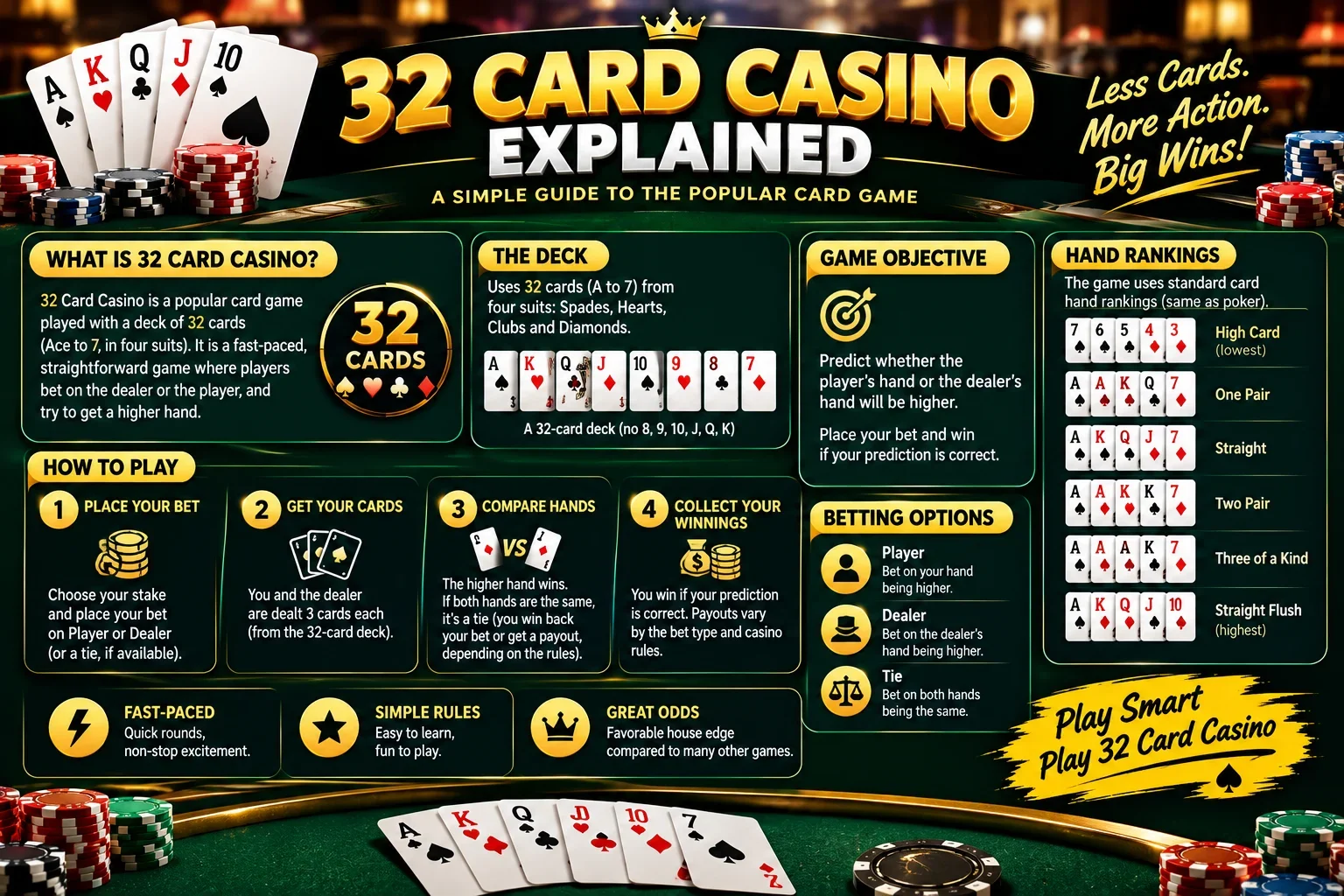
The 32 Cards games in the Mahadev Book casino lobby look like standard card games and behave differently, because removing the twos through sixes from a Mahadev Book deck reshapes every probability in the game. High cards are proportionally more common, pairs and sequences arrive more often, and the hands that feel rare in a full-deck game are routine here. Players who arrive assuming standard poker probabilities make systematically wrong decisions, usually by overvaluing hands that the reduced deck produces constantly. Chat on WhatsApp with +918796447546 for a Mahadev Book ID that opens the live 32 Cards tables, then read the four variants below before you sit down.
The Mahadev Book 32 Cards Casino Explained covers the mechanics in more depth if you want the full picture first.
Variant One: 3 Card 32 Cards
This is the most common Mahadev Book 32 Cards version and the one most players meet first. Each side receives three Mahadev Book cards and the higher ranking hand wins, with the hierarchy running from trail through pure sequence, sequence, colour, pair and high card. Because the deck is reduced, a Mahadev Book trail arrives far more often than three of a kind does in a full-deck game, and a pure sequence is considerably less rare than intuition suggests. The practical consequence is that you should fold or avoid backing hands that would look strong in poker. A pair of jacks is a genuinely weak holding here, and players who back it because it looks respectable lose steadily over a session. Learning the adjusted Mahadev Book 32 Cards hierarchy is the entire skill, and it takes perhaps twenty hands to internalise properly.
Variant Two: 6 Card 32 Cards
Mahadev Book six-card versions deal three cards to each of two positions and combine them into a larger hand, which introduces hand types that do not exist in the three-card game. Full houses, quads and higher flushes all become possible, and the ranking order shifts accordingly. The Mahadev Book pace is slower than the three-card variant because more cards are dealt and more comparison is needed, which suits players who prefer time to think over volume of rounds. The house edge is generally in a similar range, but the variance differs, because larger hands produce more decisive outcomes. Players who move between the two variants without adjusting their expectations are the ones who get surprised, since a hand that wins consistently in the three-card game can be routine and worthless in the six-card one.
Variant Three: 29 Baccarat
This Mahadev Book variant blends baccarat scoring with the reduced deck, and it plays faster than the poker-style versions because decisions are simpler. Cards are valued close to their baccarat equivalents, totals are compared modulo ten, and the side closer to nine wins. The reduced deck shifts the distribution of totals, which changes the relative value of backing each position compared with standard baccarat. Tie bets pay attractively and carry a substantially higher edge, which is why they exist and why they should be treated as occasional entertainment rather than a route to winnings. Mahadev Book players who stick to the two main positions experience the lowest edge available in the game, and that single choice affects long-run results more than any pattern of betting ever will.
Variant Four: Luck-Based and Side Bet Formats
Some Mahadev Book 32 Cards tables add side bets on specific outcomes such as whether a particular hand type appears, or which position wins by a defined margin. These pay well and carry a much higher edge than the main game, and they are the fastest way to deplete a session budget in the Mahadev Book casino lobby. That does not mean avoiding them entirely; it means sizing them separately and capping them at a small fixed amount so that a run of losses cannot affect your main session. The rule worth following is simple: if a side bet is the reason you joined the table, you are playing a different game from the one with the reasonable edge, and you should budget for it accordingly. Reading the Mahadev Book paytable before your first side bet takes ten seconds and prevents the most common expensive surprise.
How the House Edge Actually Affects You
The Mahadev Book 32 Cards house edge is a percentage of each stake that the game retains on average over a very large number of rounds, and it is worth understanding what that does and does not mean. Over forty rounds it tells you almost nothing, because variance dominates and you can easily finish ahead. Over four thousand rounds it tells you nearly everything, because the average asserts itself. The practical implication is that session length is the variable you control that matters most. A Mahadev Book player who plays forty rounds at a fixed stake and stops is buying a bounded amount of entertainment at a known price. A player who plays for six hours at the same stake is exposing themselves to the edge four hundred times, and the expected result is a loss. Neither outcome is about skill, and both are entirely predictable.
Live Dealer Versus Software Tables
The Mahadev Book lobby typically offers both, and the difference affects your experience more than players expect. A live dealer table streams a real person dealing from a real shoe, which means you can watch the shuffle and the deal, and rounds move at human pace with time to think between decisions. A software table deals faster, which increases rounds per hour and therefore increases how many times the edge acts on your budget in the same amount of time. For a Mahadev Book beginner, the live 32 Cards table is objectively the better choice, because the slower pace allows the adjusted hierarchy to become familiar before money is at serious risk. Faster formats suit players who already know the rankings cold and want volume. The comparison between Mahadev Book Live Casino Guide covers fairness and latency in detail.
Stake Structure for a Card Session
Convert your Mahadev Book session budget into units before you join a table and stake one unit per round. A budget of forty units gives you forty rounds at a fixed stake, which sets a natural stopping point and removes mid-session decisions about sizing. The alternative is deciding each round how much to stake, and that decision reliably drifts upward after losses and near misses, which are the two moments when judgement is worst. Unit staking also makes your results interpretable, because you can see at a glance whether you played forty rounds at one unit or forty rounds at escalating amounts. The second pattern is what hurts, and it is visible in your own history long before it becomes visible in your bank balance.
Reading the Table Before You Join
Thirty seconds of observation costs nothing and prevents most table-level surprises. Check the Mahadev Book minimum and maximum stakes, because joining a table whose minimum is a meaningful fraction of your budget forces decisions you cannot afford. Watch two or three Mahadev Book 32 Cards rounds to gauge the pace, since a fast table suits volume players and a slow table suits deliberate ones. Confirm the stream is stable, because a lagging feed on a card game means you may act without seeing the current state. Look at how many seats are filled, since a full table produces a different rhythm from a two-player contest. And read the Mahadev Book rules panel for the specific variant, because the differences between 32 Cards formats are exactly the kind of detail that causes expensive misunderstandings when assumed rather than checked.
Getting an ID and Starting Properly
The practical route is short. Chat on WhatsApp with +918796447546 and request a Mahadev Book ID, which opens the full casino lobby including every 32 Cards table. Deposit a modest Mahadev Book Payment from a bank account in your own name so that a later Mahadev Book Withdrawal is not held for a name-matching review. Sign in, open the Mahadev Book casino lobby, and spend five minutes watching a table before joining it. Set your Mahadev Book stake and your round limit before the first round rather than after the third. Play at the lowest stakes available until the adjusted hierarchy is completely automatic, which usually takes a couple of dozen hands. The Mahadev Book Casino Games page lists what is currently running, which makes it easy to compare variants and stake ranges before you commit a session budget to any one of them.
Keeping the Session Contained
Mahadev Book 32 Cards games resolve quickly, and speed is what turns a small budget into a large loss. Set a Mahadev Book round limit before you sit down and honour it whether you are ahead or behind, because the value of a limit is entirely in whether you respect it. Stop when you reach your time limit as well, since fatigue degrades decision quality faster than losses do. Request a Mahadev Book Withdrawal at the end of a session rather than leaving winnings in the account as an available balance, because money moved out cannot be lost in round forty-one. If you find yourself playing past a planned limit, raising stakes without deciding to, or thinking about the game when you are not playing it, take that seriously. The Mahadev Book Responsible Gaming page explains the limits and tools available, and setting them before your first session is far easier than applying them during a bad run.
How the Reduced Deck Changes Hand Value
The practical consequence of removing eight Mahadev Book ranks is that intuition built on poker becomes actively harmful. In a full deck, three of a kind is rare enough to be exciting; in a 32-card deck it arrives often enough to be routine, which means betting heavily on it produces poor returns relative to the risk. Pure sequences become more frequent for the same reason, and colour hands arrive constantly. What genuinely remains strong is a high trail, and even that is less decisive than a poker player expects. The correction is not complicated: halve your estimate of how strong any given Mahadev Book hand is, and adjust your staking accordingly. Players who make that single adjustment stop losing to hands they should have folded, which is the majority of losses at this table rather than a minority of them.
Table Etiquette and Pace at a Live Dealer Game
Mahadev Book 32 Cards live tables run at human pace, and understanding the rhythm prevents avoidable mistakes. There is a betting window before each round and it closes on the dealer's signal, so placing a stake late can result in it being rejected or, worse, accepted against a state you did not see. Waiting for the window to open rather than rushing a stake into a closing one is a habit worth building. Watching the dealer's announcements matters too, since variant rules are usually stated verbally as well as displayed. And keeping your stake plan visible on paper next to the screen helps more than players expect, because at a table where rounds arrive every minute it is remarkably easy to lose track of what you intended to stake and to find yourself doubling without ever deciding to.
Comparing 32 Cards With Teen Patti
The two games share a heritage and differ in ways that matter for a player choosing between them. Mahadev Book Teen Patti uses a full deck and involves decisions about when to look at your cards and when to fold, which means skill affects results across a session. Mahadev Book 32 Cards uses a reduced deck and, in most variants, resolves through hand comparison with limited decision points, which moves it closer to pure chance. Both are social, both resolve quickly, and both are enjoyed by the same players. The honest distinction is that Teen Patti rewards judgement and 32 Cards rewards discipline. If you want your decisions to matter, choose Teen Patti. If you want a simpler experience with a fixed budget and a round limit, 32 Cards delivers it without requiring you to read opponents.
Recording a Card Session Properly
Most players record results and learn nothing, because results over forty rounds are dominated by variance. What is worth recording is behaviour. Note the Mahadev Book stake you planned for each round and the stake you actually used, and flag every round where they differed. Note the round number at which you stopped and whether it matched your plan. Note whether you played side bets and how they affected the session. Over three sessions those notes show exactly where your discipline breaks, which for most people is the same place every time. That is genuinely actionable information in a way that net profit never is, and it is the only record that will change how you play next week rather than simply documenting how this week went.
18+ only. Play responsibly. Betting involves financial risk; never stake money you cannot afford to lose. Online betting legality varies by jurisdiction.