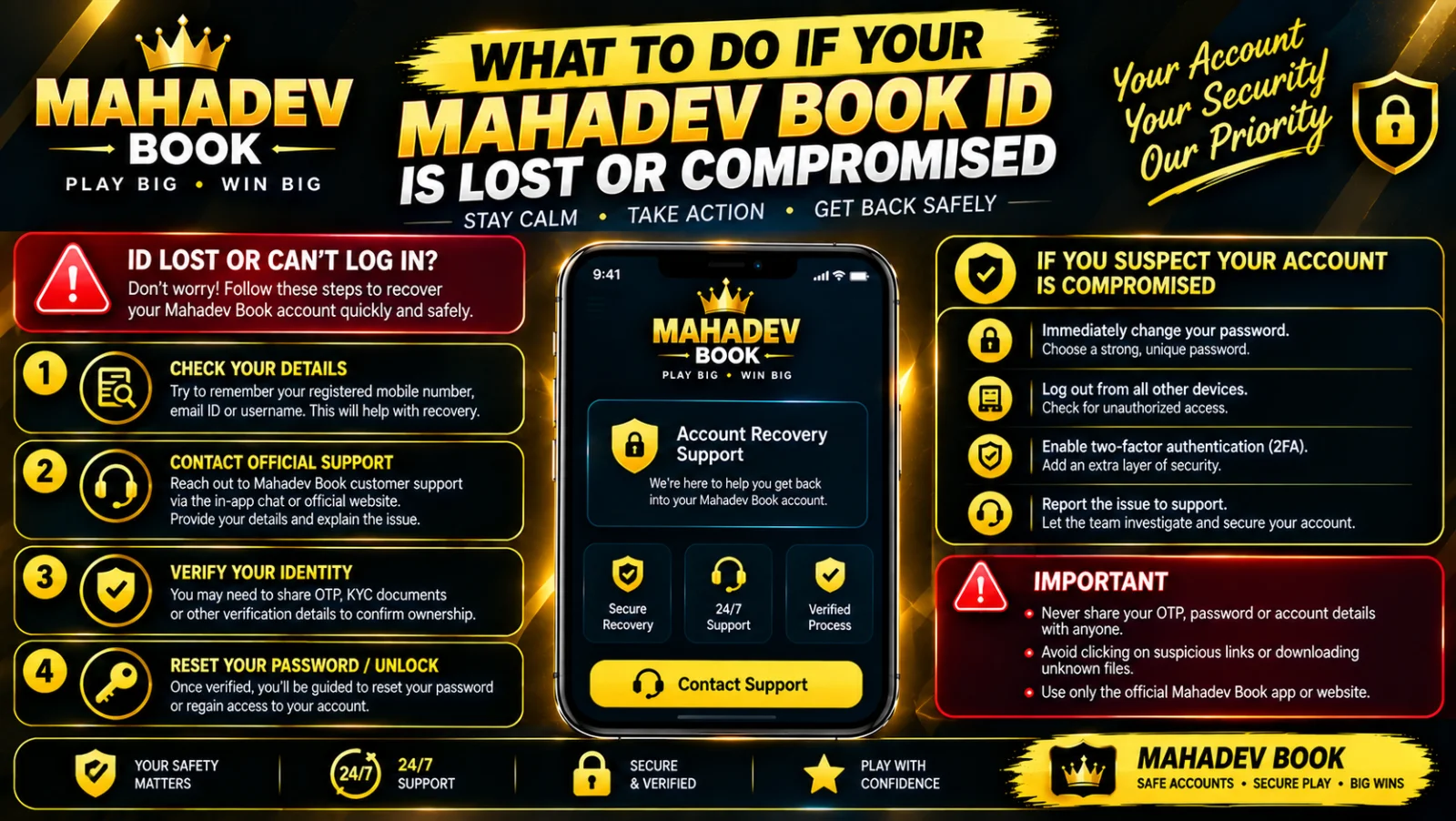

A Checklist Costs an Evening and Saves Months
Opening a Mahadev Book account takes two minutes, and that speed is precisely why people skip the preparation that would protect them. A Mahadev Book account is a financial relationship: money moves in, positions are held, money moves out, and every step has rules attached. Running through the six checks below before you register costs an evening and removes almost every cause of the problems users complain about later, from held withdrawals to locked logins to settlement disputes that turn out to be misunderstandings. None of it is complicated. Chat on WhatsApp with +918796447546 when you reach the registration step, and use the rest of this guide as the preparation that makes that conversation productive rather than exploratory.
Step One: Verify the Source Before Anything Else
Confirm you are dealing with the genuine operator rather than a reseller, and the test is practical rather than philosophical. Check that the website domain matches what you expect, character by character, because lookalike spellings are the standard trick. Confirm the Mahadev Book WhatsApp number is one you found on the official site rather than one that arrived in an unsolicited message. Ask a direct operational question early, such as how a Mahadev Book Withdrawal is requested and what the usual timeframe is, and judge the answer: a genuine desk gives a specific reply in one message, while a reseller deflects to bonuses or pushes you toward a second contact. If anyone asks you to transfer to a personal number for faster processing, stop there, because that handover is where most ID scams in the Mahadev Book market actually happen.
Step Two: Prepare the Details You Will Need
Have three things ready before you message anyone. A Mahadev Book ID username you can type quickly without looking, chosen in advance so you are not inventing one under pressure. A bank account registered in your own name, because deposits and payouts must match, and third-party transfers are the most common reason a Mahadev Book Payment gets held for review. And a clear idea of the amount you intend to start with, decided before the conversation rather than during it. What you do not need is any identity document at this stage, and you should be wary of anyone requesting one before a deposit has been discussed. Preparing these three items takes five minutes and it turns the registration conversation into a two-minute exchange rather than a scattered back-and-forth across an hour.
Step Three: Read the Rules That Will Govern Your Money
This is the step nobody takes and the one that prevents the most disputes. Understand how markets settle, because settlement follows the official result of an event rather than anybody's opinion of it. Understand what happens to a void market, a postponed fixture or an abandoned match, since those conditions determine whether your stake returns. Understand commission, which is usually charged on net winnings rather than turnover and which changes the margin you need simply to break even. Understand bonus conditions, because wagering requirements and eligible markets decide whether promotional funds can ever become withdrawable cash. The Mahadev Book Rules and Regulations page covers all of this, and reading it once costs fifteen minutes and removes the majority of the frustration that users experience in their first three months of betting.
Step Four: Set Your Limits Before the First Deposit
Decide your weekly Mahadev Book deposit ceiling in advance and write it down, because the number you choose while calm is the only one worth having. Treat that figure as spent the moment it leaves your bank, which is the mental shift that keeps a losing session from becoming a serious problem. Set your stake size as a fixed percentage of the ceiling so it does not creep upward after a win, which is the pattern that turns a good week into a bad one. Decide in advance what you will do after three consecutive losses, and make the answer a break rather than a bigger stake. None of this restricts enjoyment; it is the reason enjoyment continues. The Mahadev Book Responsible Gaming page explains the tools available for self-limiting, and reading it before you need it is far more useful than discovering it during a bad run.
Step Five: Deposit Small and Test Everything
Your first Mahadev Book Payment should be modest, and it should be followed by four tests rather than by betting. Sign in and confirm the Mahadev Book ID username matches what you were issued. Check that the Mahadev Book balance equals what you transferred. Change the temporary Mahadev Book Login password to something unique immediately. Place one small bet on a market you understand and confirm it appears in your bet history with the correct stake. Those four checks prove the Mahadev Book account is live, the Mahadev Book Payment is credited, the Mahadev Book odds engine works and you can read your own history, and they take five minutes. Skipping them is how people discover a dead account days later, after the Mahadev Book Support thread has gone quiet and the Mahadev Book Payment is much harder to trace back to a specific instruction from the Mahadev Books team.
Step Six: Run One Withdrawal Before Scaling Up
This is the step almost everyone skips and the most valuable one in the entire checklist. Request a Mahadev Book Withdrawal of a modest amount, roughly what you deposited, and time how long it takes to reach your bank. You are not testing whether Mahadev Book can pay; you are testing whether it pays you, on your details, within the timeframe it quoted. A payout that lands in fifteen minutes tells you the process is real. A payout that stalls with requests for extra verification, a release fee, or a demand to deposit more before unlocking tells you everything you need to know while the amount at risk is still small. The Mahadev Book Withdrawal Guide sets out what normal looks like, and it is the benchmark to judge your first payout against rather than your own optimism.
Choosing a Username That Will Not Cause Trouble
Your Mahadev Book ID username is usually permanent, so choose it with the same care you would give an email address. Avoid your full legal name, your birth year, or anything that appears in your social media handles, because a Mahadev Book ID gets shared in group chats more often than people expect and a guessable username is half of a compromised account. Short letter-and-number combinations work best and type quickly on a small screen, which matters when you are messaging support from a venue with poor signal. If your first choice is taken, add two digits rather than switching to a memorable phrase that you will then have to recall under pressure. Write it down somewhere offline for the first week, because misremembering a username in the first few days causes more locked accounts than forgotten passwords do.
Documents, Verification and What Is Reasonable
Some panels request identity confirmation before releasing a large withdrawal, and in regulated markets that is normal practice rather than a red flag. What is not normal is being asked for documents before your first deposit, being asked for a selfie holding your bank card, or being told to send anything to a personal email instead of the official WhatsApp thread. If verification is requested at withdrawal stage, provide the minimum required through the same channel you have used throughout, and keep a copy of exactly what you sent. The Mahadev Book ID Documents Guide lists what a legitimate request looks like, which makes it easy to distinguish a routine compliance step from a stalling tactic dressed up as one.
Payment Methods and the Name-Matching Rule
Mahadev Book deposits run through UPI, Google Pay, PhonePe, Paytm and IMPS, all of which reflect quickly in normal conditions. The rule that causes most first-month trouble is name matching: a payout must reach a bank account whose registered name matches the identity on the betting account, and a deposit from a different name triggers review. The simplest prevention is to deposit only from a Mahadev Book account registered to you, which removes an entire category of delays and means a Mahadev Book Withdrawal later in the month processes without a manual check nobody wants. Always send the transaction reference to the Mahadev Book Support thread immediately after transferring, because that message links the Mahadev Book Payment to your username and prevents the Mahadev Book Payment credit from sitting unallocated while somebody works out whose payment it was.
Keeping One Thread for the Life of the Account
Every advantage in this model depends on one behaviour, and it starts on day one. Pin the Mahadev Book WhatsApp chat with +918796447546 and keep everything there: ID creation, deposit confirmations, market questions, withdrawal requests and any dispute. Scattering these across multiple contacts means no single person can see your history, which turns a two-minute fix into a day of repetition. One thread also means one record that you own and can export, and in any relationship involving money, the person who can produce a clear record is the person who gets resolved first. Building the habit from the beginning costs nothing. Rebuilding a fragmented history three months later, when something has gone wrong and you need it urgently, is considerably harder and considerably more stressful.
What Good Looks Like After One Month
Set a marker for yourself, because it is a useful reality check. After a month of using Mahadev Book you should know your weekly ceiling and have stayed inside it. You should have completed at least one successful withdrawal and know roughly how long yours takes. You should be able to sign in from your chosen device without friction and without a block. You should understand how your usual markets settle, including the void conditions. And you should have a thread with complete records of every transaction. If any of those is missing, fix it before you increase your stakes, because each one is a small thing that becomes a large thing under pressure. Chat on WhatsApp with +918796447546 with questions at any point; asking early is cheaper than asking after a mistake, and Mahadev Book Support answers operational questions plainly whether or not you have deposited yet.
Understanding Exchange Odds Before Your First Stake
Most new Mahadev Book users arrive expecting fixed odds and meet an exchange instead, and the difference changes how every bet behaves. On an exchange you are matched against another participant rather than against Mahadev Book, so prices move with supply and demand rather than being set by a bookmaker's margin. The back price and the lay price sit either side of a market, and the gap between them represents genuine uncertainty. Depth at each price shows how much money is waiting, which determines whether a large stake can be matched without moving the Mahadev Book market. None of this is complicated, but it needs to be understood before money is committed, because a user who expects fixed odds will misread both the price they get and the reason it changed between the moment they looked and the moment they confirmed.
Commission and the Break-Even Margin Nobody Calculates
Commission is usually charged on net winnings rather than on turnover, and it is published in the Mahadev Book panel rules rather than hidden. Knowing the figure before your first deposit matters, because it changes the margin you need simply to break even across a month of betting. A user who ignores commission will consistently find payouts slightly below their mental arithmetic and will conclude something is wrong with the settlement when nothing is. It also explains why certain markets look better value than a fixed-odds alternative while others do not, which is a comparison worth making before you settle into a style. Mahadev Book publishes its terms openly, and users who read them once report far fewer surprises than those who learn the mechanics through their bank balance over several months.
Setting a Review Rhythm Instead of a Reaction Rhythm
How often you review your betting determines whether it stays contained. Reviewing after every match produces emotional decisions, because a single result feels like a pattern when it is noise. Reviewing once a week produces calm ones, because a week of results is enough data to see whether your approach is working. Pick a fixed time, look at your net position, compare it with the ceiling you set in step four, and adjust stake size rather than market choice if the numbers are off. Write down one thing you will do differently next week. That rhythm costs ten minutes and it is the single most effective habit for keeping betting a hobby. Users who review weekly stay inside their limits; users who react match by match almost never do.
When to Walk Away From a New Account
Sometimes the right outcome of a checklist is deciding not to proceed, and that is a legitimate result rather than a failure. If the source will not answer a direct question about withdrawals, walk away. If you are asked for documents before any deposit is discussed, walk away. If you cannot set a weekly ceiling you genuinely intend to respect, do not deposit at all. If a first small withdrawal stalls with demands for more money, stop immediately and ask for a refund. None of these are judgments about Mahadev Book, which operates transparently; they are protections that apply to any operator in any market. The users who lose money in this space are rarely outsmarted by odds. They are the ones who continued past a warning sign that was perfectly visible at the time and entirely cheap to act on.
18+ only. Play responsibly. Betting involves financial risk; never stake money you cannot afford to lose. Online betting legality varies by jurisdiction.