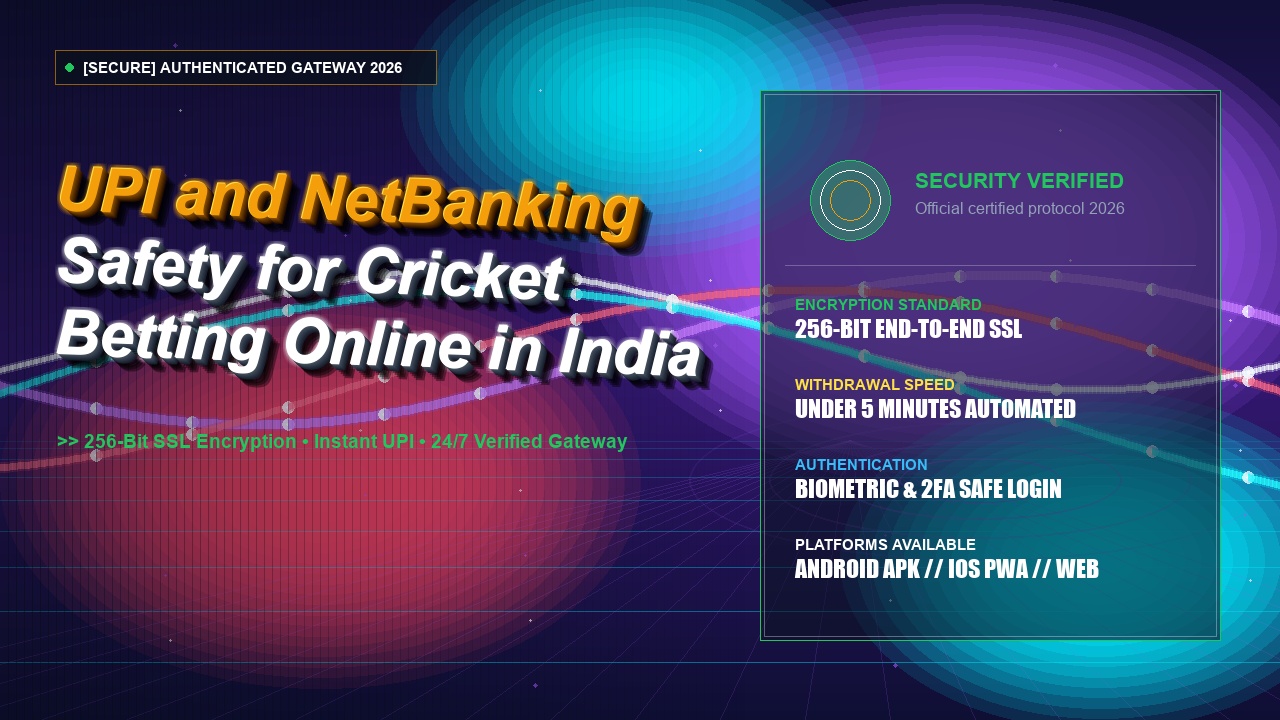
Every rupee you transfer to a cricket betting account leaves a digital trail. The question is whether that trail is protected by bank-grade encryption or exposed to interception. In India, where UPI processes over 10 billion transactions monthly, the convenience of instant deposits often overshadows the underlying security protocols. For the commercial bettor, understanding the difference between a licensed operator's payment gateway and a rogue site's unencrypted form is not optional—it is the first line of defense.
The Payment Security Triad: UPI, NetBanking, and IMPS
When you initiate a deposit on a betting platform, three distinct security layers come into play: the user interface, the payment gateway, and the banking backend. Each has its own vulnerabilities and safeguards.
UPI: Tokenization and Transaction Limits
Unified Payments Interface (UPI) has become the default deposit method for Indian bettors due to its speed and low cost. However, not all UPI integrations are equal. A secure platform will use a tokenized UPI flow, where your Virtual Payment Address (VPA) is replaced by a unique token for each transaction. This prevents merchants from storing your actual VPA, reducing the risk of phishing and unauthorized recurring debits.
Additionally, the National Payments Corporation of India (NPCI) mandates a per-transaction limit of ₹1 lakh for UPI, though many betting sites impose lower caps. Be wary of platforms that encourage you to split large deposits into multiple smaller transactions to bypass limits—this is a common tactic used by unregulated operators to avoid scrutiny.
NetBanking: 2FA and Session Security
NetBanking deposits require you to log in to your bank's portal. The security here depends on your bank's implementation of two-factor authentication (2FA). Most Indian banks now enforce 2FA via OTP or grid-based authentication. However, the risk arises when a betting site asks for your NetBanking credentials directly—never share your login details with a sportsbook. Legitimate platforms redirect you to your bank's secure page, where you complete the transaction without exposing your credentials.
Session hijacking is another concern. Ensure the betting site uses HTTPS with a valid SSL certificate (look for the padlock icon) and that your browser's autofill is disabled for banking pages. Public Wi-Fi should be avoided for NetBanking transactions; use a mobile data connection or a trusted private network.
IMPS: Real-Time Gross Settlement Risks
Immediate Payment Service (IMPS) is often used for withdrawals due to its 24/7 availability. While IMPS is secure, the irreversible nature of the transaction means you must double-check the beneficiary account details. A single typo can send your winnings to the wrong account with no recourse. Reputable operators provide a pre-filled withdrawal form to minimize manual entry errors.
Key Takeaway: The safest payment method is the one that keeps your credentials out of the merchant's hands. UPI tokenization and NetBanking redirection are non-negotiable features of a trustworthy sportsbook.
SSL Encryption and Data Privacy: What to Look For
SSL (Secure Sockets Layer) encryption is the baseline for any financial transaction online. It ensures that data exchanged between your browser and the betting site's server is encrypted and cannot be intercepted by third parties. However, not all SSL certificates are created equal. A valid certificate from a trusted Certificate Authority (CA) such as Let's Encrypt, DigiCert, or Comodo is essential. You can verify this by clicking the padlock icon in your browser's address bar.
Beyond SSL, check the site's privacy policy. Does it clearly state how your personal and financial data is stored? Is data shared with third parties? A compliant platform will adhere to the Digital Personal Data Protection Act (DPDPA) 2023, which mandates consent-based data collection and storage. When evaluating Mahadev Book official platform on regulated platforms, verifying these encryption protocols prevents unnecessary capital risk during high-volatility sessions.
Another red flag is the absence of a clear refund and cancellation policy. Regulated sites provide detailed terms outlining deposit confirmation times, withdrawal processing, and dispute resolution mechanisms. If these are missing, proceed with caution.
KYC Protocols: Why They Protect You
Know Your Customer (KYC) is often viewed as a nuisance, but it is a critical consumer protection tool. A robust KYC process verifies your identity, age, and address, preventing identity theft and underage gambling. In India, KYC norms for financial transactions are governed by the Reserve Bank of India (RBI) and the Prevention of Money Laundering Act (PMLA). While cricket betting legality India remains a complex subject, licensed offshore operators that accept Indian players typically enforce KYC to comply with international anti-money laundering standards.
A proper KYC flow requires:
- Government-issued photo ID (Aadhaar, PAN, or Passport)
- Proof of address (utility bill, bank statement)
- Live selfie or video verification
- Source of funds declaration for large deposits
If a site skips KYC entirely, it may be operating illegally or facilitating money laundering. Such platforms are high-risk for chargebacks and account freezes. For a deeper dive into licensing verification, refer to our guide on Cricket Betting Online and how to confirm a site's legitimacy.
10-Point Site Safety Checklist
Use this checklist before depositing any money. Each point addresses a specific security or regulatory aspect.
- Valid SSL Certificate: Padlock icon present; certificate issued to the correct domain.
- Licensed Operator: Display of a recognized gambling license (e.g., Curacao, Malta, UKGC).
- UPI Tokenization: No storage of VPA; unique token per transaction.
- NetBanking Redirection: Never asks for bank login credentials on-site.
- Clear KYC Policy: Detailed verification steps and data usage explanation.
- Responsible Gaming Tools: Deposit limits, self-exclusion, and time-out options.
- Transparent Terms: Withdrawal fees, processing times, and dispute resolution clearly stated.
- 24/7 Customer Support: Live chat or phone support with responsive agents.
- Data Privacy Compliance: Adherence to DPDPA 2023 or equivalent; no unauthorized sharing.
- User Reviews and Reputation: Independent forums and rating sites show consistent positive feedback.
This checklist is not exhaustive but covers the fundamentals. For a more detailed analysis of odds and margins, see our article on Cricket Betting Online and how sportsbook margins affect your returns.
State-by-State Legality: Public Gambling Act vs Modern Ordinances
The legal landscape for cricket betting online in India is a patchwork of colonial-era laws and modern state amendments. The Public Gambling Act of 1867, a pre-independence law, prohibits operating or visiting a gambling house. However, it does not explicitly address online betting, leading to varied interpretations across states.
Several states have enacted their own gambling laws. For example, Maharashtra, Gujarat, and Telangana have strict prohibitions on online gambling, while states like Sikkim and Nagaland have legalized online skill-based gaming but not sports betting. Goa and Daman & Diu permit land-based casinos, but online sports betting remains a grey area.
In 2023, the Indian government amended the Information Technology Rules to ban online gaming platforms that facilitate betting on outcomes of games. This has led to a crackdown on real-money gaming apps, but enforcement varies. Offshore operators continue to accept Indian players, relying on the lack of a centralized enforcement mechanism. However, players should be aware that under the Foreign Exchange Management Act (FEMA), transferring funds to offshore betting sites may violate currency regulations.
From a consumer protection standpoint, the safest approach is to verify your state's specific laws. A platform that provides clear guidance on state-wise restrictions and blocks registrations from prohibited states demonstrates a commitment to compliance. For a broader overview of cricket betting rules and terminology, explore our Cricket Betting Online resource hub.
Responsible Gaming and Financial Discipline
Security is not only about encryption and legality; it also involves personal discipline. Set deposit limits before you start playing. Use separate bank accounts for betting transactions to avoid commingling with essential funds. Never chase losses with larger deposits. Reputable platforms offer self-exclusion tools and links to support organizations. If you suspect a site is not adhering to responsible gaming practices, report it to the relevant authorities.
Finally, remember that cricket match prediction accuracy is never guaranteed. No amount of security can protect you from poor betting decisions. Treat betting as entertainment, not an investment.
Frequently Asked Questions
Is UPI safe for cricket betting deposits?
Yes, UPI is safe when used on a licensed platform that implements tokenization and does not store your VPA. Always verify the recipient's UPI ID before confirming the transaction.
Can I use NetBanking on a betting site without sharing my password?
Absolutely. Legitimate sites redirect you to your bank's secure page. If a site asks for your NetBanking username or password directly, it is a scam.
What should I do if a betting site refuses to process my withdrawal?
First, review the site's terms and conditions for any bonus wagering requirements. If you believe you are being unfairly treated, file a complaint with the platform's customer support and, if unresolved, report to the licensing authority or a consumer forum.
Is cricket betting legal in India?
Legality varies by state. While the Public Gambling Act of 1867 prohibits gambling houses, online betting operates in a grey area. Some states have specific prohibitions, while others have no explicit ban. Always check your state's laws before participating.
How can I verify a betting site's license?
Check the site's footer for a license number and issuing authority (e.g., Curacao Gaming Control Board). Visit the authority's website to confirm the license is active and covers the operator's domain.
Disclaimer: This article is for educational purposes only and does not constitute legal advice. Gambling involves financial risk. Please play responsibly and within your means.