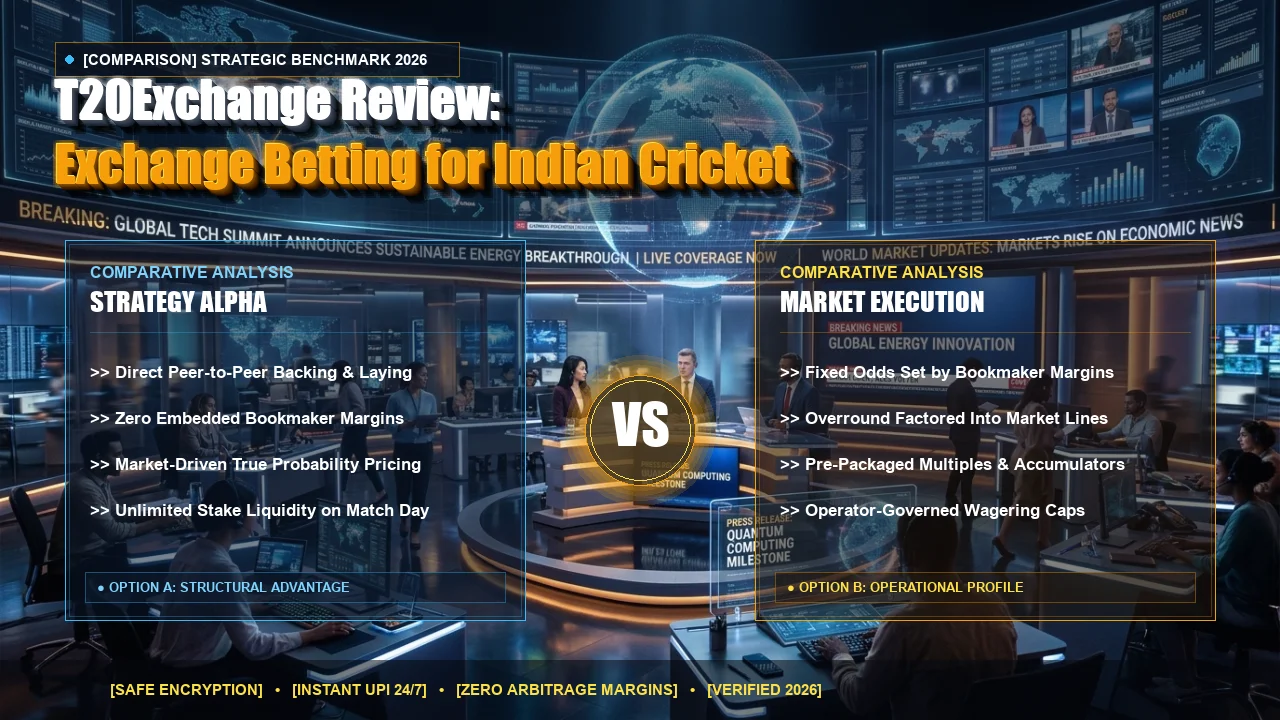
Why would a cricket bettor willingly accept a 2% commission on winnings instead of taking a fixed odds payout? The answer lies in the fundamental difference between exchange betting and traditional sportsbooks—a distinction that T20Exchange has built its entire model around for the Indian market. Unlike conventional bookmakers that set their own prices and profit from your losses, T20Exchange operates as a peer-to-peer marketplace where odds are shaped by supply and demand, not by a trader's margin.
For Indian cricket fans accustomed to the fixed-odds simplicity of mainstream platforms, this presents both opportunity and complexity. This review dissects T20Exchange through a comparative lens, benchmarking its exchange mechanics against established sportsbook models to determine where it genuinely delivers value and where caution is warranted. We examine liquidity depth, commission structures, payout reliability, and the strategic adjustments required when transitioning from a bettor to a trader.
Also Read:IPLWin Review: What Indian Bettors Should Know First
What Exactly Is T20Exchange? A Structural Overview
T20Exchange positions itself as a dedicated cricket exchange, allowing users to back (bet for) or lay (bet against) outcomes. This dual-sided functionality is the core differentiator. When you lay a bet, you act as the bookmaker, accepting someone else's stake. The platform facilitates the match, taking a commission on net winnings rather than building a margin into the odds.
This structure has profound implications for pricing. On a traditional sportsbook, the odds you see include an overround—typically 5-10% for cricket markets—which represents the operator's built-in profit. On an exchange, the odds reflect pure market sentiment. If you can consistently identify value, the absence of embedded margin means your potential returns are theoretically higher. However, this comes with the caveat that exchange odds are only as reliable as the liquidity backing them.
The platform's interface is functional but not flashy, prioritizing order books and market depth charts over promotional banners. For users familiar with financial trading platforms, the layout will feel intuitive. For those accustomed to the streamlined bet-slip of a traditional bookmaker, the learning curve is real but manageable.
The Comparative Framework: Exchange vs. Traditional Sportsbook
To properly evaluate T20Exchange, we must establish clear comparison criteria. The table below breaks down the critical dimensions that separate exchange betting from the fixed-odds model offered by most Indian-facing sportsbooks.
Also Read:Reading Platform Odds: Decimal, Fractional and Margin
| Comparison Factor | T20Exchange (Exchange Model) | Traditional Sportsbook (e.g., 1x Bet India; 4rabet India; Parimatch India) |
|---|---|---|
| Odds Formation | Peer-to-peer; determined by supply and demand | Set by in-house traders; includes overround margin |
| Commission Structure | 2-5% on net winnings per market | No explicit commission; margin embedded in odds |
| Liquidity Dependency | High; requires active market participants for order matching | Low; bookmaker guarantees all accepted bets |
| Volatility | Higher; odds fluctuate rapidly based on market activity | Lower; odds stable until bookmaker adjusts lines |
| Payout Speed | Typically 24-48 hours post-settlement | Instant to 24 hours; varies by operator |
| Strategy Requirement | Advanced; requires understanding of lay betting, market depth, and trading | Basic; straightforward back-only betting |
| Risk Profile | Dual-sided; potential for unlimited liability on lay bets | Single-sided; risk capped at stake amount |
| Market Depth (Cricket) | Strong for IPL and major T20s; thinner for domestic and Test matches | Consistent across all major cricket formats |
| Regulatory Clarity | Exchange model faces varied legal interpretation across jurisdictions | Operators often hold licenses from multiple gaming authorities |
The table reveals a clear trade-off: T20Exchange offers potentially superior pricing but demands a higher level of market literacy. The commission structure, while transparent, can erode profits if you are not consistently achieving net positive results. For a deeper dive into how established sportsbooks structure their cricket markets, including payment processing and odds compilation, the 1x Bet India; 4rabet India; Parimatch India comparative analysis provides a useful benchmark.
Key Takeaway: Exchange betting is not a substitute for traditional sportsbook betting—it is a different discipline. The absence of a built-in margin is attractive, but the commission and liquidity constraints mean that only disciplined, analytical bettors consistently benefit.
Liquidity Analysis: Where T20Exchange Shines and Stumbles
Liquidity is the lifeblood of any exchange. Without sufficient counterparties, your back or lay order sits unmatched, and the theoretical pricing advantage evaporates. T20Exchange performs admirably during high-profile events—IPL playoffs, international T20 series involving India, and major franchise tournaments. During these windows, the order book for match winner, top batsman, and over/under markets is deep enough to absorb significant stakes without moving the line dramatically.
However, the story changes for domestic tournaments, women's cricket, and Test matches. Here, liquidity thins out considerably. You may find yourself waiting for an order to be matched or forced to accept less favorable odds. This is a critical limitation for bettors who follow niche cricket markets. By contrast, traditional sportsbooks maintain consistent market depth across formats because the bookmaker assumes the risk. If you are a specialist in Ranji Trophy or county cricket, an exchange model may frustrate more than it rewards.
It is also worth noting that liquidity on exchanges can be fragmented across multiple markets. A common strategy is to focus on the most liquid markets—match winner and innings runs—and avoid exotic side markets where the order book is sparse.
Commission Structure and Net Profitability
T20Exchange typically charges a commission of 2-5% on net winnings per market. This means if you win ₹10,000 on a market, you might pay ₹200-500 in commission. On the surface, this seems favorable compared to the 5-10% overround embedded in traditional sportsbook odds. But the comparison is not straightforward.
On a sportsbook, the margin is baked into the odds you accept—you never see a separate commission line. On an exchange, you see the commission explicitly, which can create a psychological barrier. More importantly, the commission applies to net winnings, not gross. If you have a mix of winning and losing trades in the same market, the commission is calculated on the net positive. This is a fair structure, but it requires active management.
For high-volume traders, even a 2% commission can significantly impact annual returns. It is essential to factor this into your pricing models. A common mistake is to compare exchange odds directly with sportsbook odds without adjusting for commission. A back bet at 2.10 on an exchange with 2% commission is roughly equivalent to a 2.06 odds bet on a sportsbook with no commission—assuming the sportsbook's margin is zero, which it rarely is.
Strategic Personas: Who Should Use T20Exchange?
The exchange model is not a one-size-fits-all solution. Based on our analysis, we can segment users into distinct personas, each with a tailored strategic approach.
The Casual Enthusiast
If you bet primarily for entertainment, placing small stakes on IPL matches and enjoying the thrill of the game, T20Exchange may be overkill. The interface is more complex, the need to understand lay betting adds friction, and the commission structure can feel punitive on small wins. For casual users, a traditional sportsbook with a user-friendly app and straightforward bet slip is often a better fit. Platforms like Iplwin offer a more streamlined experience for recreational betting on Indian cricket.
The Analytical Bettor
If you treat betting as a serious analytical pursuit—tracking odds movements, calculating implied probabilities, and seeking value—T20Exchange offers distinct advantages. The ability to lay bets opens up hedging opportunities and allows you to profit from outcomes you believe are overpriced. You can also act as a market maker, offering odds that others accept, effectively becoming the bookmaker. This requires a deep understanding of cricket dynamics and market psychology, but the potential rewards are higher.
For this persona, the key is to focus on liquid markets and maintain a disciplined staking plan. The absence of a built-in margin means that a well-calibrated model can yield better long-term returns than on a sportsbook. However, the commission must be factored into every calculation.
The High-Volume Trader
For professional traders, T20Exchange is a viable alternative to traditional sportsbooks, particularly for major tournaments. The ability to back and lay in-play creates opportunities for trading—backing a team at a higher price and laying it at a lower price to lock in profit. This requires fast execution and a reliable platform, but it is a legitimate strategy. The main constraint is liquidity: high-volume traders may find that their orders move the market, especially in less liquid markets. To mitigate this, they often spread orders across multiple markets or use algorithmic tools.
Betting Brand Verification and Legitimacy Concerns
When evaluating any betting platform, betting brand verification is paramount. T20Exchange operates as an exchange, which introduces unique regulatory considerations. In some jurisdictions, exchange betting is treated differently from fixed-odds betting, and the legal status of the operator can vary. It is essential to verify the platform's licensing and regulatory standing before depositing funds.
Indicators of betting website legitimacy include transparent ownership, clear terms and conditions, and a verifiable license from a recognized authority. Fake betting apps often mimic legitimate brands, so users should download apps only from official sources and check for consistent branding across the platform's website and communications. For a broader perspective on how established operators handle brand verification and legal compliance, the 1x Bet India; 4rabet India; Parimatch India review provides a useful reference point.
Data privacy is another critical concern. Exchanges require personal and financial information, and users should ensure that the platform employs robust encryption and does not share data with third parties without consent. Always read the privacy policy and check for independent security audits.
Responsible Gaming Reminder: Exchange betting can be more volatile than traditional betting due to the potential for lay bets with unlimited liability. Never stake more than you can afford to lose, and set strict deposit limits. If you feel you are losing control, seek support from responsible gaming organizations.
Payout Speeds and Financial Operations
Payout speed is a practical concern for any bettor. T20Exchange generally processes withdrawals within 24-48 hours, which is competitive but not exceptional. Traditional sportsbooks often offer instant withdrawals for verified users, especially for e-wallet transactions. The delay on exchanges can be attributed to the need to settle markets and calculate commissions accurately.
For Indian users, payment options include bank transfers, UPI, and popular e-wallets. It is important to check the platform's deposit and withdrawal limits, as well as any fees associated with transactions. Some exchanges charge a fee for inactive accounts or for withdrawals below a certain threshold. Always review the banking page before committing funds.
When comparing platforms, consider the total cost of operation: commission, withdrawal fees, and currency conversion charges (if applicable). A platform with lower commission but higher withdrawal fees may end up being more expensive. The Mahadev Book official platform offers a transparent fee structure that can serve as a benchmark for evaluating other operators.
The Verdict: Is T20Exchange Right for Indian Cricket Bettors?
T20Exchange is a legitimate and well-structured exchange that offers genuine advantages for analytical bettors, particularly during high-liquidity cricket events. The peer-to-peer model eliminates the bookmaker's margin, and the ability to lay bets opens up sophisticated strategies. However, it is not a platform for everyone. Casual bettors may find the interface daunting, and the commission structure can erode small profits. Liquidity constraints in niche markets are a real limitation.
For those who treat cricket betting as an intellectual challenge and are willing to invest time in understanding market dynamics, T20Exchange is a valuable addition to their portfolio. It should be used alongside traditional sportsbooks, not necessarily as a replacement. The key is to match the tool to your betting style and objectives.
Ultimately, the decision hinges on your willingness to engage with the mechanics of exchange betting. If you are comfortable with the concepts of back and lay, and you have a disciplined approach to bankroll management, T20Exchange can be a rewarding platform. If you prefer simplicity and fixed odds, a traditional sportsbook remains the better choice.
Frequently Asked Questions
Is T20Exchange legal for Indian users?
The legality of exchange betting in India is complex and varies by state. T20Exchange operates under international licenses, but users should verify local regulations before participating. It is always advisable to consult legal counsel if unsure about your jurisdiction's stance on exchange betting.
How does the commission on T20Exchange compare to sportsbook margins?
T20Exchange charges 2-5% commission on net winnings, while traditional sportsbooks embed a 5-10% margin in their odds. For winning bettors, the exchange model can be more cost-effective, but for casual bettors who win infrequently, the explicit commission may feel more burdensome. The net effect depends on your win rate and volume.
Can I use T20Exchange on my mobile device?
Yes, T20Exchange offers a mobile-optimized website and a dedicated app for iOS and Android. The app provides full functionality, including order book viewing and in-play betting. However, the complexity of the exchange interface may be more challenging on smaller screens.
What is the minimum deposit on T20Exchange?
The minimum deposit varies by payment method but is generally around ₹500. It is recommended to start with a small amount to familiarize yourself with the platform before committing larger sums.
How do I verify the legitimacy of T20Exchange?
Check for a valid gaming license from a recognized authority (e.g., Malta Gaming Authority, UK Gambling Commission). Look for transparent terms and conditions, secure payment gateways, and positive user reviews. Avoid platforms that make unrealistic promises or lack clear contact information.
Official Regulatory & Industry References
Mahadev Book adheres to industry compliance, fair play principles, and statutory regulatory standards: