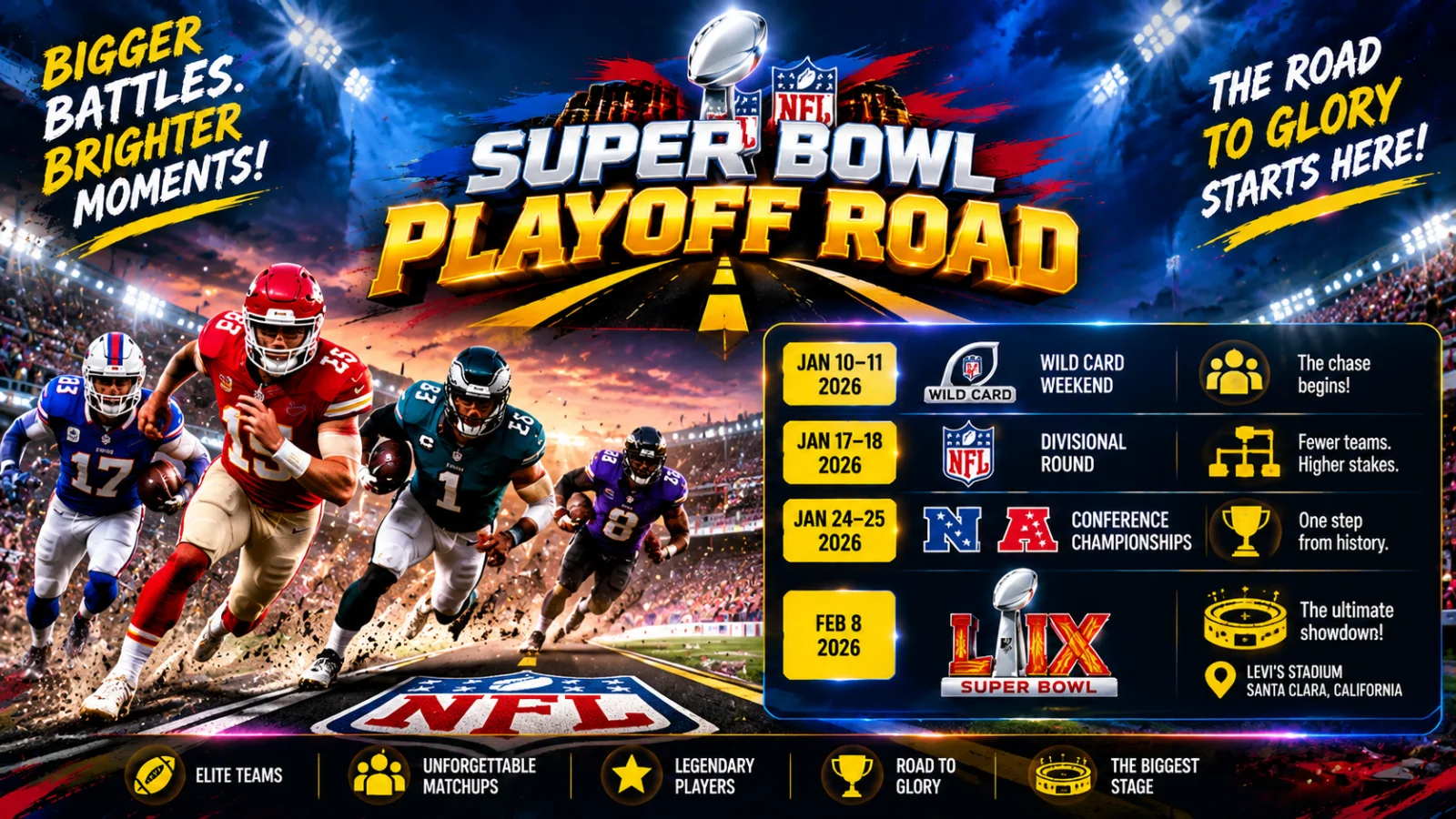
The NFL’s route to a championship is a test of timing as well as talent. A regular season determines the playoff field, the top seed in each conference gets a week off, and the next three rounds send one AFC team and one NFC team to the Super Bowl. For fans making plans over the next two years, the good news is that major dates and host stadiums are already known. The uncertainty is equally important: neither a team’s final seed nor its Super Bowl opponent is settled until the relevant games have been played.
This guide brings together the confirmed postseason timetable, the next two Super Bowl hosts and a practical way to read American football. It covers American football, not association football: a soccer fixture or a Champions League market has a different rulebook. For general site information, start at Mahadev Book.
Also Read:Mahadev Book Login: Account Access and Security Guide
The dates on the championship calendar
| Date or period | Event | Venue or status |
|---|---|---|
| 9–10 January 2027 | Final weekend of the 2026 NFL regular season | League venues; exact results and final standings unknown |
| 16–18 January 2027 | Wild Card Weekend | Six playoff games; pairings depend on final seeds |
| 23–24 January 2027 | Divisional playoffs | Four games; participants depend on Wild Card results |
| 31 January 2027 | AFC and NFC Championship Games | Host teams determined by the bracket |
| 14 February 2027 | Super Bowl LXI | SoFi Stadium, Inglewood, California; teams TBA |
| 2028, date TBA | Super Bowl LXII | Mercedes-Benz Stadium, Atlanta, Georgia; teams TBA |
The National Football League has confirmed the January 2027 playoff windows and 14 February championship date. Atlanta has been awarded the 2028 Super Bowl, but the cited host announcement did not provide an exact date. Do not infer the day from an old promotional calendar or treat a host venue as proof that the local team will play in the game.
How fourteen teams become two finalists
The NFL has two conferences, the AFC and NFC. Each conference sends seven teams to the postseason: four division winners and three wild-card teams. The league’s current playoff structure rewards the top seed in each conference with a bye through Wild Card Weekend. The remaining six teams in each conference play three opening-round games: the second seed hosts the seventh, the third hosts the sixth, and the fourth hosts the fifth.
The surviving teams advance to the divisional round, where the top seed joins them. The conference championship winners then meet in the Super Bowl. The order of opponents depends on results and the league’s seeding rules; a bracket showing a potential matchup is not the same thing as an announced game.
A division title and a wild-card berth both put a team into the playoffs, but they are obtained in different ways. A division winner finishes first under the league’s ranking and tie-break procedures. Wild-card places go to eligible non-division winners based on conference standings and the applicable tie-breaks. Head-to-head results, conference records and other criteria can matter, so a single win-loss number may not explain the final order.
Also Read:World Series to Wrigley: Baseball Dates and Storylines
By the final weekend, games played at the same time can affect one another. A team may need a win and help elsewhere, but such scenarios are best checked against the NFL’s current playoff picture. A prediction published several weeks before Week 18 should not be described as a clinching scenario without updated standings.
Inglewood’s Super Bowl: what has and has not been decided
Super Bowl LXI is scheduled for 14 February 2027 at SoFi Stadium in Inglewood, California. The venue is known, but the two teams will be decided by the conference championships on 31 January. A team that plays its home games at SoFi Stadium does not receive an automatic place in the final.
The NFL has announced Jay-Z as the halftime performer. Entertainment announcements, ticket information and stadium access are separate from football qualification. A seat may be sold before the finalists are known, and a hospitality package may carry different terms from a standard ticket. Verify the seller, seat category, transfer conditions and refund provisions through the NFL’s authorised channels.
For an international audience, time-zone conversion is part of the story. The game is played on a Sunday in California, but the live broadcast can cross into Monday in parts of Europe and Asia. Use the official local kickoff time once published and convert it for the actual date. A date displayed in a home-country TV listing may therefore differ from the venue’s calendar date.
The Mahadev Betting page is a general sports overview; it does not establish that a particular NFL event or market is available. Check the actual listing and local law independently.
Why the Atlanta announcement is not a complete fixture
Mercedes-Benz Stadium in Atlanta has been selected for Super Bowl LXII in 2028. The venue award gives fans a destination and gives the organising city time to prepare. It does not determine the finalists, kickoff, ticket price or precise game date in this guide.
The 2027 season schedule leading to that championship must also be read separately once the NFL publishes it. A team’s 2026 opponent list or its performance in the previous season does not establish all of its later fixtures. Bye weeks, international games, broadcast windows and venue assignments can change the practical travel plan.
A useful editorial calendar therefore has two fields: confirmed host and game details awaiting announcement. That distinction prevents a projected date from becoming an apparent fact when it is copied into a headline, a ticket comparison or a social post.
The four downs that structure almost every drive
An offense normally has four downs, or attempts, to advance the ball ten yards. If it reaches the required distance, it receives a new series of downs. If it falls short, the opponent can take possession after the fourth down, although teams often choose to punt or attempt a field goal instead of running an offensive play.
The correct decision depends on field position, score, time remaining and the yards required. A team facing fourth-and-one near the opponent’s goal line has a different choice from a team facing fourth-and-ten deep in its own territory. The possibility of a successful conversion must be weighed against the possibility of giving the opponent favourable field position. There is no single decision that is correct in every situation.
A quarterback can pass, hand the ball to a runner or keep it on a designed play, depending on the offensive scheme. Receivers, offensive linemen and running backs each have roles in protection and execution. A completed pass can gain substantial yardage, but an incomplete pass stops the clock and does not advance the ball. An interception transfers possession to the defense.
A touchdown normally scores six points, after which the team can attempt an extra-point kick or a two-point conversion under the rules. A field goal is worth three points, and a safety is generally worth two. Understanding these scoring options helps explain why a team may still have a plausible route back from a deficit without assuming that a comeback is likely or guaranteed.
Reading the game beyond the quarterback
Quarterbacks draw much of the attention, but the offensive line and defensive front influence how a play develops. Pass protection gives the quarterback time to read the field; a defensive pass rush tries to disrupt that timing. Pressure can force an early throw, a scramble or a sack. A sack statistic is useful, but it does not capture every play on which pressure alters the offense’s decision.
Coverage is another moving part. Defenders may cover specific receivers, defend zones or combine assignments. An offense can use motion before the snap to reveal information or create a favourable alignment. The defense can disguise its intentions and change after the ball is snapped. A successful play reflects the interaction of both schemes, not just the speed of one receiver.
The running game is similarly contextual. A high average per carry can reflect blocking, opponent personnel, game situation or a small number of long runs. A team protecting a late lead may run to use time even if the defense expects it. A team trailing may pass more frequently because it needs to conserve time. Raw pass-run totals should therefore be read alongside the score and clock.
The clock changes the strategy
An NFL game has four 15-minute quarters, but the clock does not run continuously. Incomplete passes, players going out of bounds in relevant situations, timeouts, penalties and the two-minute warning can stop or affect the clock under the rules. Each team has a limited number of timeouts per half.
The end of a half can be a separate strategic contest. An offense must balance gaining yards, preserving enough time for another play and staying in field-goal range. The defense may protect the sideline, defend deeper passes or pressure the quarterback. A sack in the middle of the field can be particularly costly if the offense has few timeouts left.
Overtime rules are governed by the NFL’s current regulations and can differ between regular-season and postseason games. Before using an overtime result in an analysis or discussing a betting market, check the rules for the specific competition and season. Do not assume that an old highlight reflects the current overtime procedure.
What a playoff preview should actually verify
- Status: Has the team clinched a place, a division, or a particular seed? Those are three different claims.
- Availability: Check official injury reports and the game-day active list. A player listed as questionable is not the same as a confirmed starter or a confirmed absence.
- Venue: The playoff host is determined by the bracket, not by the identity of the most famous team.
- Conditions: Weather can affect outdoor games; a roofed stadium has different considerations. Look at the actual forecast rather than an average for the city.
- Matchup: Review pass protection, defensive pressure, coverage and special teams, not just a previous head-to-head score.
- Game state: A team that often throws while trailing may appear pass-heavy for reasons that do not apply to its next game.
Special teams can be decisive. Kickoffs, punts, field-goal attempts and returns determine field position or points. A missed field goal and a blocked punt have different causes and consequences. A preview should check the relevant kicker, injury report and conditions rather than treating every kick as automatic.
A possession-by-possession example
Imagine the opening possession begins at a team's own 25-yard line. A six-yard run makes it second-and-four; a short completed pass for five yards produces a first down. The offense has advanced, but it still has a long field ahead. If a subsequent sack loses eight yards, the next down and distance become more difficult and the coordinator may need a different mix of routes and protection.
On third-and-long, the defense can guard the required yardage while still pressuring the quarterback. The offense might attempt a pass beyond the sticks, take a shorter completion and hope for yards after the catch, or call another play that suits its personnel. If it falls short, fourth-down strategy depends on the field position and the specific score and clock. These examples illustrate choices, not a script that all teams follow.
Now imagine the same team trailing by four points with one minute remaining and no timeouts. Three points from a field goal would not put it ahead, so it needs a touchdown. Staying in bounds, the amount of time needed to line up and the distance to the end zone matter alongside the yards gained. If instead the team trails by two, a field goal could take the lead, and the calculation changes. Neither situation guarantees that the coach will make a particular decision.
Understanding seeding and a bye
The top seed's first-round bye provides recovery and preparation time, while the other six qualifiers in the conference face an immediate elimination game. The bye does not award points in the divisional round or remove the need to win. The top seed has to beat its postseason opponents on the field to reach the Super Bowl.
Because the NFL reseeds after the opening round, the highest remaining seed meets the lowest remaining seed in its conference. Fans should therefore avoid filling in the divisional bracket solely by drawing lines from one fixed Wild Card matchup. The actual pairings depend on which teams survive and their seed numbers.
Home advantage similarly follows the postseason structure rather than a team's popularity. The highest remaining seed typically hosts within the conference rounds, subject to league rules and unusual circumstances. The Super Bowl host is selected in advance, so it is possible, but not automatic, that a finalist will play at a familiar stadium.
A score is not a complete performance report
Turnovers can rapidly change a game because they transfer possession and may create good field position. Yet a team that wins the turnover count does not automatically win the game. An offense can offset a mistake with later scoring drives, while penalties, special teams and efficiency on critical downs can also be decisive.
A box score may show one quarterback throwing more yards than the other, but the game state needs attention. A quarterback whose team trailed early may have attempted many more passes. Passing yardage without attempts, sacks, interceptions and scoring context can create an incomplete comparison. Use multiple measures and describe the limitations of the sample.
Penalties require similar care. A defensive holding penalty can extend a drive even when the offense gained little on the play. An offensive penalty can erase a gain or force a longer down and distance. The official gamebook records penalties, but a preview should verify whether a player or unit involved in an earlier game will actually be present in the next one.
When an update changes the article
Before Wild Card Weekend, replace general seeding descriptions with the confirmed matchups only after the NFL releases the bracket. After each round, update the next opponent, venue and start time. Once the conference champions are known, name the Super Bowl finalists and remove any sentence saying they are unknown. Keep the original research date and add the date of the substantive update so readers understand when each fact was checked.
Markets, terminology and responsible limits
Anyone choosing to look at a sportsbook should first distinguish a game’s result from a point spread or total. A spread asks about the margin relative to a stated line; a total concerns combined points. Overtime and settlement treatment vary by market and operator. Read the exact terms rather than assuming that the way a winner is recorded on the NFL scoreboard is identical to every wagering rule.
The general Mahadev Book betting guide explains platform terminology, but it is not an NFL rulebook or a promise that a given market exists.
An exchange and a traditional sportsbook can also handle orders and payouts differently. The Mahadev Book exchange comparison discusses the general models; actual fees, prices and settlement terms must be checked before any transaction.
If an exchange charges commission, the calculation can change the return. The site’s betting exchange commission guide is a general reference, not a guarantee of the fee on a particular event.
Account policies are separate from the NFL’s playing rules. Readers can review Mahadev Book rules and regulations for general platform information and the NFL rulebook for game decisions.
Gambling laws and age limits depend on the reader’s location. No bet is risk-free; never use money needed for essentials or chase losses. The site’s responsible gaming information describes account safeguards.
Frequently asked questions
When is Super Bowl LXI? The NFL schedules it for 14 February 2027 at SoFi Stadium in Inglewood.
Who will play? The AFC and NFC champions; they are not known until the conference championship games have concluded.
When are the playoffs? Wild Card Weekend is 16–18 January, divisional games are 23–24 January, and conference championships are 31 January 2027.
Where is the following Super Bowl? Mercedes-Benz Stadium in Atlanta has been named as the 2028 host. Check the NFL for the final date.
Does a division winner receive a bye? Only the top seed in each conference receives the opening-round bye under the playoff structure described here.