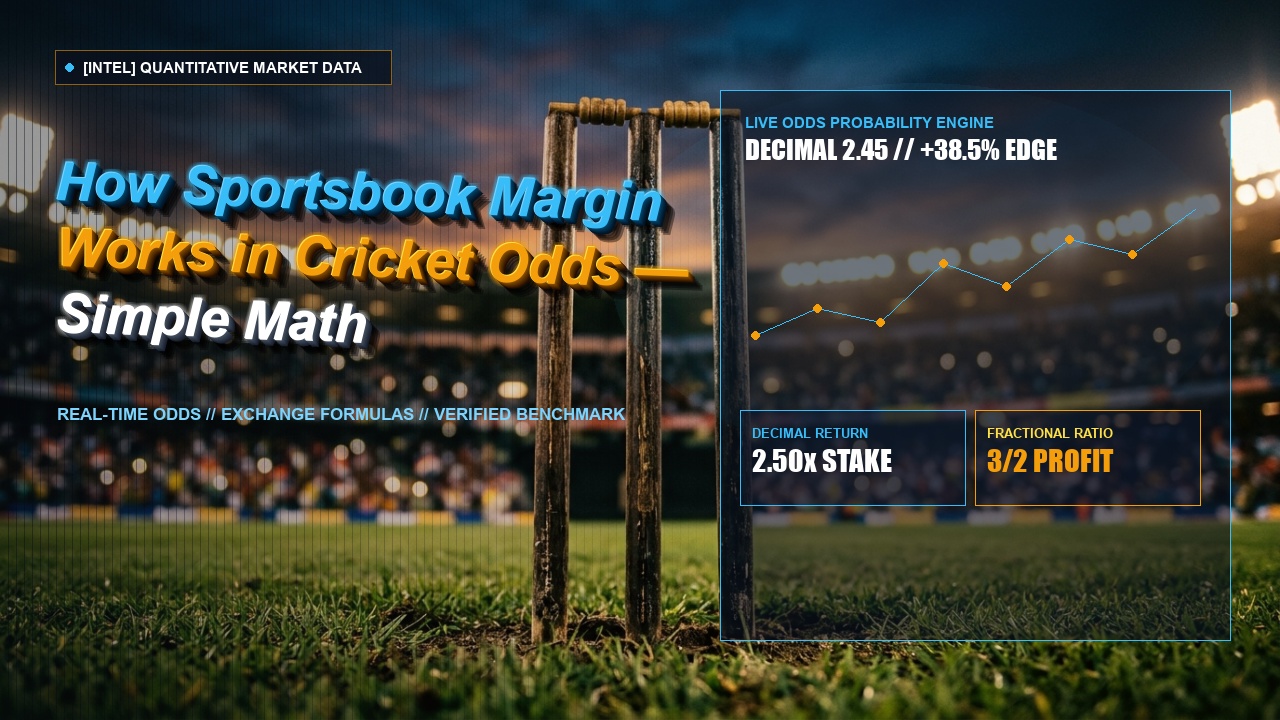
The Hidden Tax on Every Bet You Place
Every time you look at a cricket odds board, you're not seeing a pure reflection of probability. You're seeing a carefully constructed price that includes the bookmaker's built-in profit margin—a concept known as the overround. Most bettors ignore this invisible tax, yet it's the single biggest factor determining long-term profitability. Understanding how margin works is not optional for serious bettors; it's the foundation of every smart decision. In this guide, we'll break down the simple math behind sportsbook margin, using concrete examples and clear explanations, so you can see exactly where your money goes and how to spot value.
Odds, Probability, and the Bookmaker's Edge
At its core, betting odds are just another way of expressing probability. Decimal odds of 2.50 imply a 40% chance (1 / 2.50 = 0.40). Fractional odds of 6/4 imply the same: (4 / (6+4)) = 0.40. But here's the catch: if a bookmaker offered true odds on both sides of a market, they'd make zero profit. Instead, they adjust the odds so that the implied probabilities of all outcomes sum to more than 100%. That excess is the margin. For a two-way market like a cricket match winner, if the implied probabilities add up to 105%, the bookmaker's theoretical margin is 5%. This margin ensures they profit regardless of the outcome, assuming balanced action. To see this in practice, check the odds on Cricket Betting Online platforms and try calculating the overround yourself—it's an eye-opener.
A Concrete Example: India vs Australia T20
Suppose India is priced at 1.80 and Australia at 2.10. Implied probability for India: 1 / 1.80 = 0.5556 (55.56%). For Australia: 1 / 2.10 = 0.4762 (47.62%). Total = 103.18%. The overround is 3.18%, meaning the bookmaker expects to pay out 96.82% of stakes as winnings, keeping 3.18% as gross margin. If you bet ₹10,000 on India, your potential profit is ₹8,000, but the fair odds (based on true probabilities) would be slightly higher. This is why understanding margin is crucial for Cricket Betting Online exchange users, where commission replaces traditional margin.
Key Takeaway: The overround is the bookmaker's built-in profit. The lower the overround, the fairer the odds. Sharper bookmakers operate on 2-4% margins, while softer ones may charge 8-12%.
Calculating Margin: The Simple Formula
To calculate the margin on any market, convert all odds to implied probabilities and sum them. The formula is: Margin = (Sum of implied probabilities) - 1. For a three-way market (e.g., test match with draw), sum the probabilities of all three outcomes. If the total is 1.06, the margin is 6%. This number tells you how much the bookmaker is charging for the privilege of betting. It also helps you compare markets: a margin of 4% is far better for the bettor than 10%. Over hundreds of bets, this difference compounds dramatically. For a deeper dive into betting terminology, including margin-related terms, visit our Cricket Betting Online glossary.
Real-World Scenarios: Stake, Payout, and Margin
The table below illustrates how margin affects payouts across different stake sizes and odds. Notice how the bookmaker's theoretical profit remains consistent as a percentage of total stakes, regardless of the outcome.
| Market | Odds (Decimal) | Implied Probability | Stake (₹) | Potential Payout (₹) | Bookmaker Margin |
|---|---|---|---|---|---|
| India Win | 1.80 | 55.56% | 10,000 | 18,000 | 3.18% |
| Australia Win | 2.10 | 47.62% | 10,000 | 21,000 | |
| England Win | 2.20 | 45.45% | 5,000 | 11,000 | 6.06% |
| Draw | 3.50 | 28.57% | 3,000 | 10,500 | |
| South Africa Win | 3.80 | 26.32% | 2,000 | 7,600 |
As you can see, the margin is not a fixed fee but a percentage edge that ensures profitability when bets are balanced. In reality, bookmakers adjust odds dynamically based on betting volume to manage risk, which is why Mahadev Book official platform odds can shift as the match approaches.
Back vs. Lay: Margin in Exchange Betting
On betting exchanges, there is no traditional bookmaker margin. Instead, you bet against other users, and the exchange charges a commission on net winnings (typically 2-5%). This means the overround can be close to 100% (or even lower), offering better value for savvy bettors. However, liquidity can be an issue, especially on niche markets. Understanding the difference between back and lay is crucial for Cricket Betting Online enthusiasts looking to exploit margin differences.
Why Margin Matters for Prediction Accuracy
Your cricket match prediction accuracy is only half the battle. If you consistently bet on markets with high margins, you need a higher strike rate to overcome the bookmaker's edge. For example, with a 5% margin, you need to win more than 52.5% of even-money bets just to break even. This is why professional bettors hunt for low-margin markets and value opportunities. They also pay close attention to Mahadev Book official platform promotions and odds boosts, which can temporarily reduce effective margin.
Regulatory Landscape and Responsible Gaming
In India, cricket betting legality varies by state, and online betting operates in a grey area. Always ensure you comply with local laws and bet responsibly. The margin is just one aspect of the game; never bet more than you can afford to lose. For more on rules and regulations, refer to our guide on Cricket Betting Online rules.
Frequently Asked Questions
What is a typical sportsbook margin on cricket?
Most online bookmakers operate with a margin between 4% and 8% on major cricket markets. Exchanges may have commissions of 2-5%, often resulting in lower effective margin.
How do I calculate the margin on a betting market?
Convert all odds to implied probabilities (1/decimal odds), sum them, and subtract 1. The result is the margin. For example, if probabilities sum to 1.05, the margin is 5%.
Does a lower margin guarantee profit?
No, a lower margin improves your expected value, but you still need accurate predictions and proper bankroll management to be profitable long-term.
Can margin change during a match?
Yes, bookmakers adjust odds and margin dynamically based on betting volume, match events, and risk exposure. Live betting often has higher margins.
Is cricket betting legal in India?
Legality varies by state; while some forms are permitted, online betting is largely unregulated. Always check local laws and use licensed platforms.