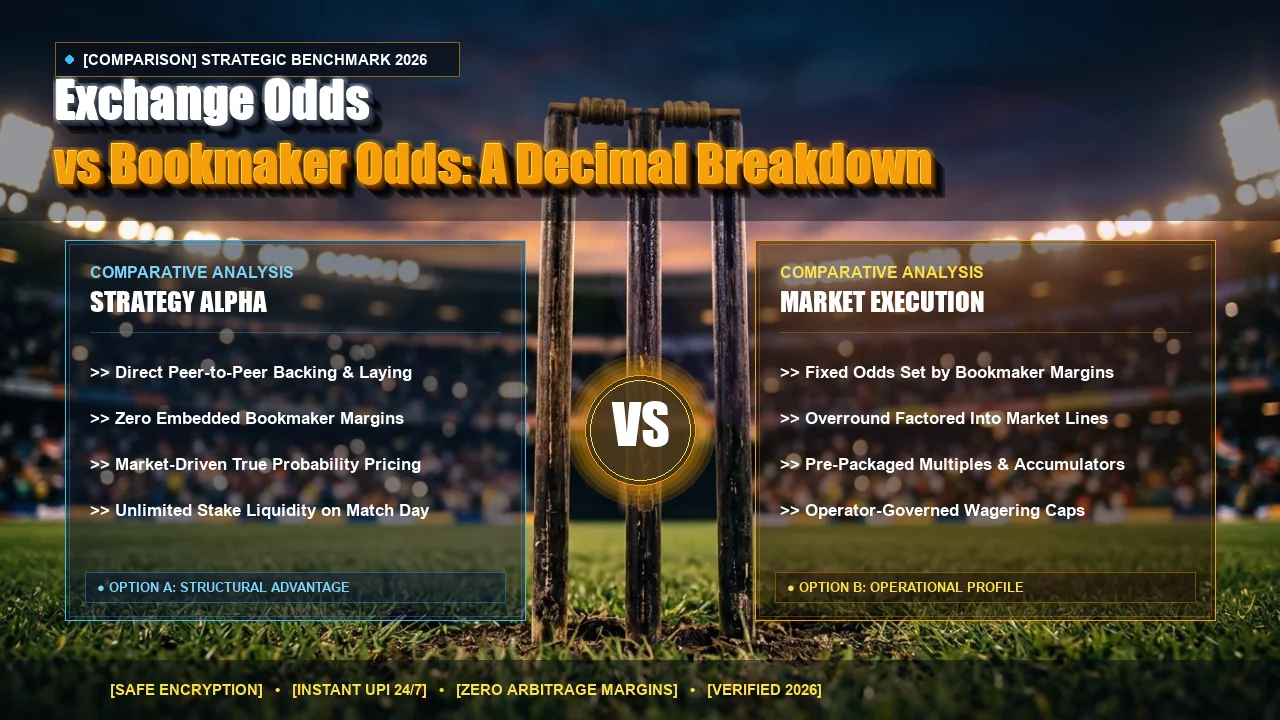
Why does a bookmaker offer 2.00 on a coin toss when the true probability is 50%? The answer lies in the margin—a built-in profit that silently erodes your returns. Exchange odds, by contrast, reflect pure market sentiment, with no hidden margin. This article breaks down the decimal mechanics behind both models, showing you exactly how to compare them and calculate the real cost of placing a bet.
The Decimal Foundation: Implied Probability and Overround
Every decimal odd is a probability statement. To convert decimal odds to implied probability, use the formula: Implied Probability = 1 / Decimal Odds. For example, decimal 2.50 implies a 40% chance (1 / 2.50 = 0.40). This conversion is the first step in comparing bookmaker and exchange prices.
Also Read:Betting Exchange Liquidity: Why Thin Markets Cost You Money
Bookmakers build a margin into their odds by offering prices that sum to an implied probability greater than 100%. This excess is called the overround. For a two-outcome market, if a bookmaker offers 1.90 on both sides, the implied probabilities are 52.63% each, summing to 105.26%—a 5.26% overround. That 5.26% is the bookmaker's theoretical profit if the book is balanced.
Exchanges operate differently. They match back and lay bets between users, charging a commission on net winnings. The odds you see are the raw market prices, and the overround is typically close to 100% (or even below, due to liquidity gaps). To understand how liquidity shapes these prices, see our detailed guide on Betting Exchange liquidity mechanics.
Back vs Lay: The Two Sides of Exchange Odds
In back vs lay betting, you can either back an outcome (bet on it to happen) or lay it (bet on it not to happen). The lay odds represent the price at which you are willing to accept a bet from someone else. For example, if you lay at 2.50, you are risking 1.50 to win 1.00 (plus stake). This two-sided market is the core of exchange odds, and it allows you to act as both punter and bookmaker.
The relationship between back and lay odds is tight: the lay price is always slightly higher than the back price due to the spread. This spread is where the exchange earns its commission. For a deeper dive into how these orders are matched, read our article on Betting Exchange back vs lay models.
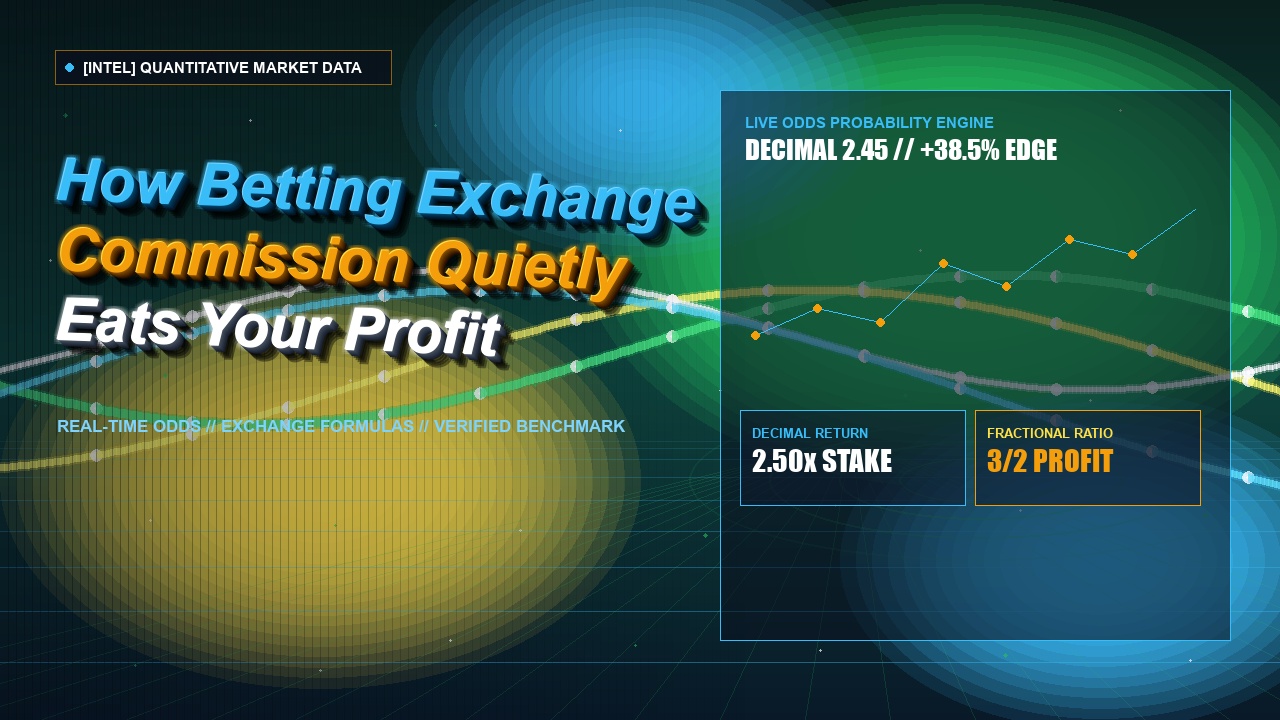
Also Read:How Betting Exchange Commission Quietly Eats Your Profit
Key Takeaway: Exchange odds are not inherently better—they simply reflect market forces. A 2.50 back price on an exchange may be equivalent to a 2.40 bookmaker price after commission, so always calculate the net return.
A Concrete Decimal Breakdown: Bookmaker vs Exchange
Let's compare a typical football match where the true probability of a home win is 45%. A bookmaker might offer decimal 2.10, while an exchange might show back odds of 2.20 and lay odds of 2.22. The table below illustrates the implied probabilities and the effective margin for each scenario.
| Market | Decimal Odds | Implied Probability | Overround / Commission | Net Payout on 100 Stake |
|---|---|---|---|---|
| Bookmaker (Home) | 2.10 | 47.62% | 4.76% (overround) | 110.00 (profit 110) |
| Bookmaker (Away) | 1.80 | 55.56% | Total overround 103.18% | 80.00 (profit 80) |
| Exchange Back (Home) | 2.20 | 45.45% | 2% commission on winnings | 117.60 (profit 117.60) |
| Exchange Lay (Home) | 2.22 | 45.05% | Lay liability: 122 | N/A (you win 100 if home loses) |
Notice that the bookmaker's implied probabilities sum to 103.18%, meaning a 3.18% margin. The exchange back odds imply 45.45%, much closer to the true 45%. However, after a 2% commission on net winnings, the effective odds on the exchange back bet become 2.20 * (1 - 0.02) = 2.156, which is still better than the bookmaker's 2.10. But if the commission were 5%, the effective odds drop to 2.09, making the bookmaker competitive. This is why understanding Betting Exchange commission structures is vital.
How Market Liquidity Shapes Exchange Odds
Exchange odds are not set by a central authority; they emerge from the order book. When you place a back bet, you are matched against a lay bet from another user. If liquidity is thin, the spread between back and lay odds widens, and large stakes may not be matched at the desired price. This is the betting exchange meaning in practice: a peer-to-peer marketplace where prices are determined by supply and demand.
Bookmakers, on the other hand, can offer fixed odds regardless of liquidity, but they adjust their margins based on exposure. In high-liquidity markets like Premier League football, exchange odds often outperform bookmaker odds. In niche markets, bookmakers may offer better value due to their ability to absorb risk. For a reliable platform to compare these markets, the Mahadev Book official platform provides transparent odds and deep liquidity across major sports.
Calculating True Value: The Effective Odds Formula
To compare exchange odds with bookmaker odds, you must adjust for commission. The formula for effective exchange odds is: Effective Odds = (Back Odds - 1) * (1 - Commission) + 1. For example, back odds of 2.20 with 2% commission yield (1.20 * 0.98) + 1 = 2.176. If the bookmaker offers 2.15, the exchange is still superior. However, if the bookmaker offers 2.25, the bookmaker is better.
This calculation becomes even more critical when you consider that exchange odds fluctuate rapidly. A price of 2.20 may vanish before your bet is matched. Bookmaker odds, while carrying a margin, are locked in at the moment of placement. Thus, the choice between exchange and bookmaker depends on your trading style, risk tolerance, and the specific market's liquidity.
Practical Example: Converting Fractional to Decimal and Implied Probability
Fractional odds of 6/4 convert to decimal 2.50 (since 6/4 + 1 = 2.50). The implied probability is 40%. If a bookmaker offers 6/4 on an event, but an exchange offers decimal 2.60, the exchange implies a 38.46% probability—a better value. After a 5% commission, the effective odds are (1.60 * 0.95) + 1 = 2.52, still better than 2.50. This demonstrates why professional bettors often migrate to exchanges for high-liquidity events.
Always remember: a bookmaker's margin is a guaranteed cost, while an exchange's commission is only paid on net winnings. Over time, the lower margin of exchanges can significantly boost your ROI.
The Role of Overround in Bookmaker Pricing
Bookmakers don't just add a flat margin; they adjust odds based on betting patterns. If a large volume of money comes in on one outcome, the bookmaker will shorten that price and lengthen others to balance their book. This means the overround can vary across markets and over time. In contrast, exchange odds are purely market-driven—no bookmaker intervention. This makes exchange odds a purer reflection of crowd wisdom, but also vulnerable to manipulation in low-liquidity markets.
Regulatory and Responsible Gaming Considerations
Exchange betting is regulated in many jurisdictions, but not all. In some countries, exchanges operate under different licenses than bookmakers, and commission structures may be subject to local taxes. Always verify the legality of exchange betting in your region. Additionally, both bookmakers and exchanges should offer responsible gambling tools such as deposit limits and self-exclusion. The Mahadev Book official platform adheres to strict regulatory standards and promotes responsible gaming practices.
FAQ
What is the main difference between exchange odds and bookmaker odds?
Exchange odds are set by peer-to-peer matching and typically have no built-in margin, while bookmaker odds include a margin (overround) that guarantees the bookmaker a profit. Exchange odds are subject to commission on winnings.
How do I calculate the effective odds after exchange commission?
Use the formula: Effective Odds = (Back Odds - 1) * (1 - Commission) + 1. For example, back odds 2.20 with 2% commission gives (1.20 * 0.98) + 1 = 2.176.
Why do exchange odds fluctuate more than bookmaker odds?
Exchange odds are driven by real-time supply and demand from users. Large bets or news events can quickly shift prices. Bookmakers adjust odds manually or algorithmically, often with a delay.
Is exchange betting always better value?
Not always. In low-liquidity markets, exchange odds may have wide spreads, and commission can erode value. Bookmakers may offer better odds in niche markets or for small stakes.
Can I use both bookmakers and exchanges?
Yes, many bettors use both to arbitrage or to find the best price. Always compare effective odds after commission and consider the reliability of the platform.
Official Regulatory & Industry References
Mahadev Book adheres to industry compliance, fair play principles, and statutory regulatory standards: