Every cricket bet you place is a negotiation with probability. The odds displayed on your screen are not just numbers; they are a compressed language that tells you the bookmaker's assessment of an outcome, the margin they've baked in, and the potential return on your stake. Yet most bettors never learn to read that language fluently. They see 2.50 and think "double my money," without realizing that 2.50 implies a 40% chance—and that the true probability might be closer to 45%. This guide is your decoder ring. We'll break down decimal, fractional, and American odds, show you exactly how to convert between them, and expose the mechanics that determine whether you're getting a fair price or paying a hidden tax.
The Three Dialects of Value: Why Format Matters
Cricket is a global game, and betting markets reflect that. A punter in London might see odds as 6/4, a bettor in Mumbai sees 2.50, and someone in Las Vegas sees +150. All three represent the same underlying probability and payout—but the format changes how you calculate value. Understanding all three is essential for Cricket Betting Online across international platforms, because arbitrage opportunities and line-shopping require you to translate quickly.
Decimal Odds: The Transparent Standard
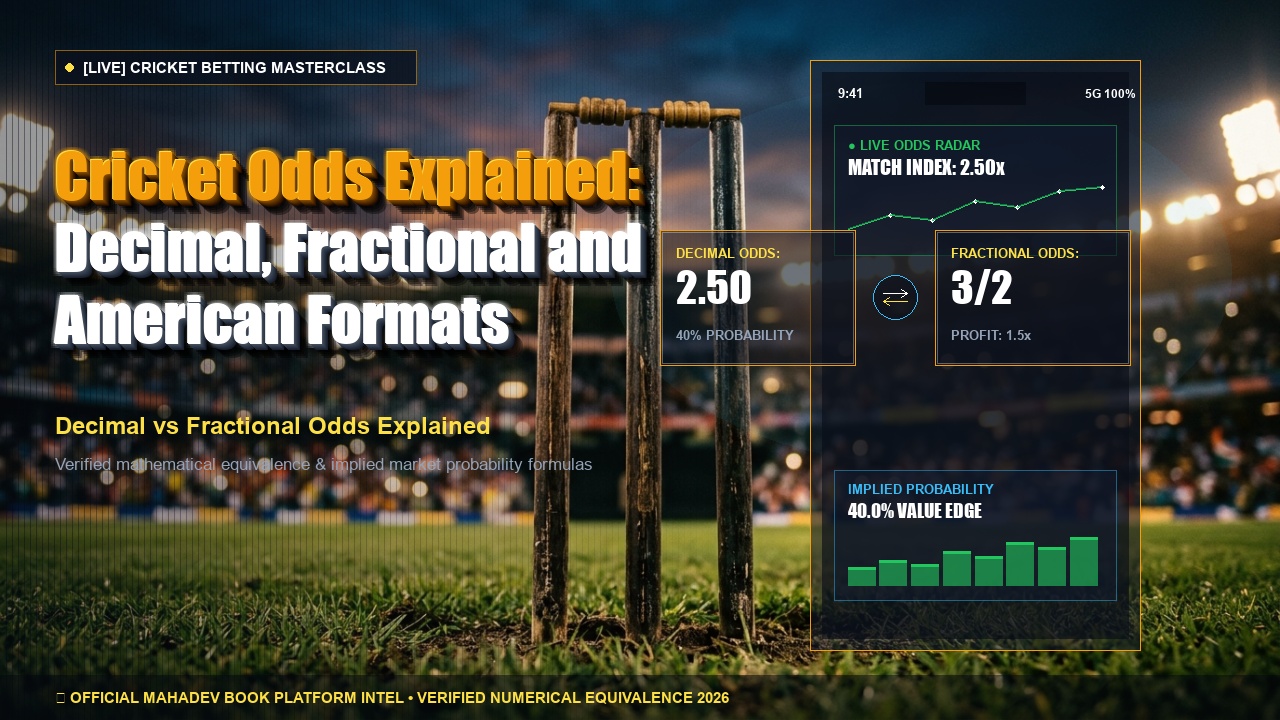
Decimal odds (also called European odds) are the simplest to understand: they represent the total return per unit staked, including your original stake. An odds of 2.50 means for every ₹100 you stake, you receive ₹250 back if you win—₹150 profit plus your ₹100 stake. The implied probability is calculated as 1 / decimal odds. So 2.50 implies a 40% chance (1 / 2.50 = 0.40).
Decimal odds are popular in India, Australia, and Canada because they make it easy to compare value across different outcomes. They also allow for quick calculation of expected value: simply multiply your stake by the decimal odds to get your total return.
Fractional Odds: The Traditional British Format
Fractional odds, common in the UK and Ireland, express profit relative to stake. A price of 6/4 means you win ₹6 for every ₹4 staked. To convert fractional to decimal, add 1 to the fraction: 6/4 + 1 = 1.5 + 1 = 2.50. The implied probability is the denominator divided by the sum of numerator and denominator: 4 / (6+4) = 0.40, or 40%.
Fractional odds can be confusing because they don't include the stake in the profit figure. But they're deeply ingrained in British racing and cricket betting culture, so serious bettors learn to read them fluently.
American Odds: The Plus-Minus System
American odds (moneyline odds) use a plus or minus sign to indicate underdog or favorite. A positive number (+150) shows how much profit you'd make on a $100 stake. A negative number (-200) shows how much you need to stake to win $100. To convert American odds to decimal:
- For positive odds: (American odds / 100) + 1. So +150 becomes (150/100)+1 = 2.50.
- For negative odds: (100 / |American odds|) + 1. So -200 becomes (100/200)+1 = 1.50.
Implied probability for American odds: for positive, 100 / (odds + 100); for negative, |odds| / (|odds| + 100).
Key takeaway: No matter the format, the underlying probability and payout are identical. Mastering conversion is the first step to spotting value and avoiding costly mistakes.
Converting Odds: A Numerical Walkthrough
Let's take a concrete example. Suppose a bookmaker offers odds on an India vs Australia match. The decimal odds for India to win are 2.50. What does that look like in other formats?
- Decimal: 2.50
- Fractional: 2.50 - 1 = 1.50 = 3/2 (since 1.50 = 3/2). So fractional odds are 3/2.
- American: Since decimal > 2.00, American = (2.50 - 1) * 100 = +150.
- Implied probability: 1 / 2.50 = 0.40 = 40%.
Now, if you see fractional odds of 6/4, that's 6/4 + 1 = 2.50 decimal, or +150 American, with 40% implied probability. The table below summarizes common conversions.
| Decimal | Fractional | American | Implied Probability |
|---|---|---|---|
| 1.50 | 1/2 | -200 | 66.67% |
| 2.00 | 1/1 | +100 | 50.00% |
| 2.50 | 3/2 | +150 | 40.00% |
| 3.00 | 2/1 | +200 | 33.33% |
| 4.00 | 3/1 | +300 | 25.00% |
Understanding these conversions is crucial for Cricket Betting Online because different platforms may display odds in different formats. Being able to quickly translate them ensures you're comparing apples to apples.
Implied Probability and the Bookmaker's Margin
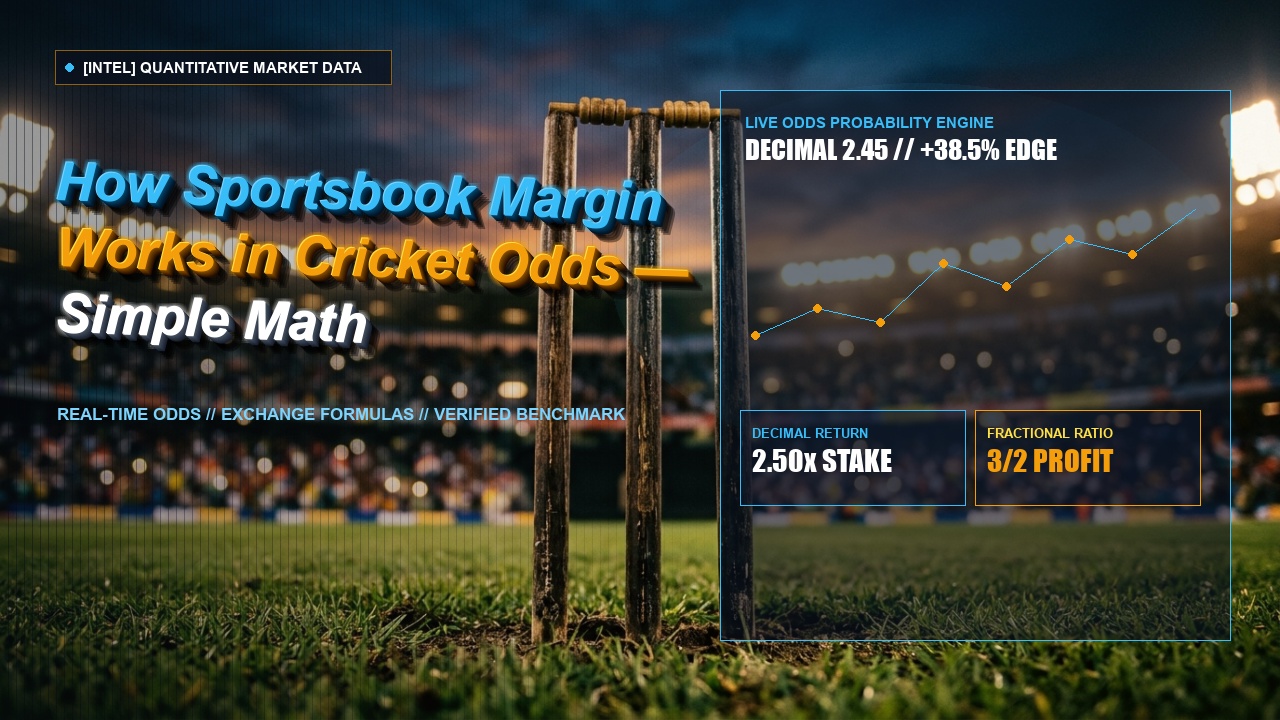
Implied probability is the probability that the odds suggest. But bookmakers don't offer fair odds; they build in a margin (also called overround or vigorish) to ensure profit. The sum of implied probabilities for all outcomes in a market will exceed 100%. The excess is the bookmaker's margin.
For example, in a two-way market (India vs Australia), suppose the odds are:
- India: 1.90 (implied probability 52.63%)
- Australia: 1.90 (implied probability 52.63%)
Total implied probability = 105.26%, so the bookmaker's margin is 5.26%. This means for every ₹100 wagered, the bookmaker expects to pay out about ₹95, keeping ₹5 as profit (before expenses).
Understanding margin helps you identify value. A market with a 2% margin is much friendlier to bettors than one with 10%. When you engage in Mahadev Book official platform activities, always check the margin—it directly affects your long-term profitability.
Calculating Margin
Margin = (sum of implied probabilities) - 1. Expressed as a percentage, multiply by 100. For a three-way market (e.g., Test match with draw), sum the implied probabilities of all three outcomes and subtract 1.
Market Liquidity, Order Matching, and Commission
On exchange platforms (like Betfair), odds are determined by supply and demand. Users post back (bet on) and lay (bet against) offers. The exchange matches these orders and charges a commission on net winnings (typically 2-5%). This creates a more efficient market with lower margins than traditional bookmakers.
Liquidity refers to how much money is available at a given price. High liquidity means you can stake large amounts without moving the odds. In cricket, major international matches have deep markets, while domestic games may have thin liquidity, leading to wider spreads.
When you place a bet on an exchange, you're not betting against the house but against other punters. The odds fluctuate based on collective opinion, which can be a more accurate reflection of true probability. However, exchanges require a learning curve and may not be available in all jurisdictions.
Pro tip: On exchanges, always check the available liquidity at your desired price. If you're staking more than the displayed size, your bet may get matched at worse odds.
Practical Example: Stake, Payout, and Margin
Let's compare a traditional bookmaker and an exchange for a T20 match between Mumbai Indians and Chennai Super Kings. Assume you want to back Mumbai at odds of 2.00.
| Platform | Odds | Stake (₹) | Payout if Win (₹) | Profit (₹) | Commission | Net Profit (₹) |
|---|---|---|---|---|---|---|
| Bookmaker A | 2.00 | 1,000 | 2,000 | 1,000 | 0% | 1,000 |
| Bookmaker B | 1.95 | 1,000 | 1,950 | 950 | 0% | 950 |
| Exchange | 2.02 | 1,000 | 2,020 | 1,020 | 2% on winnings | 1,000 (approx) |
Notice that Bookmaker A offers better odds than B, but the exchange might offer even better odds before commission. After commission, the exchange net profit is similar to Bookmaker A, but with the potential for higher liquidity and the ability to lay bets.
This is why understanding Betting Sites and their margin structures is critical. A small difference in odds can significantly impact your long-term returns.
Applying Odds Knowledge to Cricket Match Prediction Accuracy
Improving your cricket match prediction accuracy starts with understanding implied probability. If you believe a team has a 50% chance of winning but the odds imply only 40%, that's a value bet. Conversely, if the odds imply 60% but you think it's 50%, you should avoid it.
Factors like pitch conditions, weather, team composition, and historical data all influence true probability. By comparing your assessed probability with the implied probability, you can make more informed decisions. Remember, even with perfect analysis, variance means short-term results can be misleading.
Odds Formats in the Indian Context
In India, decimal odds are most common on local platforms, but international sites may use fractional or American. When you bet on cricket, always check the format and convert if necessary. Also, be aware of the legal landscape: cricket betting legality in India varies by state, and offshore sites operate in a grey area. Always ensure you're compliant with local laws.
Frequently Asked Questions
What is the difference between decimal and fractional odds?
Decimal odds include the stake in the return, while fractional odds show profit relative to stake. For example, decimal 2.50 equals fractional 3/2. Both imply a 40% probability.
How do I calculate implied probability from American odds?
For positive American odds, divide 100 by (odds + 100). For negative odds, divide the absolute value of odds by (absolute odds + 100). For example, +150 gives 100/250 = 0.40 (40%), and -200 gives 200/300 = 0.6667 (66.67%).
What is a bookmaker's margin and why does it matter?
The margin is the bookmaker's built-in profit, calculated as the sum of implied probabilities minus 100%. A lower margin means better odds for bettors. It matters because it directly affects your expected value over time.
Can I use odds conversions to find arbitrage opportunities?
Yes, by comparing odds across different bookmakers and converting to a common format, you can identify discrepancies where the sum of implied probabilities is less than 100%, allowing for a risk-free profit. However, such opportunities are rare and often short-lived.
Is cricket betting legal in India?
Legality varies by state; while some states allow skill-based betting, others restrict it. Offshore betting sites operate in a grey area. Always consult local laws and gamble responsibly.
Disclaimer: This article is for educational purposes only. Betting involves financial risk. Please gamble responsibly and only with funds you can afford to lose.