You place a £100 back bet at odds of 3.0 on a betting exchange. The horse wins, and you expect £200 profit. But your account shows only £196. Where did the other £4 go? In addition, reviewing verified parameters via Aviator Game allows participants to identify market discrepancies and confirm expected value. That's the commission—a silent tax on every winning bet that most punters overlook. Over a year of active trading, that 2% can quietly devour a fifth of your edge. This article dissects the mechanics of betting exchange commission, from the formula used to calculate it to the subtle ways it interacts with exchange odds and liquidity. By the end, you'll know exactly how much you're paying and how to minimise it.
The Betting Exchange Model: Why Commission Exists
To understand commission, you first need to grasp the Betting Exchange meaning: a marketplace where punters bet against each other, not against the house. The exchange acts as a broker, matching back bets (staking on an outcome) with lay bets (staking against an outcome). For this service, the exchange charges a commission on net winnings. Unlike a sportsbook, which builds a margin into its odds, the exchange takes its cut after the fact. This model can offer better exchange odds, but it also introduces a cost that compounds with every winning bet.
Commission rates typically range from 2% to 5% of net winnings per market. Some exchanges also charge a flat fee per bet or a premium charge for high-volume traders. The key difference from a sportsbook's margin is transparency: you see the commission rate, but its cumulative effect on your bottom line is often underestimated.
The Mathematics of Commission: A Numerical Breakdown
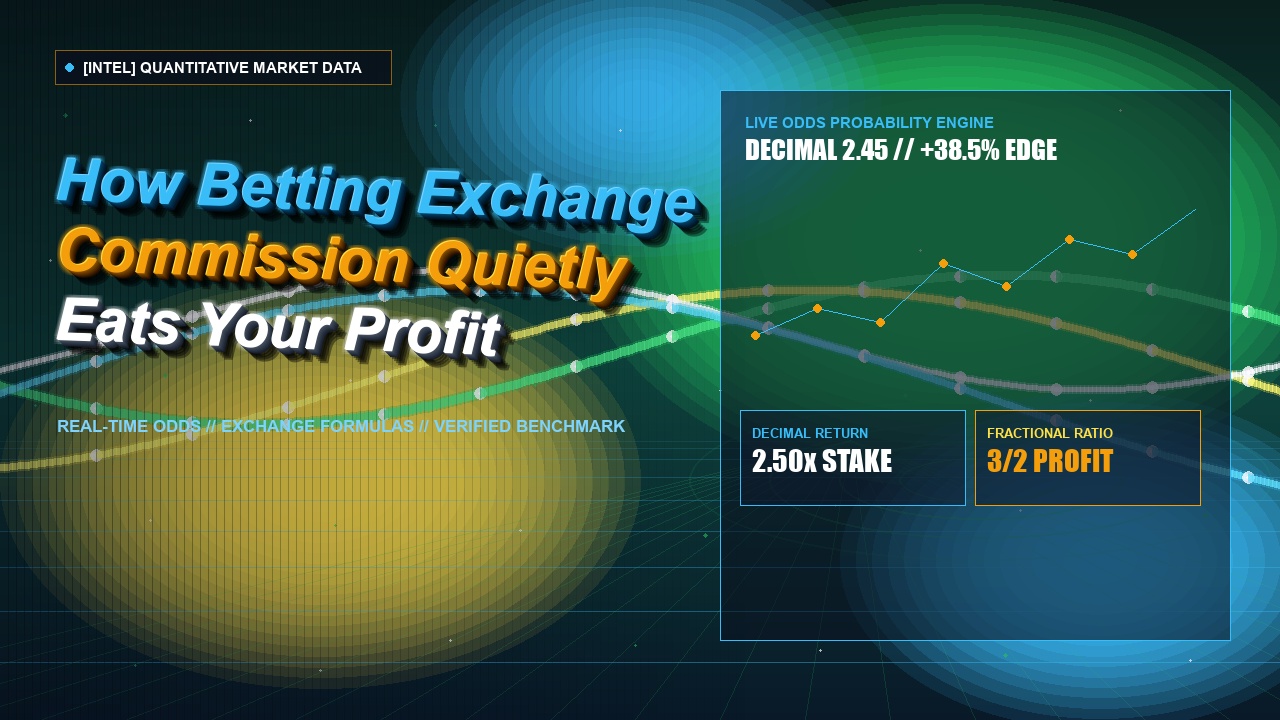
Let's start with a simple example. Suppose you back a selection at decimal odds of 2.50 (fractional 6/4) with a £100 stake. Your potential profit is £150. If the bet wins, the exchange deducts 2% commission on the profit: £150 * 0.02 = £3. You receive £147 profit instead of £150. That's a 2% reduction in profit, but it's equivalent to a 1.2% reduction in the effective odds (from 2.50 to 2.47). Over many bets, this compounds.
Now consider a trader who places 500 bets per year with an average profit of £20 per bet. Total profit = £10,000. At 2% commission, they pay £200. But if their average odds are lower (say 1.80), the commission represents a larger proportion of the profit margin. The table below illustrates how commission affects returns across different odds and commission rates.
| Decimal Odds | Fractional Odds | Implied Probability | Stake | Profit (Before Commission) | Commission (2%) | Net Profit | Effective Odds |
|---|---|---|---|---|---|---|---|
| 1.50 | 1/2 | 66.67% | £100 | £50 | £1.00 | £49.00 | 1.49 |
| 2.00 | 1/1 | 50.00% | £100 | £100 | £2.00 | £98.00 | 1.98 |
| 2.50 | 6/4 | 40.00% | £100 | £150 | £3.00 | £147.00 | 2.47 |
| 3.00 | 2/1 | 33.33% | £100 | £200 | £4.00 | £196.00 | 2.96 |
| 5.00 | 4/1 | 20.00% | £100 | £400 | £8.00 | £392.00 | 4.92 |
As you can see, the commission reduces your effective odds. The higher the odds, the larger the absolute commission, but the percentage impact on profit remains constant at 2%. However, when you consider that many traders operate on thin margins, this 2% can be the difference between profit and loss.
Key Insight: Commission is charged on net winnings per market, not per bet. If you back and lay the same selection for a guaranteed profit, you pay commission only on the net profit. This is crucial for traders who use Betting Exchange strategies like trading or arbitrage.
Back vs Lay Betting: How Commission Differs
In back vs lay betting, commission applies differently. When you back a selection and it wins, you pay commission on your profit. When you lay a selection (bet against it) and it loses, you also pay commission on your profit (the liability minus the backer's stake). However, if you lay and the selection wins, you incur a loss and pay no commission. This asymmetry means that successful layers also face commission on their winnings.
Consider a layer who stakes £100 at odds of 3.0. Their liability is £200. If the selection loses, they win £100 (the backer's stake). Commission at 2% on £100 is £2, leaving £98 profit. If the selection wins, they lose £200 and pay no commission. So commission only affects winning outcomes, but it's a cost that must be factored into your lay betting strategy.
The Role of Liquidity and Exchange Odds
Betting exchange liquidity determines how easily you can match bets at desired odds. In thin markets, you may have to accept worse odds, which indirectly increases the effective cost of commission. For example, if you want to back at 2.50 but the available odds are 2.45 due to low liquidity, your potential profit is lower, and the commission takes a larger slice of that smaller pie. High liquidity ensures you get the best available exchange odds, minimising the impact of commission.
Moreover, commission rates can vary based on your activity. Some exchanges offer discounts for high-volume traders or charge premium fees for those who consistently win. Understanding these tiers is essential for serious bettors. For a deeper look at how liquidity affects payouts, see our analysis of Betting Exchange vs sportsbook payouts.
Calculating Your True Cost: Beyond the Headline Rate
The advertised commission rate is not the whole story. Many exchanges use a points system or charge commission on the market's net profit, which can be more complex. For instance, if you place multiple bets in the same market, your commission is calculated on the net result. This can work in your favour if you have offsetting bets, but it can also obscure the true cost.
To calculate your effective commission rate, divide the total commission paid by your total net profit over a period. This gives you a personalised percentage that reflects your betting style. If you frequently trade in and out of positions, you may pay less commission than a pure backer because your net profit per market is smaller.
Strategies to Minimise Commission's Bite
While you can't avoid commission entirely, you can reduce its impact. Here are some practical tactics:
- Choose lower-commission exchanges: Some platforms offer rates as low as 1% or capped fees. Compare before committing.
- Trade rather than back: By backing and laying to lock in a profit, you may reduce your net winnings per market, thus lowering the absolute commission paid. However, this requires skill and liquidity.
- Focus on high-liquidity markets: Better odds mean higher profits, which dilutes the percentage impact of commission.
- Utilise commission-free offers: Some exchanges run promotions with zero commission on certain markets. Take advantage.
Additionally, consider the tax treatment of commission in your jurisdiction. In some countries, commission may be deductible against gambling winnings, but regulations vary. Always consult local laws and use platforms like Mahadev Book official platform that operate transparently within legal frameworks.
Case Study: The Compounding Effect Over a Year
Let's simulate a year of betting with a £10,000 bankroll, 500 bets, average odds of 2.0, and a 55% win rate. Without commission, expected profit = (500 * 0.55 * £100) - (500 * 0.45 * £100) = £5,000. With 2% commission on winning bets, each win yields £98 instead of £100, so profit = (500 * 0.55 * £98) - (500 * 0.45 * £100) = £4,450. That's an 11% reduction in profit. If the commission rate is 5%, profit drops to £3,625—a 27.5% reduction. This illustrates how commission can quietly eat a significant portion of your profit, especially for frequent bettors.
“Commission is the silent killer of betting exchange profits. Most bettors focus on odds and strike rate, but the cumulative effect of commission can turn a winning strategy into a break-even one.” — Professional exchange trader
Regulatory and Responsible Gaming Considerations
Betting exchanges operate under various regulatory frameworks depending on the country. In the UK, they are licensed by the Gambling Commission, which mandates transparency in commission structures. In other regions, such as India, the legality of betting exchanges is ambiguous, and players should ensure they use licensed offshore platforms at their own risk. Always prioritise responsible gaming: set deposit limits, never chase losses, and treat betting as entertainment, not a income source. If you suspect you have a gambling problem, seek help from local support services.
Data privacy is another concern. Reputable exchanges use encryption and comply with GDPR-like regulations. When using platforms like Mahadev Book official platform, verify their privacy policy and licensing details.
FAQ: Betting Exchange Commission
What is betting exchange commission?
Betting exchange commission is a fee charged by the exchange on your net winnings from a market. It typically ranges from 2% to 5% and is deducted automatically when you have a winning bet.
How does commission affect my overall profit?
Commission reduces your effective odds. Over time, it can significantly erode your profit margin, especially if you place many bets at low odds. For example, a 2% commission can reduce a 10% ROI to 8%.
Can I avoid paying commission on betting exchanges?
No, all betting exchanges charge commission on winnings. However, you can minimise its impact by choosing low-commission platforms, trading to reduce net winnings, and focusing on high-liquidity markets.
Is commission calculated on stake or profit?
Commission is calculated on your net profit per market, not on the stake. If you have multiple bets in the same market, it's the net result that matters.
Do betting exchanges charge commission on losing bets?
No, commission is only charged on winning bets. If you have a net loss in a market, you pay no commission.
Understanding the mechanics of betting exchange commission is essential for any serious bettor. By factoring it into your calculations and adopting strategies to mitigate its impact, you can keep more of your hard-earned profits. For those looking to explore exchange betting further, remember to gamble responsibly and stay informed about local regulations.